From Chisinau to Yerevan: How Russia’s Evrazia brought its Moldova playbook to Armenia
Russia is using sanctioned NGOs to influence elections and undermine pro-Western governments
From Chisinau to Yerevan: How Russia’s Evrazia brought its Moldova playbook to Armenia
Share this story
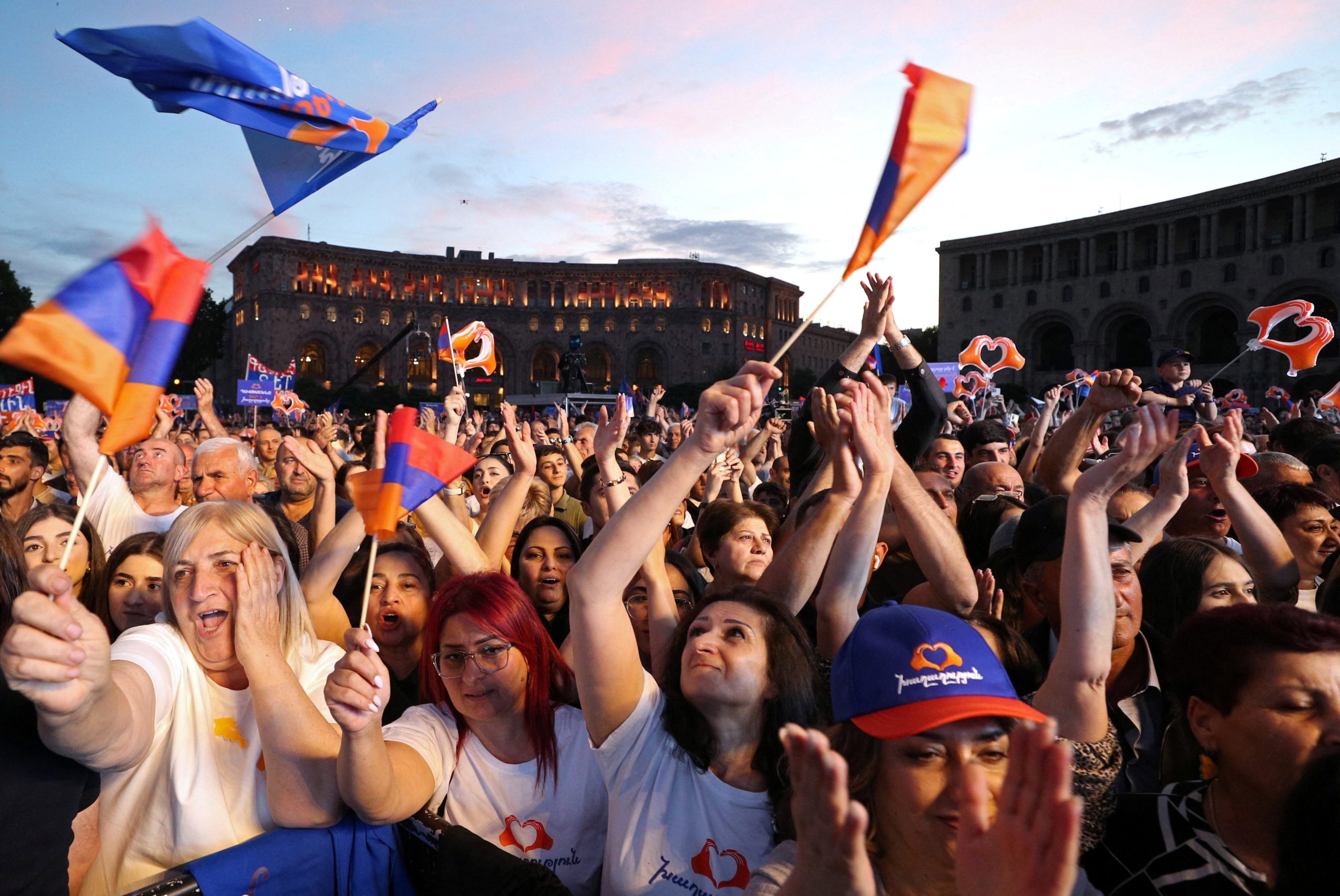
BANNER: People attend a campaign rally of the Civil Contract party, led by Prime Minister Nikol Pashinyan, ahead of the June 7 parliamentary election in Yerevan, Armenia, on June 5, 2026. (Source: Hayk Baghdasaryan/Photolure via REUTERS)
As Armenia prepares for its June 7 parliamentary elections, it must navigate the influence of a Russian non-governmental organization (NGO) sanctioned by the United States, European Union, and United Kingdom that operates freely in the country and has a history of election interference. Under the cover of humanitarian activities, the Russian “independent non-commercial organization” Evrazia operates as a Kremlin-backed tool of influence abroad. Evrazia promotes media schools, camps, and forums, while providing aid to communities in need, but these activities are leveraged for election meddling, covert fundraising, and destabilization actions targeting democratic institutions in other countries.
This joint investigation by the DFRLab and CivilNet shows how Evrazia has been replicating its Moldovan election interference model in Armenia ahead of the June 2026 parliamentary elections. Together with the representative of a pro-Russian political party in Armenia, it launched an online petition platform to mobilize Armenians around a religious cause while also including electoral and political demands. There is no confirmation that the number of signatories it claims to have is legitimate. Using its platform, Evrazia organizes rallies at churches in Armenia and abroad. Evrazia has openly offered to buy plane tickets for Armenians living in Russia to travel home and vote, replicating the diaspora transportation tactic the organization used in Moldova ahead of the 2024 elections.
In September 2024, the US Treasury’s Office of Foreign Assets Control added Evrazia to its Specially Designated Nationals list under Executive Order 14024, citing “covert global Russian influence operations.” In October 2024, the EU sanctioned Evrazia for actions destabilizing the Republic of Moldova. In April, 2025, the UK sanctioned Evrazia for acting on behalf of sanctioned Moldovan oligarch Ilan Shor.
NGO by name, influence tool by design
Evrazia runs cultural, educational, and professional programs across countries Moscow considers its “near abroad.” These programs include youth education, teacher training, journalism grants, business missions, and cultural projects, serving as instruments of Russian soft power. Evrazia openly positions itself as a counterweight to Western initiatives such as the United States Agency for International Development (USAID), Konrad Adenauer Stiftung, and Open Society Foundations. At the April 2026 “Evrazia – Territory of Traditional Values” forum in Moscow, Russian foreign ministry spokesperson Maria Zakharova claimed that Evrazia had mobilized 120,000 participants across forty countries over its two years of operation.
Evrazia opened its Armenian branch in June 2024. Evrazia supports eleven Russian-language centers in Yerevan and offers classes in robotics, animation, and financial literacy. It runs a media school affiliated with Russian propagandists and organizes cultural trips, including sending students to the Artek camp in Crimea. Activities also include Russian history quizzes and presentations on WWII aligned with Kremlin narratives. In Moldova, identical or similar programs were documented by security services as the infrastructure through which Evrazia built its voter manipulation and disinformation networks.
How Evrazia uses aid to build political leverage
Humanitarian aid has been one of Evrazia’s most consistent tools for influencing electoral outcomes in both Moldova and Armenia. In Moldova, the organization delivered fuel, fertilizer, and grain to Gagauzia in quantities large enough to prompt corruption suspicions, made cash payments to 30,000 pensioners, and offered to pay railway workers. Moldovan authorities concluded that the payments were not humanitarian assistance but a vote-buying scheme designed to influence the October 2024 presidential election and EU membership referendum. This was echoed by the US Treasury, which stated that the funds were associated with a vote-buying campaign for pro-Kremlin candidates, and by the UK Foreign Office, which described the scheme as bribing citizens to vote against EU membership. In response, Moldovan authorities blocked Evrazia-linked financial programs and designated the organization a national security threat.
Evrazia has been engaging in humanitarian aid in Armenia since August 2025, targeting displaced people from Nagorno-Karabakh. The organization claims it delivered 180 tonnes of food and essentials to 10,000 families across forty-five settlements. Evrazia also launched helpartsakh.ru (website unavailable as of May 5, 2026), a registration portal where over 6,000 families allegedly signed up to receive assistance from Evrazia. The campaign was launched in early August 2025 and by the end of 2025, Mika Badalyan, an Evrazia board member representing Armenia, announced that the process had ended and that around 800 applications from families were successfully verified and would receive aid.
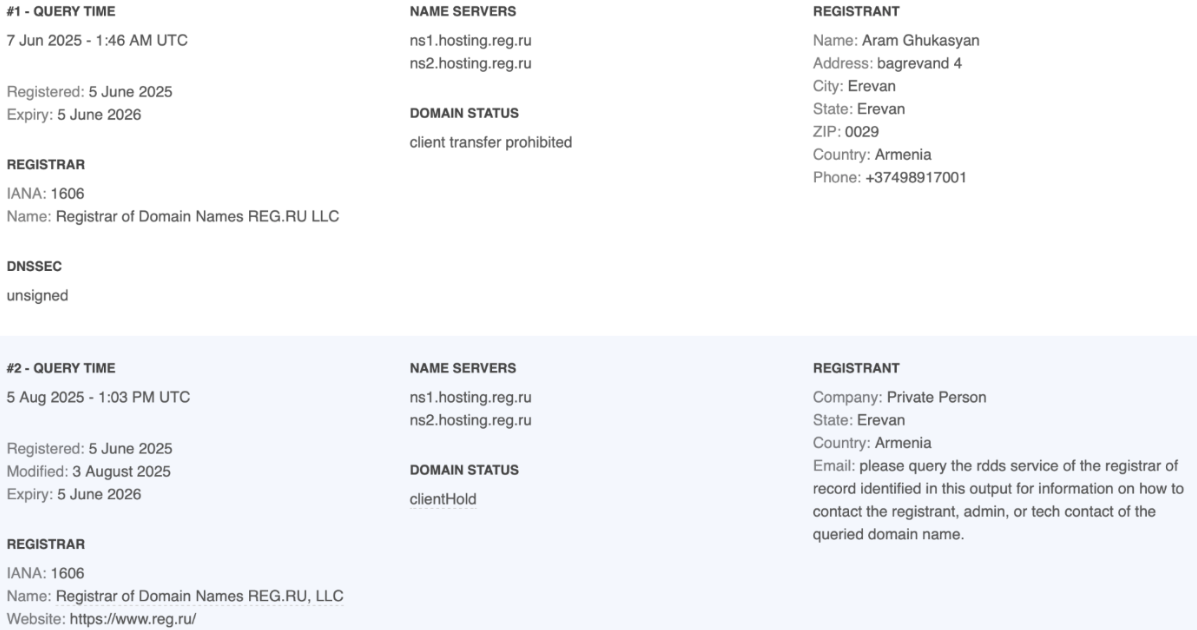
Although Evrazia announced the launch of the helpartsakh.ru website on August 4, 2025, the domain was registered two months earlier on June 5, 2025, through the Russian registrar REG.RU, suggesting advanced preparation. The registrant’s identity is hidden behind a privacy shield. However, a near-identical domain, helpartsakh.online was registered on the same day using the same server, and its WHOIS record names the owner as Aram Ghukasyan, with a Yerevan address and Armenian phone number. One day before Evrazia publicly launched the campaign on August 4, the registration details for helpartsakh.online were updated, and the named registrant was replaced with a privacy shield, which may suggest a deliberate attempt to obscure the ownership trail before launching the campaign. We identified a Facebook account with the name Aram Ghukasyan, who is associated with the Armenian Evrazia branch.
The Armenian government has recognized the electoral interference dimension of Evrazia’s humanitarian aid. In March 2026, Zakharova said the Armenian government blocked a planned Evrazia aid delivery, citing Armenian legal norms restricting sacrifices and charitable donations during the pre-election period. Under Armenia’s Electoral Code of 2016, candidates and participating parties are prohibited from distributing or promising money, food, securities, goods, or services to voters free of charge or on preferential terms during the campaign period, the day before voting, and on election day itself. This ban extends to charitable organizations whose names may be associated with or resemble those of competing parties or candidates. Zakharova claimed that Yerevan’s refusal to provide “purely charitable humanitarian aid, which has no political connotations, is due to the authorities’ pre-election desire to literally erase any mention of Russia.”
We analyzed online coverage of Evrazia’s humanitarian aid services in Moldova and Armenia between March 1, 2024, and May 15, 2026, to determine whether the organization’s activities represented a genuine, ongoing charitable effort, as claimed by Zakharova, or whether they were strategically tied to electoral cycles in both countries. Aid mentions concerning Gagauzia were concentrated around a single event, while Karabakh humanitarian aid mentions were spread across months and drew greater attention in Russian-language sources. Across both countries, queries conducted using Osavul found that Telegram dominated coverage, accounting for 83 percent of all relevant posts. The primary amplifiers were Evrazia’s channels and their amplifier networks: Mika Badalyan’s channel (@mikayelbad) ranked first overall, followed by his affiliated movement #AZATAGRUM (@azatagrum), then the channel of Alena Arshinova (@alenaarshinova), head of Evrazia’s council.
According to the Osavul query, 678 posts directly referenced Evrazia operations in Moldova broadly or Gagauzia specifically. The largest peak accounted for roughly half of all posts and centered around the September 2024 agricultural and fuel aid package for Gagauzia farmers, alongside cash payment schemes for railway workers and pensioners channelled through Shor’s Pobeda bloc.
In Armenia, of 1,614 identified posts, the overwhelming majority (1,432 posts) explicitly mentioned Evrazia’s humanitarian operations targeting Nagorno-Karabakh internally displaced peoples (IDPs). The first major peak occurred in July-August 2025 with the launch of the #РоссияСВами (“Russia Is With You”) campaign, co-organized by Evrazia, the Russian Humanitarian Mission, and Rossotrudnichestvo. Coverage in April 2026 concentrated around the announcement of the closure of phase one of aid, made during the Moscow forum.
It is also noteworthy that, in some cases, this aid was distributed in the offices (1, 2, 3) of the opposition, the Homeland of Armenians Party. The party is headed by former Armenian National Security Service chief Artur Vanetsyan, who was appointed to the position by Prime Minister Nikol Pashinyan in 2018, but resigned a year later and subsequently began participating in opposition activities. The party is not running in the current parliamentary elections. Notably, in 2021, when asked by Russian TV host Vladimir Solovyov during a Solovyov Live broadcast, “Whose is Crimea?”, Vanetsyan responded, “Crimea is ours.”
Distribution of Evrazia’s humanitarian aid-related messages between March 2024 and May 2026, showing peaks in September 2024 ahead of Moldova’s presidential elections and referendum, and July 2025 marking the launch of the organization’s humanitarian operations in Armenia. (Source: DFRLab via Osavul and Claude)
Clergy and religious infrastructure as an election interference tool
In August and September 2024, nearly 900 Moldovan clergy and affiliated parishioners took part in Russian state-funded “pilgrimages” to Moscow. According to Moldovan security services, upon arrival, participants were offered contracts ranging from $300 to $1,000, along with Russian Mir bank cards. As reported by Jurnal.md, to receive these payments, priests were required to sign cooperation agreements with Evrazia, in which they were listed as official collaborators. These financial incentives were allegedly tied to their expected role in shaping political views within rural communities and religious congregations, specifically to mobilize opposition to Moldova’s EU membership referendum and its pro-European leadership.
One of the clearest examples of Evrazia replicating its Moldovan playbook in Armenia is the armspyurk.com platform, launched at the end of January 2026 and promoted by Badalyan on his Telegram channel on February 11. The site presents itself as a grassroots platform defending the Armenian Apostolic Church. Despite claiming a Yerevan address, it is hosted on Russian servers, and its own privacy policy names the legal data operator as a Russian citizen in Saint Petersburg, processing all user data under Russian federal law. The website states that “the personal data operator is Avetyan Vahe Yegorovich, residing in the Russian Federation, city of Saint Petersburg. Contact email: vae.avetyan@yandex.ru.” Vahe also launched a Telegram group for signatories of the armspyurk.com petition on his private Facebook account, where he posts videos promoting the Strong Armenia party and has posted numerous seemingly AI-generated videos.
In one of the Facebook videos, Vahe says, “On February 12, we will find out who the candidate is for the prime minister from our party, Strong Armenia,” indicating his affiliation with the Strong Armenia Party. In a post published on Telegram on March 17, Badalyan calls armspyurk.com “our initiative,” and in another interview, says “we launched the initiative to collect signatures.” These posts suggest that armspyurk.com could be a joint initiative involving people affiliated with the pro-Russian Strong Armenia Party and Evrazia.
The armspyurk.com petition demands appear to be related to the church, but among calls to release detained clergy is a demand to “ensure honest and transparent elections.” The site’s homepage lists five “prisoners of conscience,” four of whom are archbishops, and the fifth is Samvel Karapetyan, the Russia-linked billionaire who founded the Strong Armenia Party and is running against Pashinyan in the June 2026 elections.
By March 2026, the site had evolved into a full political news portal publishing daily anti-EU commentary and election coverage. On March 13, Badalyan announced that the armspyurk.com portal was significantly updated and was “not just a platform for collecting signatures, but a full-fledged information resource covering events related to the Armenian Apostolic Church.” Since then, the number of signatories has increased exponentially. On March 17, Badalyan announced the portal had received “support from a compatriot.”
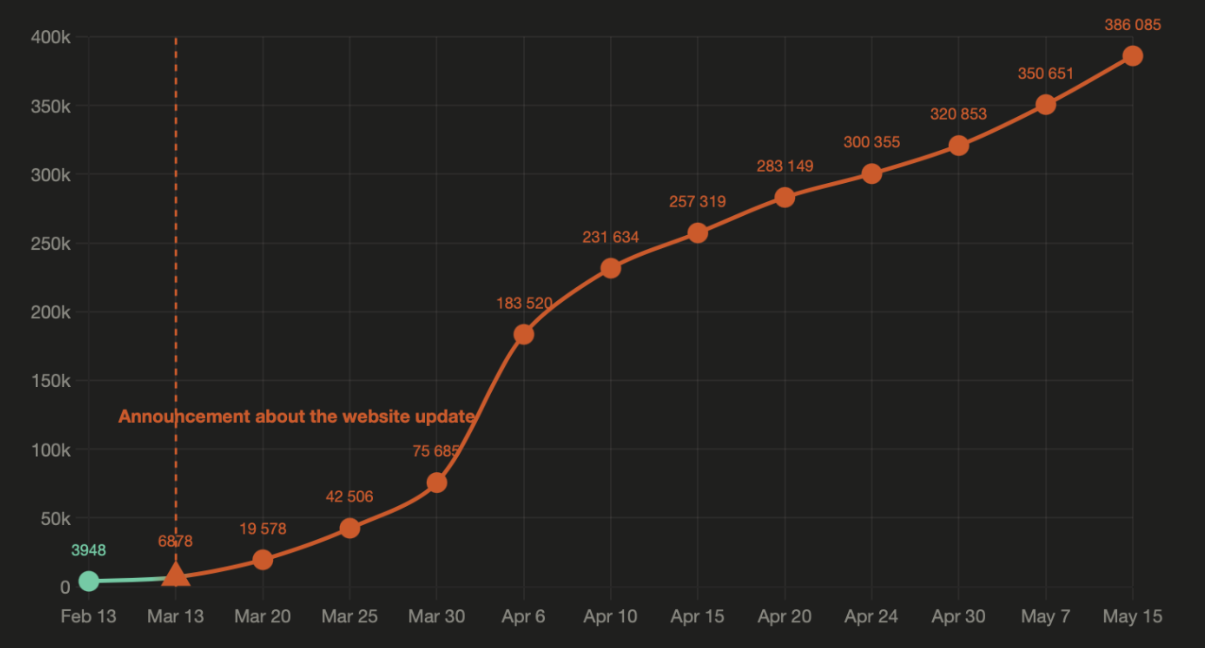
The signature growth pattern since March 13 on armspyurk.com raises questions about its authenticity. In the first month after the website launch, the petition gathered just 2,930 signatures between February 13 and March 13, 2026. The following month, 224,756 signatures were added between March 13 and April 10, which is a 77-fold increase coinciding with Badalyan’s announcement of a website upgrade and support from an unspecified funder.
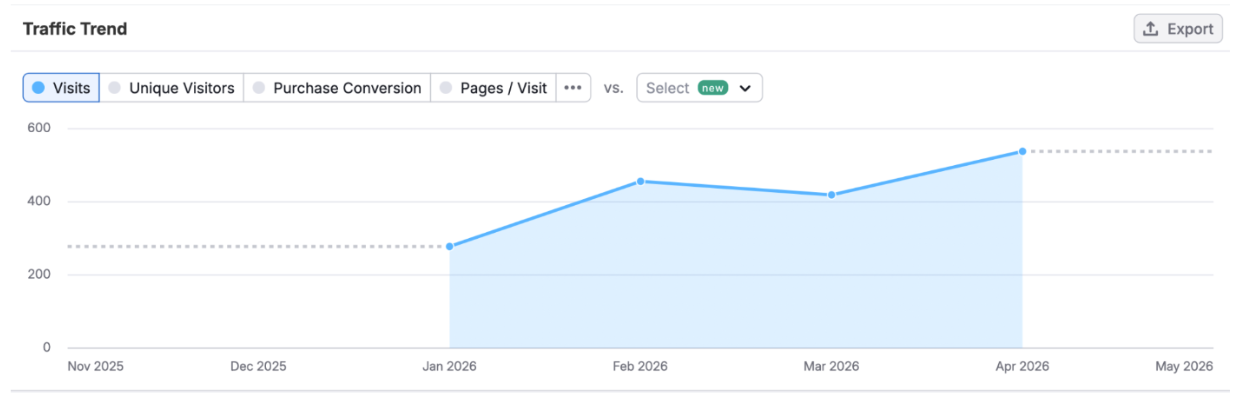
The DFRLab examined the traffic to armspyurk.com website and found that the number of visitors to the website in March, April, and May 2025 amounted to only 456, 419, and 538, respectively. In view of this, the growth of the number of signatures through the website seems to be highly marginal. However, it must be accounted for that Evrazia also collects signatures during physical rallies.
Evrazia uses armspyurk.com to organize physical protests and rallies. According to Badalyan, on Easter Sunday, April 5, large-scale international rallies in support of the Armenian Apostolic Church allegedly took place simultaneously across multiple countries, including Armenia, Russia, the United States, the United Kingdom, France, Georgia, Romania, Uzbekistan, and Belarus. He claimed that in Russia alone, protests took place in forty-eight cities, including Rostov-on-Don, Volgograd, Saint Petersburg, Novosibirsk, and Vladivostok. In Armenia itself, events were apparently held at twelve churches.
However, open-source evidence paints a different picture. Posts published by Evrazia-affiliated pages and related channels do not provide evidence of such large-scale international rallies. In Armenia, the only clearly documented event appears to be a signature collection campaign for Armspyurk held on April 5 in the courtyard of the Mother See of Holy Etchmiadzin in support of the Armenian Apostolic Church. Photos from that gathering are publicly available, but no evidence of other major rallies in Armenia could be found.
Online, only a handful of isolated posts regarding rallies in Russian cities were identified: Kaliningrad on March 22, Rostov-on-Don on March 29, Moscow on April 1, when Armenian Prime Minister Nikol Pashinyan was visiting the city, and Volgograd on April 5. These posts show relatively small gatherings, not the kind of mass international mobilization described in allied media reports.
As for the other countries mentioned, including the United States, the United Kingdom, France, Georgia, Romania, Uzbekistan, and Belarus, no photos, videos, media reports, social media posts, or any other public evidence of such rallies could be identified. Despite the absence of evidence of large-scale gatherings, over 105,000 new signatures were added on the Armspyurk website between March 30 and April 6.
The rapid growth pattern of signatories is suspicious. In the morning of April 3, Badalyan published a screenshot on Telegram with the number of signatories allegedly standing at 138,705. Twelve hours later, he published a new screenshot with 147,878 signatures. It is worth highlighting that on that day, he did not post any updates (as he has done in other instances) about the physical collection of signatures taking place on that day.
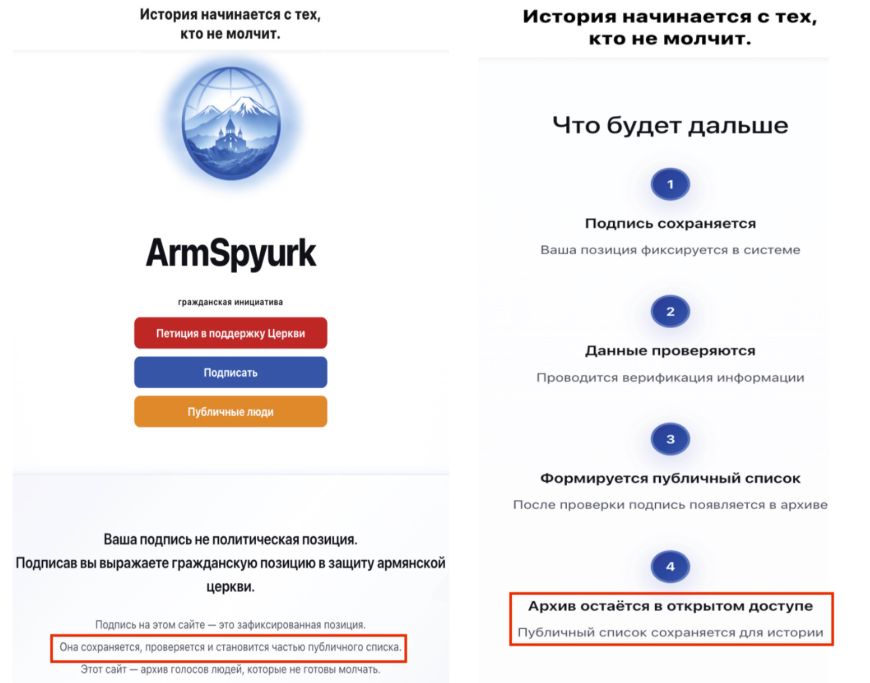
The DFRLab accessed an archived version of armspyurk.com (before its transformation into an information portal in March) through the Wayback Machine and found that the older version informs signatories that their signature will be verified and added to a public database. The site further stated that signing means “your position is recorded, verified, and becomes part of a public list,” framing the archive as proof of a genuine mass civic movement. Despite this, no such public list exists on the current or older version of the site, making it impossible to verify the identity of the signatories.
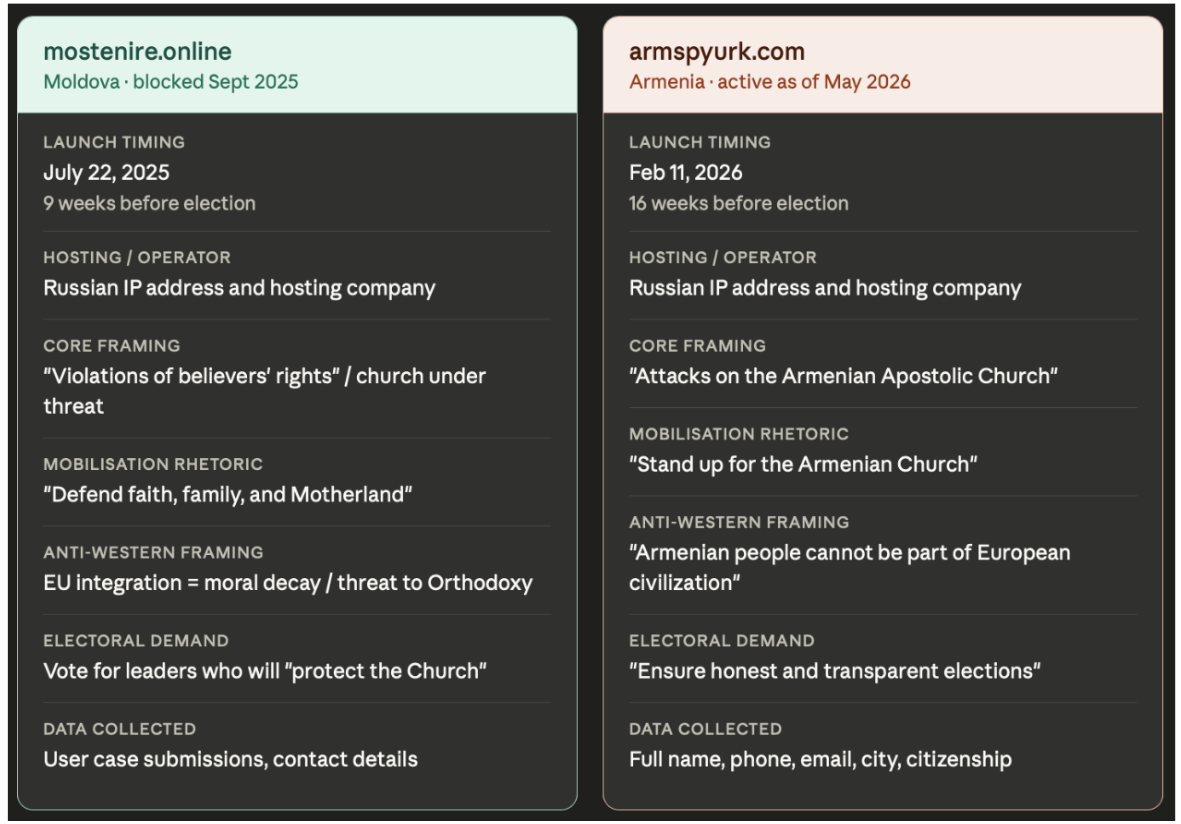
The armspyurk.com platform is not original. It closely mirrors the now-deactivated mostenire.online, a site used in Moldova ahead of the September 2025 elections and subsequently blocked by Moldovan authorities. RISE Moldova traced that site to a Russian citizen from occupied Crimea. The website was hosted on Russian servers and uses identical religious framing and data-collection methods. Like armspyurk.com, mostenire.online presented itself as a multi-national civic initiative defending the Orthodox Church and “traditional values.” It ran a petition collecting signatories’ names and phone numbers, and was promoted intensively across Telegram, TikTok, Facebook, and Instagram networks linked to Russia.
A mobilization video published two weeks before Moldova’s parliamentary elections featured a Moldovan priest spreading fear of a “Ukrainian scenario” occurring in Moldova. The priest ends by promoting a link to a petition and telling viewers to “go in and vote.” Armspyurk and Mostenire share the same hosting model, the same narrative architecture, and the same approach to collecting personal data from signatories.
Diaspora targeting and voter transportation funded by Evrazia
Ahead of Moldova’s elections, authorities documented a coordinated effort by Ilan Shor and Evrazia (Shor serves as a member of Evrazia’s board of trustees) to mobilize diaspora voters through organized transport from Russia, involving both air and ground logistics. Moldovan police reported that citizens were flown from Russia to transit hubs such as Istanbul and then transported onward by buses through multiple countries into Moldova. In several documented cases, voters did not pay for either flights or bus transport, suggesting external financing of the operation.
On March 10, 2026, the Foreign Intelligence Service of Armenia issued a statement and initiated a criminal proceeding regarding the potential pressure exerted on Armenian citizens in other countries and interference in the upcoming electoral processes. The statement said that “factual information was obtained on the allegation that the free exercise of individuals’ electoral rights is obstructed by means of material inducement by certain leaders, officials, or other actors of some political parties… they promise, under various pretexts, to organize their transfer from the foreign country to the Republic of Armenia, reimburse travel expenses, and cover accommodation costs during their stay in Armenia, thereby using material or other forms of dependency to coerce individuals into participating in the election.”
Two days later, Badalyan published a video on Telegram calling for Armenians living in Russia to write to him in case they wanted to participate in elections in Armenia, and said that he would try to help everyone. On May 3, Badalyan posted, “Anyone who needs help in purchasing tickets to participate in the elections and those who are ready to participate in purchasing tickets for our colleagues, write to @mbadalyan.”
On May 31, Badalyan claimed in a video posted on Telegram that they now had more resources to provide more flight tickets to people willing to travel to Armenia and encouraged subscribers to contact him.
On June 3, the Armenian anti-corruption bureau stated that they had received factual information demonstrating that Badalyan offered electoral bribes to hundreds of Armenian citizens living in Russia. The Bureau stated that it had initiated a criminal case and was working to identify the citizens who allegedly received electoral bribes from Badalyan.
As part of a separate investigation, CivilNet reporters went undercover as Armenians living in Russia to investigate the ticket distribution process promoted by Badalyan. Over several weeks, they exchanged messages with Badalyan and his associates and received detailed flight information, but no tickets were issued. The full investigation is available here.
Coordinated amplification of anti-Western narratives
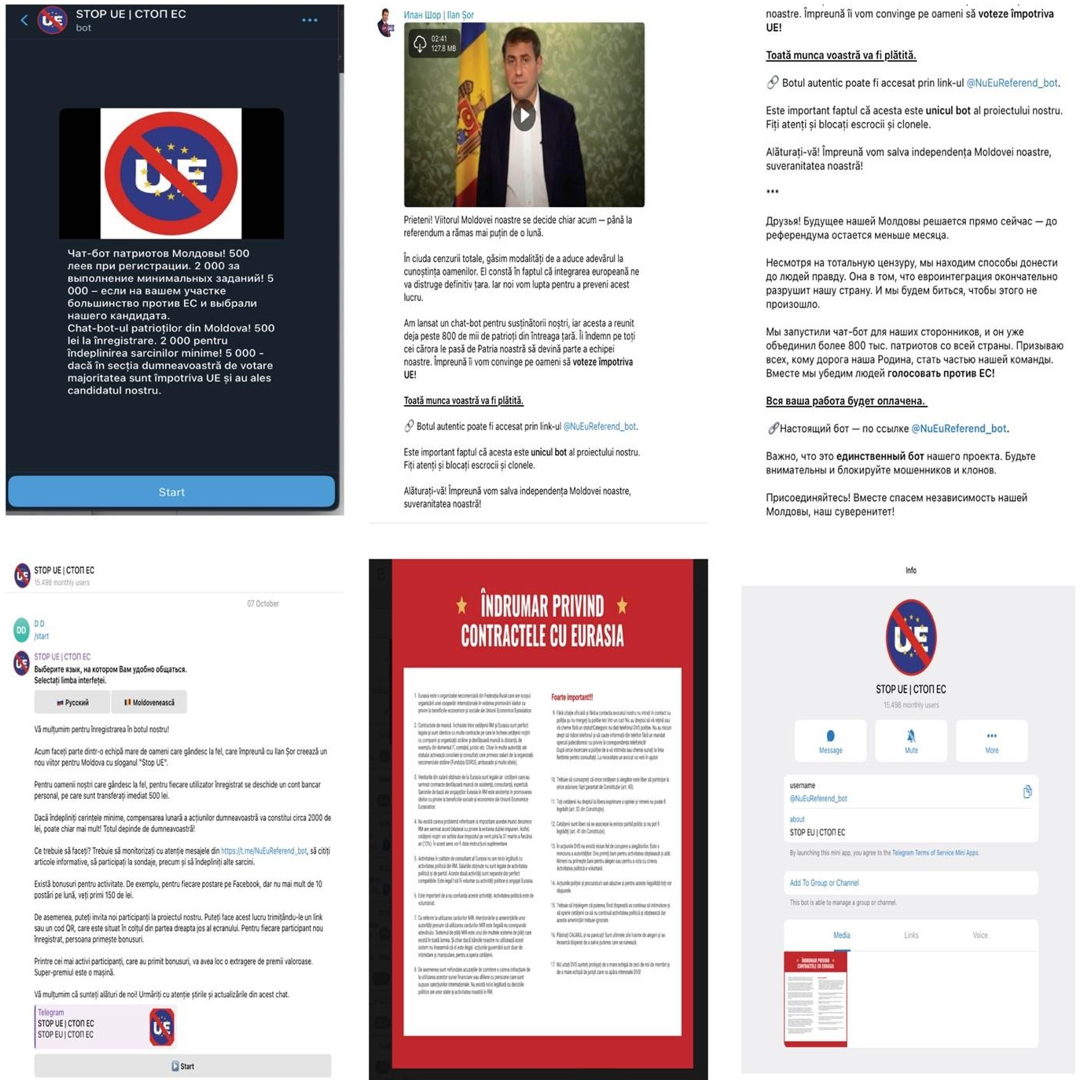
The DFRLab previously uncovered that Evrazia backed a Telegram chatbot campaign titled “STOP UE / СТОП ЕС” that financially incentivized Moldovans to promote anti-EU narratives. To receive payments for recruiting others into the disinformation network, users were first asked to sign an agreement with Evrazia.
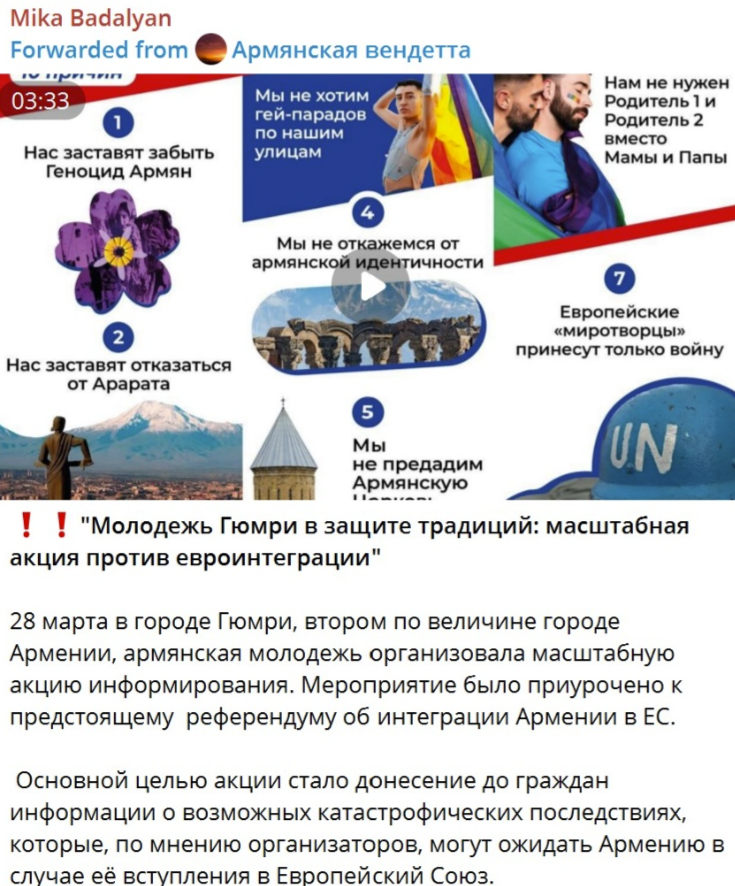
A similar anti-EU campaign in Armenia was promoted by Badalyan and affiliated channels, in which students in Gyumri distributed anti-EU leaflets two days before the election, warning that EU integration threatened Armenia’s traditions and values. Past.am reported that Evrazia organized the campaign. The students speaking in the video can be identified in previous online materials linked to Evrazia, for example, one of them is a Strong Armenia supporter, another appeared in photos published on the website of the Union of Armenians of Russia, and the third can be seen in other photos from Evrazia. It was also possible to identify several of the people distributing leaflets who appeared in videos published from the campaign. Facial recognition tool PimEyes matched three of them to photographs from meetings and events organized by Evrazia. Badalyan neither confirmed nor denied Evrazia’s role in the Gymuri leafleting activities. The campaign was later highlighted at the “Eurasia: Territory of Values” forum in Moscow, where Alpha News editor-in-chief Tigran Kocharyan emphasized the importance of providing robust media visibility for all Russian initiatives in Armenia and praised the Gyumri event as a successful example.
Conclusion
Evrazia’s operations in Moldova and Armenia are not separate initiatives; it is one operation running across two countries, which seems to share the same objective: to build political leverage for Kremlin-aligned forces ahead of elections. This constitutes an interference operation that uses the language of civil society to do the work of political campaigning. In Moldova, that operation has been widely documented, and Evrazia’s activities were designated a national security threat. In Armenia, Evrazia continues to operate freely.
Cite this case study:
Victoria Olari, Sopo Gelava, Givi Gigitashvili, Ani Grigoryan, and Salome Tsetskladze, “From Chisinau to Yerevan: How Russia’s Evrazia Brought Its Moldova Playbook to Armenia,” Digital Forensic Research Lab (DFRLab) and CivilNet, June 5, 2026, https://dfrlab.org/2026/06/05/from-chisinau-to-yerevan-how-russias-evrazia-brought-its-moldova-playbook-to-armenia/.