How Russian content sought to influence Armenia’s electoral information space
Armenian media were resilient against Russian-origin content ahead of the 2026 parliamentary vote.
How Russian content sought to influence Armenia’s electoral information space
Share this story
BANNER: Pro-Russian Media Corpus Network. (Source: TGStat, Python, and Claude)
Ahead of Armenia’s parliamentary elections on June 7, Armenian pro-Russian media outlets and Telegram channels intensified their activity compared to 2025. Semantic similarity analysis of pro-Russian media content showed that these websites pushed stronger pro-Russian narratives ahead of the vote. At the same time, infrastructure-level analysis revealed that they operate in coordination, despite attempts to conceal their connections and appear as part of a diverse media landscape.
Despite increased Russian attempts to influence Armenia’s information space ahead of the vote, the Armenian press was resilient and largely resisted Russian influence. That resilience stands out against a media landscape with deep pre-existing ties to Russia. Armenia’s information landscape has long maintained significant ties to the Russian media ecosystem. According to a 2024 Internews survey, Russian television is broadcast freely in the country and is used as a news source by 47 percent of the population, while 34 percent of Armenians rely on Russian news websites, and 29 percent on Russian blogs, vlogs, and podcasts. These historic ties are shifting: this analysis showed that Armenian media is now less reliant on Russian sourcing than a year ago, moving away from Russian media and increasing cooperation with Western outlets instead.
The investigation examined three layers of Armenia’s information environment. The first measured how far Russian-origin content penetrates mainstream Armenian media through direct citation, hyperlinking, and near-verbatim reproduction of Russian state media narratives. The second assessed a corpus of pro-Russian Armenian websites for infrastructure-level coordination (shared advertising accounts, tracking identifiers, hosting, and developers) and content-level similarity. The third analyzed Telegram as the bridging layer between Russian and Armenian information environments, mapping a relay network of pro-Russian channels, tracking how their content spread into popular Armenian channels, and detecting automated bot campaigns in comment sections.
Selection of the websites
In total, twenty media outlets were selected for analysis. We grouped them into two categories: pro-Russian corpus and mainstream media corpus. To identify mainstream online news outlets, we relied on Pikasa Analytics’ Media Ratings, which rank digital news providers based on audience reach and social media engagement (data extracted on June 13 covers six months). Pikasa was selected due to the absence of reliable and transparent rankings for Armenian media outlets. The selected outlets are: Mamul, Armtimes, Factor, 1Lurer, 168.am, 1in, News.am, Oragir News, Ararat News, and Shant News.
The selection of ten pro-Russian outlets relied on multiple criteria and was executed across a two-tiered framework. The initial phase focused on mapping corporate ownership structures and explicit political affiliations. The subsequent phase involved a content analysis to review narrative trends. A month-long monitoring of their politics sections throughout May revealed that all ten outlets uniformly maintained a highly synchronized, pro-Russian editorial stance while covering Armenian political affairs.
Selected pro-Russian Armenian media outlets, with examples of explicit pro-Russian content.
Semantic Similarity Analysis
Eighteen outlets were analyzed, nine mainstream and nine pro-Russian, across two matched windows, January 1 to June 6, 2025 (control) and the same span in 2026 (pre-election), for a semantic-similarity analysis. Two different observation windows were selected in order to compare penetration right before elections with a non-election window. Two outlets were dropped from the initial ten-per-corpus list, one from the pro-Russian corpus for having an insufficient article volume to normalize against the baseline, and the tenth-ranking outlet from the mainstream media corpus was dropped to keep corpora at nine for consistency.
Two methods were applied. A semantic-similarity engine by Qriton’s CIB detection module, was used to detect near-identical or translated text shared across the mainstream–pro-Russian groups, including re-translations from Russian, and recorded which cluster published first. Semantic reproduction captures content that crosses over without attribution. It was computed with a multilingual sentence-embedding model (LaBSE) over the full corpus, flagging pairs that are verbatim copies or cross-language translations and retaining those that carry a Kremlin-aligned narrative framing marker or a Russian-outlet citation (narrative pairs, cosine threshold 0.65 for semantic similarity). Each reproduced item was then classified by its apparent source: shared wire, state media sourcing, semantic framing, or other.
Source detection tracked which outlets each article cited or linked to, counting co-citations where a piece drew on both Russian and Western sources. A canonical list of narrative markers gauges alignment with pro-Russian framing. All rates are normalized per active day or per 1,000 articles, with trends compared at 95 percent confidence intervals.
Overall, the penetration of Russian-origin content has a real but contained presence in Armenia’s mainstream media, and it is not rising relative to the article volume outlets produce. From the control (2025) window to the pre-election one (2026), the pro-Russian cluster published more content (output up by roughly 16 percent) and pushed stronger pro-Russian narratives ahead of the vote, leaning on Russian state sourcing and, to some extent, on Kremlin-sympathetic outlets and Western commentators. Yet its actual reach into mainstream media, measured by how often mainstream outlets reproduced Russian-origin content, didn’t increase.
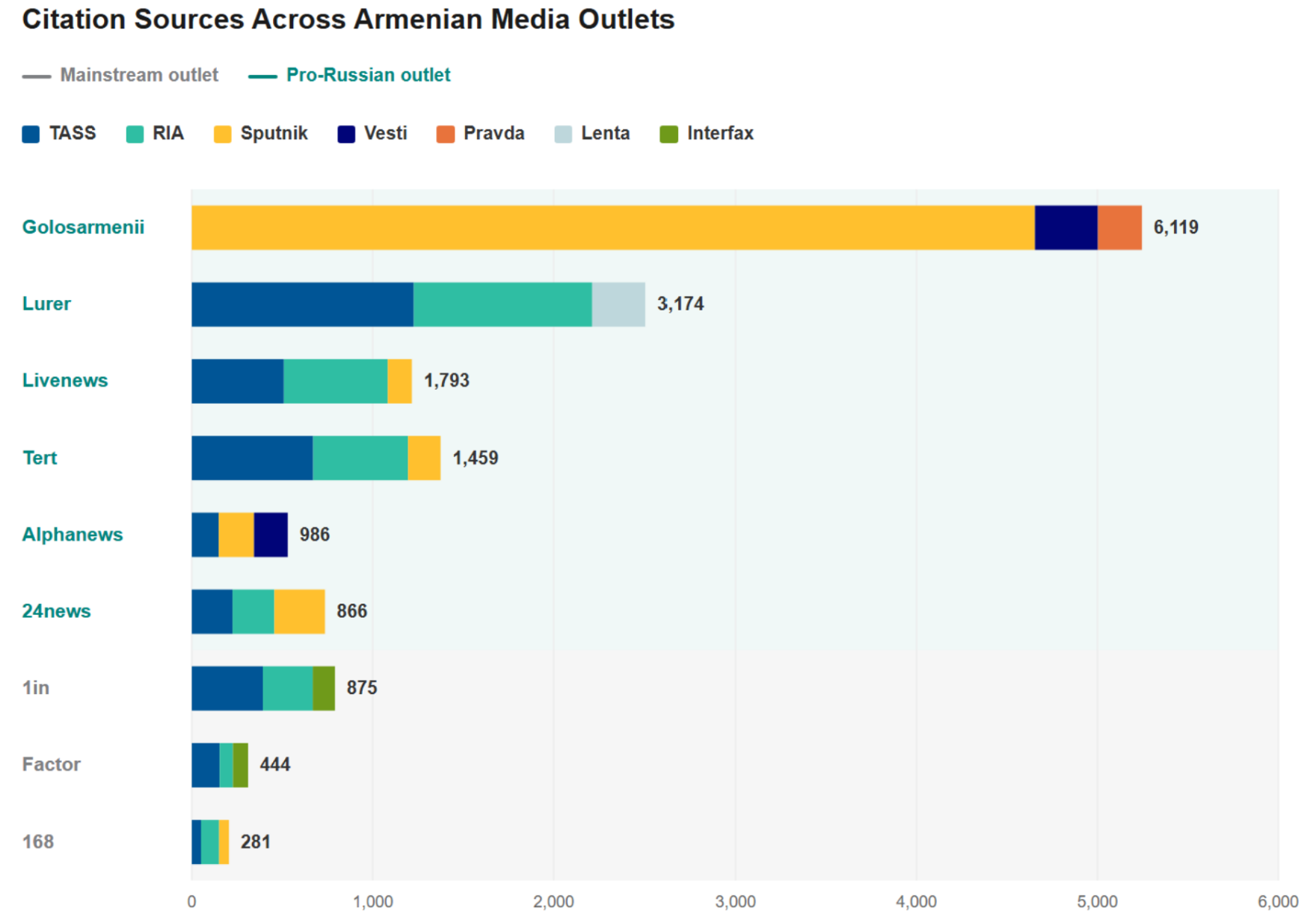
Direct citation of Russian-origin content in the mainstream fell by nearly half in 2026, from 44 to 23 mentions per 1,000 articles. Over the same period, the pro-Russian cluster’s own rate of citing Russian outlets increased from roughly 64 to 78 mentions per 1,000 articles. Thus, Armenian media appear less reliant on Russian media sourcing than they were a year ago.
The dominant mechanism across the groups remains straightforward republication of Russian wire news (TASS/RIA/Interfax), which also blends mundane coverage, reproduced word-for-word at very high similarity (cosine 0.99), accounting for roughly 60 percent of the cross-over in 2026, down from about three-quarters in 2025. The pro-Russian cluster’s coverage is led by Sputnik and other Russian state media. Sputnik alone had over 5,570 citations, followed by Vesti, Vzglyad, Pravda, RT, and Lenta.
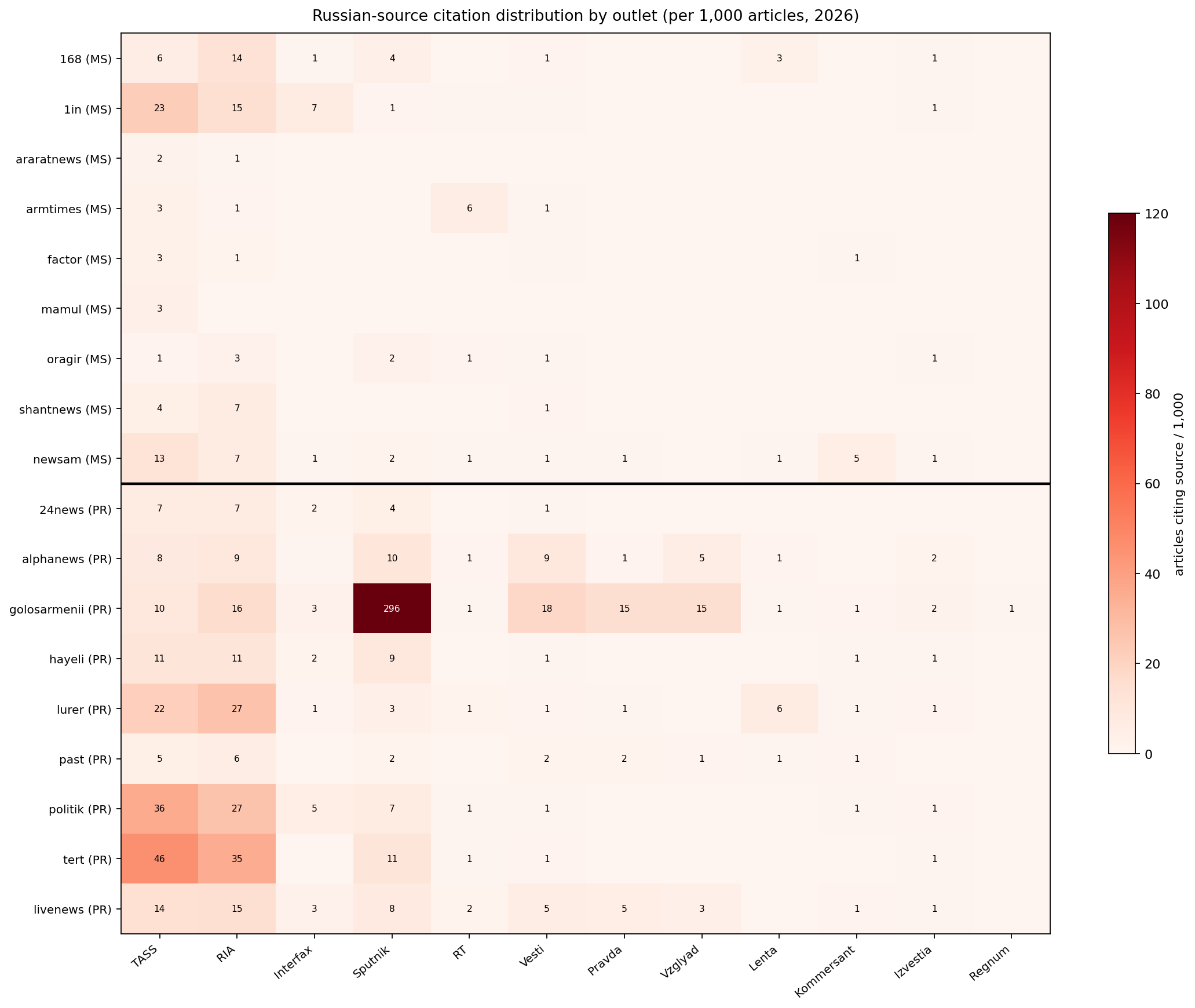
Golosarmenii leads all outlets in Russian-source citations, followed by Lurer, Livenews, and Tert, all four from the pro-Russian corpus. The only mainstream outlets that appear in the ranking (1in, Factor, 168) trail well behind, citing Russian sources at a fraction of the volume. Sputnik dominates overall, nearly 4.5 times its 2025 volume as the single most-cited Russian source.
As the wire news share contracts, the overtly pro-Russian material grows: content traceable to Russian state media (i.e., Sputnik, RT) rose from 13 percent to 24 percent of the cross-over, and Kremlin-framed items from 4 percent to 7 percent. The Russian-origin content that does cross over into mainstream appears to have shifted from wire-agency copy towards source-and-framed messaging. Even so, the absolute footprint remains comparatively smaller. Through reproduction, some 1,255 verbatim matches carried Russian-origin, pro-Russian-cluster material in 2026 (slightly fewer than in 2025), concentrated in a handful of high-volume mainstream outlets (1in, news.am, 168).
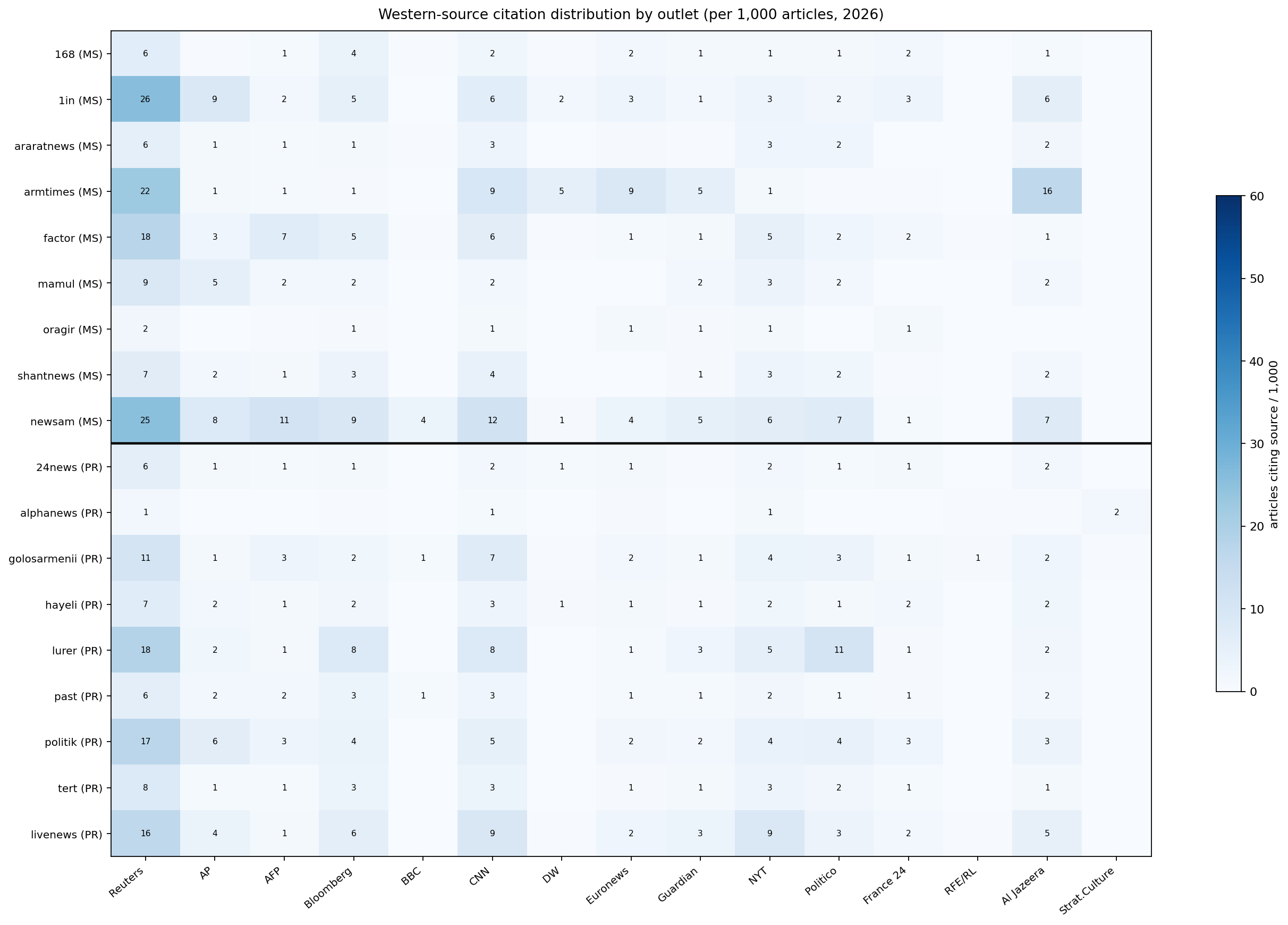
Analysis also showed that both pro-Russian and mainstream corpora cite Western media sources. The mainstream citation of Western sources climbed from 60 to about 160 mentions per 1,000 articles (in both observation windows), and by election season it was leaning more on Western news agencies (Reuters, the Associated Press, Agence France-Presse – AFP) than on Russian sourcing.
The pro-Russian cluster sourcing of Western media appears somewhat dual. In absolute terms, it cites Reuters, CNN, and Politico almost as frequently as the mainstream (Politico and CNN are disproportionately high), but typically to contest or repurpose the message. For example, one pro-Russian outlet, livenews, accounts for two-thirds of instances in which Western sourcing (NYT, Bloomberg, Reuters, etc.) is cited, and at times misrepresented, to provide contextual background for an otherwise pro-Kremlin narrative; these are often disseminated in long-form opinion pieces (junta, denazification, banderites, Western puppets). Similar geopolitical narratives are conveyed in golosarmenii (anglo-saxons/global domination, Soros-funded), alphanews (Russophobia/betrayal), and 24news (collective West), among others.
Berliner Zeitung (BZ), a Russia-sympathetic German daily, is cited in forty-seven pro-Russian articles (17 in 2025, 30 in 2026), mostly in Lurer (34). The German source citation is co-opted into geopolitical topics (i.e. ‘What Zelensky demands from Merz – BZ’; Zelensky ‘demanding €90 billion’ from Germany) to lend the appearance of sympathetic media consensus. Secondly, the BZ citation features in the amplification of a Samvel Karapetyan interview, the detained pro-Russian opposition leader. The Berliner Zeitung interview was reshared near-simultaneously by at least five pro-Russian outlets (24news, livenews, past, tert, golosarmenii) on June 1-2, with a semantic similarity of 0.86–0.95, indicating near–identical text reproduction.
In the pro-Russian cluster, an external (Western) validation layer also emerges around the Strategic Culture Foundation (SCF), a US-sanctioned, Russian-intelligence-linked outlet that presents itself on the surface as an independent think tank. An affiliated expert, Andrey Areshev, is featured as a standing commentator on Alphanews. The SCF is explicitly named in 46 unique articles across 9 outlets. Alphanews (21), Golos Armenii (6), 168.am (4), Lurer (4), Past (4), livenews (3), politik (2), and one each in 24news, and news.am. The strongest election-period messages cast Armenia’s ostensible European turn as a “Moldovan scenario”, engineered to “disrupt ties with Russia,” with Areshev repeatedly pressing that the EU-versus-EAEU question be reopened, if necessary by referendum, ahead of the vote, while dismissing talk of Russian “hybrid influence” as baseless. The framing arrives under the veneer of independent expertise, though the source is Russian-linked. The predominant reshare mechanism is Alphanews publishing each Areshev commentary in multilingual Armenian, Russian, and English versions (with a semantic similarity cosine of 0.87-0.96, indicating near repetition across the three languages), with golosarmenii picking up some of them – variably reworded, standing at a 0.85 text reproduction rate. Overall, the material remains overwhelmingly confined to the pro-Russian cluster. Mainstream reproduction is negligible, with references to the SCF mostly addressing the sanctions imposed.
Infrastructure-level evidence of coordination
Besides content and sourcing, we also examined coordination at the web infrastructure level across the pro-Russian corpus, identifying additional linked websites beyond the original sample. The investigation revealed a network of websites that share advertising accounts, unique tracking identifiers, hosting infrastructure, and a common developer. It is notable that while being connected to each other, these websites present themselves as independent outlets. The findings show a partially overlapping network through signals that range from very strong to suggestive.
A shared advertising account as an indicator of common ownership
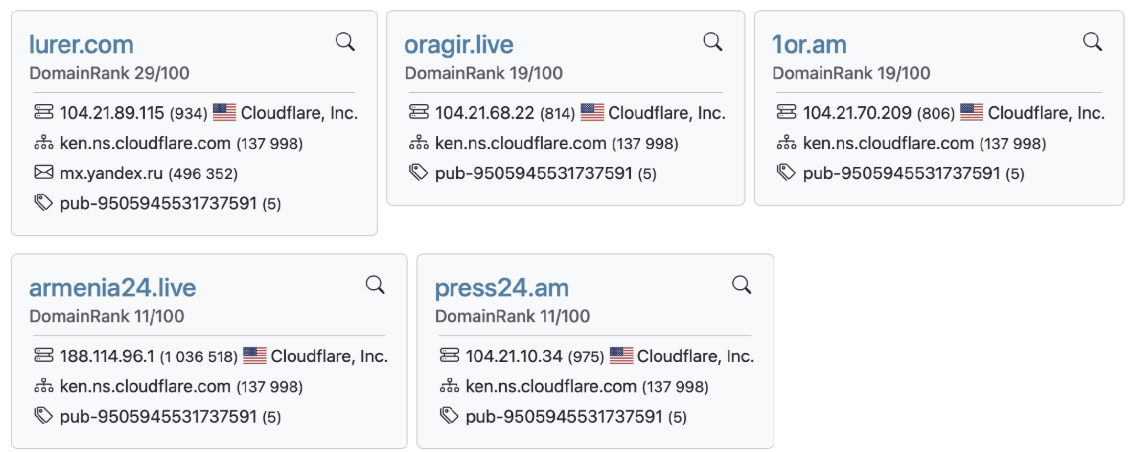
A shared Google AdSense publisher ID (ca-pub-9505945531737591) was identified across five analyzed websites: 1or.am, armenia24.live, lurer.com, oragir.live, and press24.am. A Google AdSense publisher ID is issued to a verified account holder, and the account is used to get and distribute the advertising revenue. Therefore, the presence of the unique ID across five seemingly independent news outlets is one of the strongest indicators of a connection between them. In other words, whoever owns this AdSense account collects the advertising revenue generated by all five websites. Some of these domains may be mimicking the domains of popular Armenian media websites; for instance 1or.am has a similar name structure to 1in.am, and oragir.live may be mimicking oragir.news.
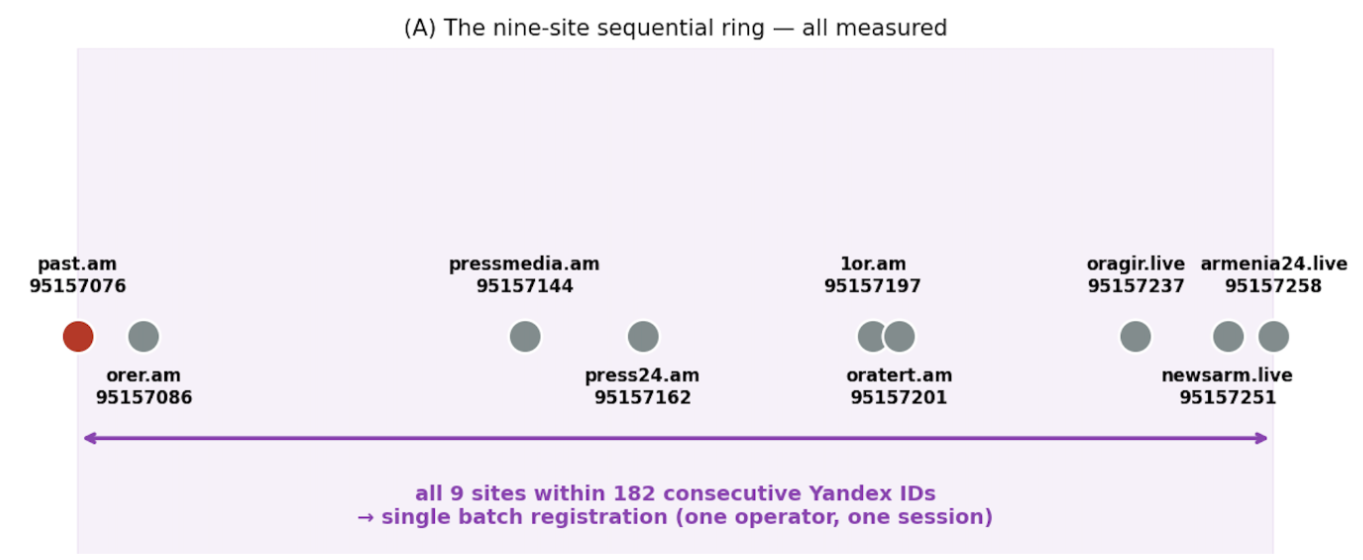
The second revealing signal is associated with the analytics tool Yandex Metrica counter ID, it captured near-simultaneous creation of websites by their developer. Nine websites contain Yandex Metrica counter IDs within a sequential range of only 182 numbers. These websites are past.am, orer.am, pressmedia.am, press24.am, 1or.am, oratert.am, oragir.live, newsarm.live, and armenia24.live. This means four of the five websites with a shared publisher ID (ca-pub-9505945531737591) discussed in the previous section are likely to have been created simultaneously.
Yandex Metrica allows website users to collect data about site users and their sessions, and it assigns counter IDs sequentially at the moment of account registration. The platform serves millions of websites globally, and therefore the ID queue advances very fast. Nine sites clustered within a 182-number window would likely happen when a single operator registers all nine websites/counters in one session or within a very short period. The websites were very likely set up as a batch simultaneously rather than independently over time. A Yandex Metrica counter can only be installed by the account holder to whom it was issued, and therefore it is a strong indicator of common operational control.
Combining findings about the shared AdSense ID and Yandex Metrica widens the network’s composition. Taking both signals together, at least nine websites carry evidence of connection to a common operator or operational structure.
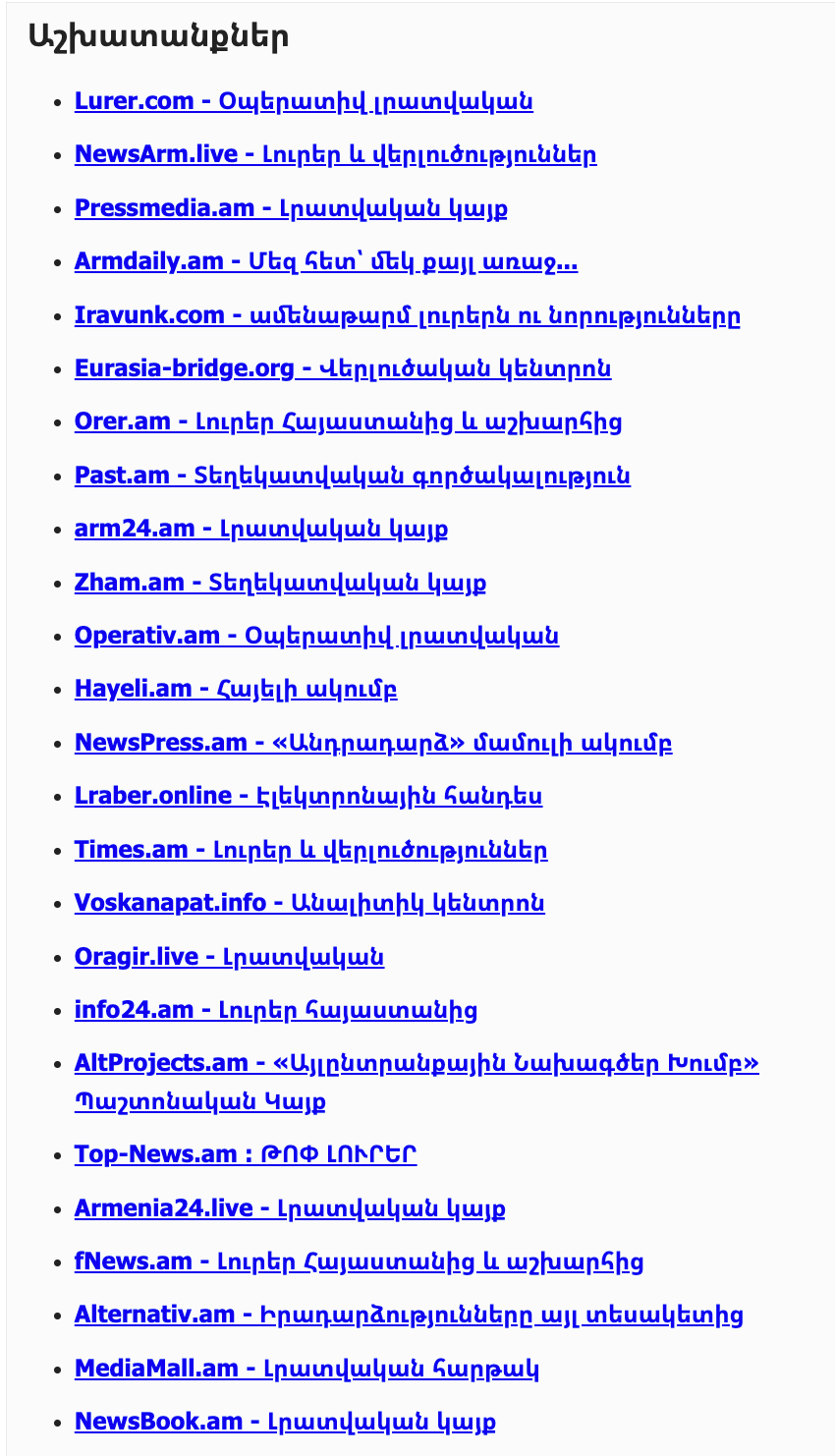
Another significant finding is the attribution of eighteen analyzed pro-Kremlin websites to a single Armenian developer operating under the handle “Sargssyan™”. The Sargssyan™ cluster includes iravunk.com, past.am, hayeli.am, Lurer.com, pressmedia.am, newsarm.live, orer.am, newspress.am, times.am, and armenia24.live, among others. The developer of these websites is Sargssyan Studio, and the website sargssyan.com lists the portfolio of websites created by the studio. The portfolio contains the analyzed pro-Kremlin media websites.
A shared developer does not comprehensively confirm coordination between the websites, as the developer could, in theory, build websites for unrelated clients. However, as noted above, nine of the sites registered their Yandex Metrica counters within a sequential batch of only 182 IDs. Second, most of these websites maintain a shared AdSense account, meaning that this cluster pools revenue into a single shared publisher ID. Taken together, these signals point to common operational and revenue control over the cluster.
Together, these signals establish common operational and financial control over the cluster.
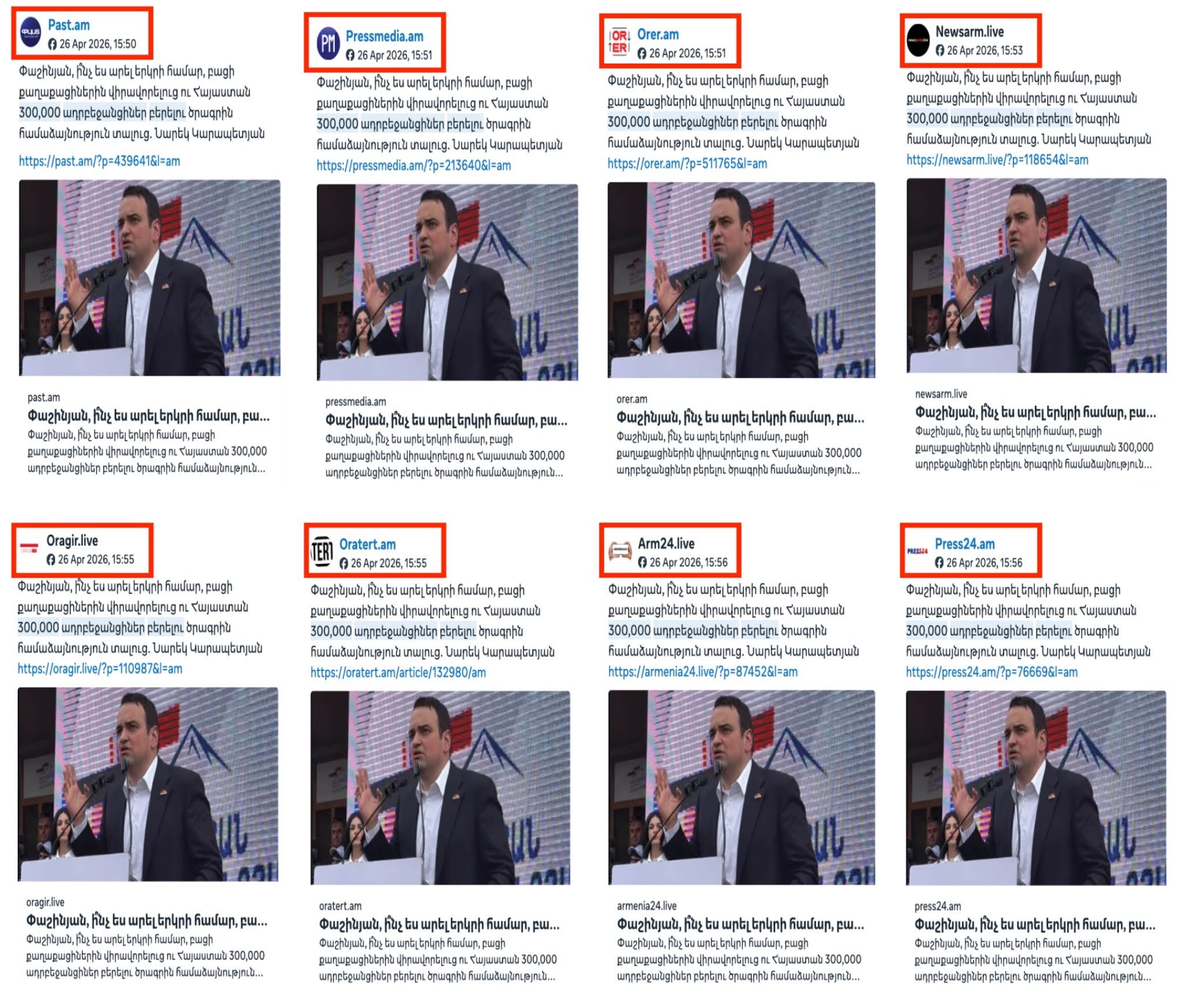
Moreover, we detected that at least six websites in the data set published an identical video with identical headlines on their websites (here, here, here, here, here, here, here, here, here, and here) within a three minute interval. Moreover, the Facebook pages of these websites posted the same video on Facebook within six-minute interval, indicating close coordination between websites.
Shared file artifacts
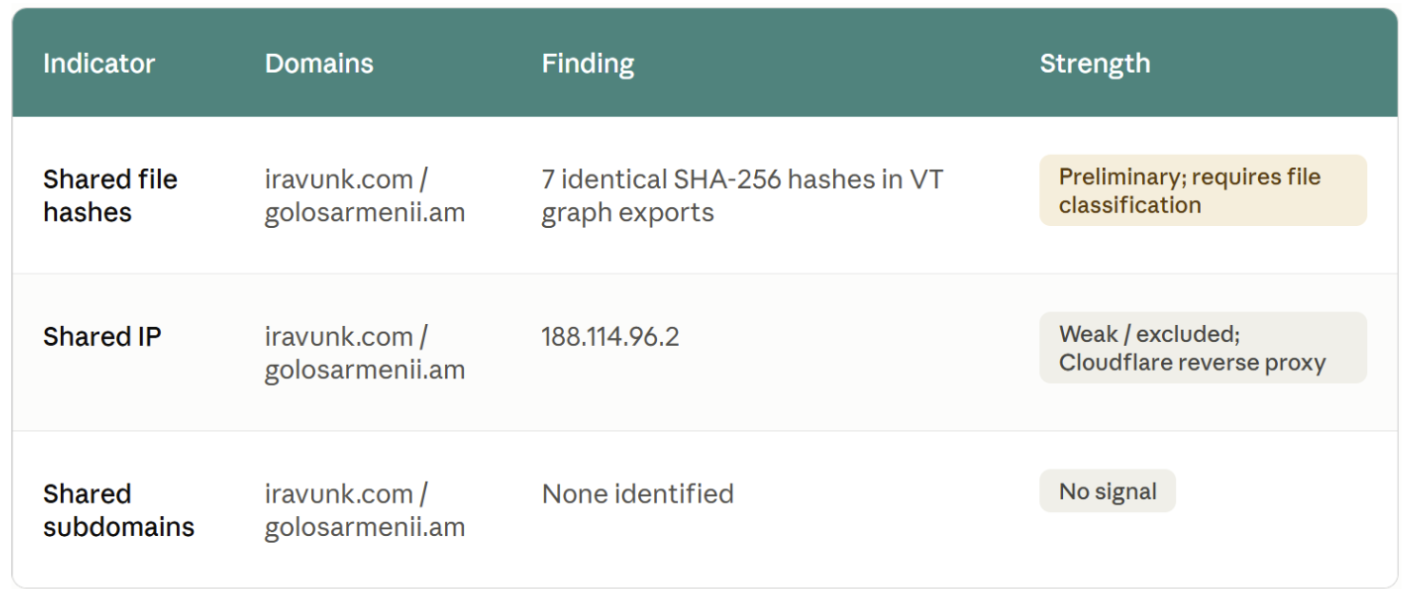
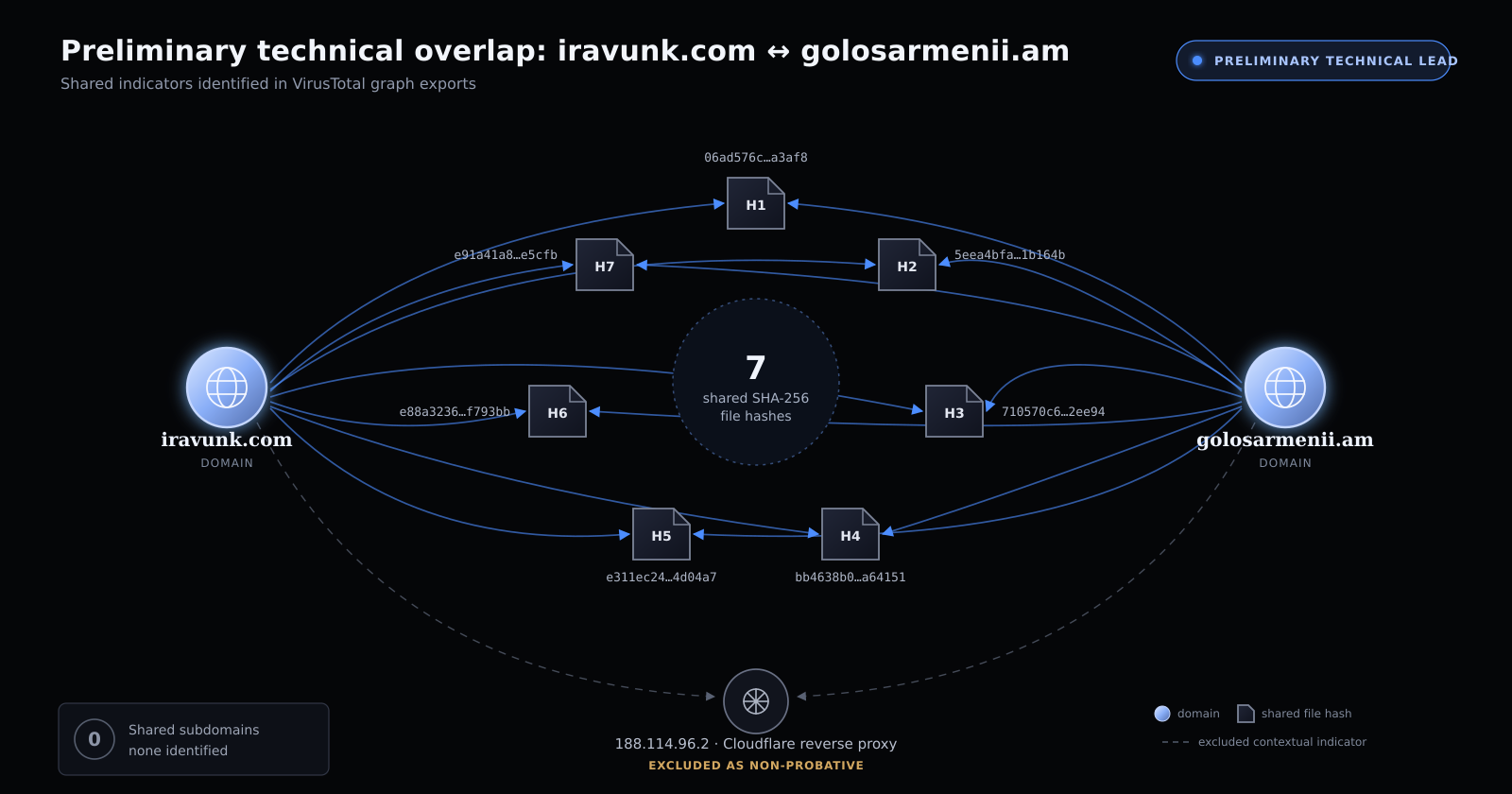
Google-owned VirusTotal graph exports identified overlapping file-hash nodes across several domains. The most notable overlap was observed between iravunk.com and golosarmenii.am, which share at least seven identical file hashes. However, this finding should be treated as a preliminary technical lead rather than confirmed evidence of infrastructure-level coordination. Its evidentiary value depends on the nature of the underlying files and on the specific VirusTotal relationship type.
The infrastructure-level evidence reveals a partially overlapping ecosystem of at least nine pro-Russian websites. On the other hand, the mainstream Armenian outlets show a diverse set of developers with no dominant cluster, almost no shared advertising identifiers, and no comparable technical overlap.
Telegram as a bridging layer
A further layer of the analysis examined Telegram. The DFRLab report Foreign and domestic: Information manipulation during elections in Georgia, Moldova, Armenia, and Azerbaijan demonstrated that in 2025 Telegram served as the primary vector for pushing anti-Pashinyan and anti-Western narratives in Armenia and has been an important part of the Armenian information ecosystem. Here, two complementary approaches were used: tracing how a known relay network’s content spreads through the platform’s most popular channels, and mapping audience overlap across the broader Armenian Telegram ecosystem.
Drawing on a report by Qriton and the Digital Forensic Team, we selected ten channels that serve as the main coordination hub and relay network for amplifying pro-Russian content. These channels are: @tzitzak, @Abovyanarman, @ArmenianVendetta, @parallel95, @mikayelbad, @caucasar, @anivarmenia, @m1acum, @hayspaigrarumner, and @artsah44.
We then downloaded a list of the most popular Telegram channels in Armenia from TG Stat’s country catalogue, filtering for channels focused on news and politics. Channels belonging to the news websites already in our dataset were removed, since a preliminary check confirmed they post identical content on both their websites and Telegram channels. The ten relay network channels were also removed. Then we collected posts from the remaining 100 most popular Telegram channels across two comparable periods: January 1 through June 7, 2026, and January 1 through June 7, 2025, using Python library Telethon.
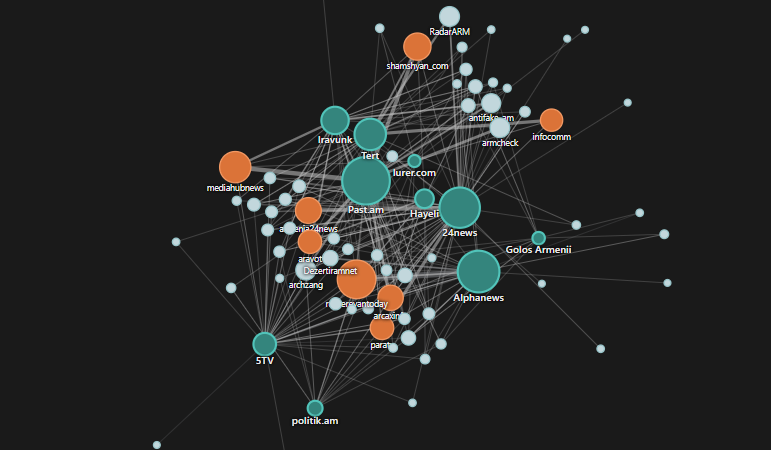
Across 403,172 posts from those 100 channels, the ten relay network channels generated 1,885 (less than 1 percent) unique matches, appearing either as forwarding sources or by name. Compared to 767 mentions in 2025, the figure rose by 46 percent to 1,118 mentions in 2026, with a peak in May 2026, just ahead of the June 7 vote. ArmenianVendetta and parallel95 are the two dominant relay channels, together accounting for 52 percent of all matches. Amplification is heavily concentrated in five channels: @arcaxinfo, @tovgeneral, @enabludatel, @Dezertiramnet, and @rusyerevantoday, which account for the vast majority of relay network appearances in popular Telegram channels. These findings show that pro-Russian relay channels did not spread widely across most of the popular Armenian news and politics Telegram channels. The channels that amplified them most are themselves Russia-aligned, meaning the relay network largely circulates within its own pro-Russian cluster.
Network graph showing penetration of pro-Russian relay network channels into the popular Armenian Telegram channels in 2026. (Source: TGStat, Python & Claude)
We also checked how often pro-Russian corpus websites were mentioned across the scraped Telegram messages to see if pro-Russian corpus websites penetrated popular Armenian Telegram channels. We looked at domain names, outlet names in Russian, English, and Armenian, as well as forwards and mentions of the outlets’ Telegram channels where relevant in scraped messages. This produced 2,692 unique matches in total. Past.am (780), Alphanews (576), and 24news (535) were the most referenced outlets. Alphanews stands out as the only outlet with significant forwarding activity: 491 of its 576 matches (85 percent) are direct forwards, almost entirely originating from @rusyerevantoday.
Unlike the growth seen in relay channel mentions, website references actually declined in 2026 compared to 2025. Past.am, for instance, dropped from 502 mentions in 2025 to 278 in 2026. The sharpest relative increase belonged to 5TV, which went from 41 mentions in 2025 to 89 in 2026.
Rusyerevantoday leads with 480 matches, nearly all from forwarding Alphanews content. It is followed by mediahubnews (293), shamshyan_com (208), armenia24news (183), and arcaxinfo (174). (Source: TGStat, Python & Claude)
The Telegram and website layers discussed above are consistent with one key difference. Website citations and reposts stayed the same or declined, while Telegram reposting increased by 46 percent into the vote between January 1 to June 7 compared to similar timeframe in 2025. This shows that amplification intensified on Telegram but remained mostly within the concentrated pro-Russian network instead of spreading to mainstream channels.
That said, this does not mean pro-Russian content is absent from the mainstream. Five channels that amplified pro-Russian relay channels are themselves among the top channels in TGStat’s Armenia country ranking in the dataset. Within that same list, we also identified other pro-Russian Telegram channels, Telegram channels belonging to pro-Russian websites in our corpus, and two channels run by Sputnik, a Russian state media outlet. In the news and politics category on Telegram, pro-Russian channels are therefore well-represented and act as nodes through which pro-Russian messaging enters the broader Armenian Telegram environment, beyond forwarding or direct mentions.
Another layer of Telegram analysis mapped 457 Armenian Telegram channels with 500 or more subscribers focused on socio-political and news content. To map how their audiences overlap, we used Telegram’s “similar channels” feature, which pairs channels automatically by the size of their shared subscriber base. Each link therefore marks two channels read by largely the same people, making it possible to see which outlets share a readership and which circulate on their own. Within collected channels, two large hubs stood out: one built mainly around Armenian-language channels, the other around Russian-language ones.
Clustering the network’s largest component yields nine distinct clusters. Community structure within this network was identified using Louvain community detection (Python function networkx.algorithms.community.louvain_communities). One of them, Cluster 3 (shown in orange on the visualization), stands apart: it brings together channels that most frequently echo Russian propaganda narratives, including those run by Robert Kocharyan, the Russian House in Armenia, and the Union of Armenians of Russia. Thirteen of the cluster’s fifty-seven channels were also behind last year’s biolab hoax targeting Armenia-French strategic partnership, which the DFRLab reported on.
Same network of Armenian Telegram channels, colored by community cluster (Louvain community detection). Node size reflects subscriber count. Largest connected component only. (Source: Louvian community detection/Python/Graphic created by Claude)
What’s notable is that despite the network’s overall connectivity, this pro-Kremlin cluster holds together largely on its own terms – its audience overlap suggests a stable, dedicated readership that stays largely separate from the Armenian-language hub of mainstream news and information channels.
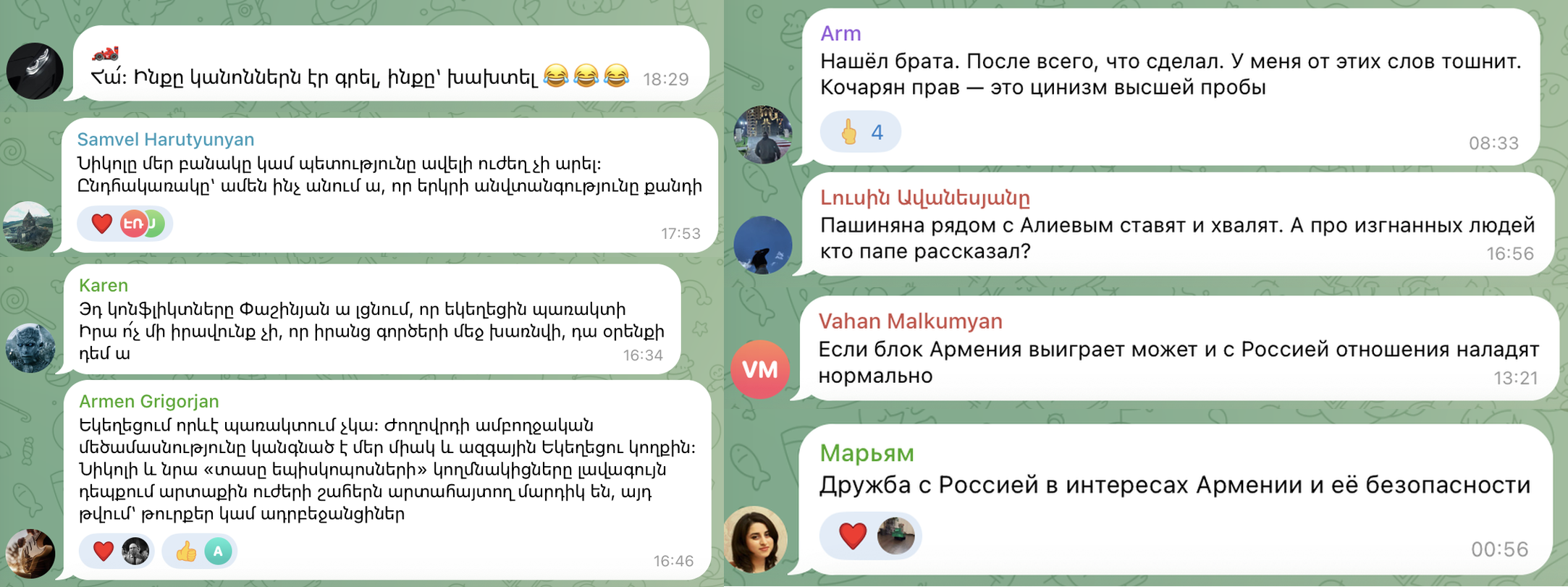
As in Ukraine’s temporarily occupied territories or ahead of Moldova’s elections, Russia deployed a network of automated bots in Armenia to spread pro-Russian narratives in the comment sections of Armenian Telegram channels ahead of the vote.
Comments were collected for all channels in the dataset for the period December 20, 2025, through June 1, 2026. Bot detection started with accounts that commented in five or more distinct channels, then applied behavioral and content thresholds. Among them: an activity ratio above 0.8 (the share of days between an account’s first and last comment on which it was active), average comment length more than 20 symbols, mentions of a single political party or public figure in more than 30 percent of an account’s comments, and bilingual commenting with the second language above 10 percent. These were not applied as a fixed rule: an extreme value on a single metric was treated as sufficient, while accounts closer to the thresholds were flagged only when several coincided. Coordinated content was identified through cosine similarity of 0.85 or higher between comments from different accounts (paraphrase-multilingual-MiniLM-L12-v2 embeddings). All flagged accounts were reviewed manually, and those showing signs of genuine discussion — comments off-narrative or atypical of the rest of the set — were excluded.
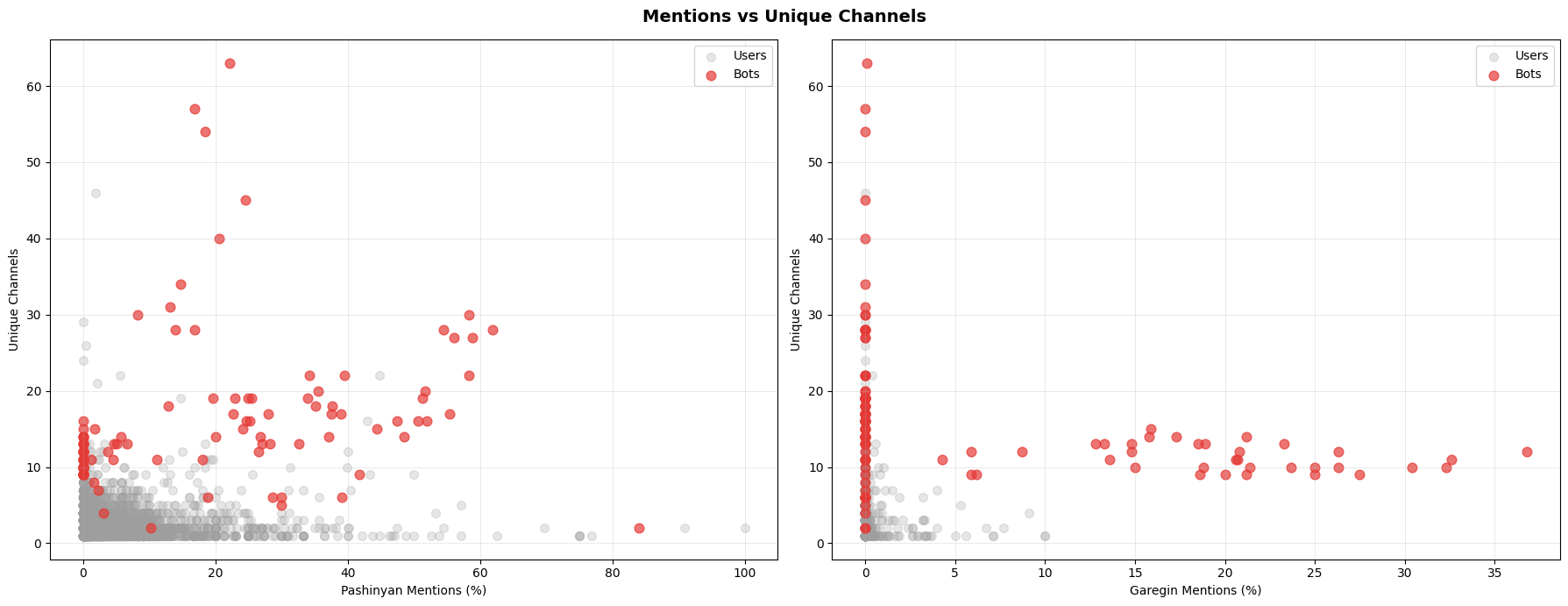
In total, we identified 104 bots active across the study period. Across the investigated channels, the bots left 13,226 comments on 8,737 posts, appearing in 111 of the 234 channels that had comments enabled. Almost every comment was unique and bore signs of AI-generation. Notably, each comment’s language was adapted to the language of the post it appeared under, meaning the same inauthentic account might write in Armenian in one channel and in Russian in another.
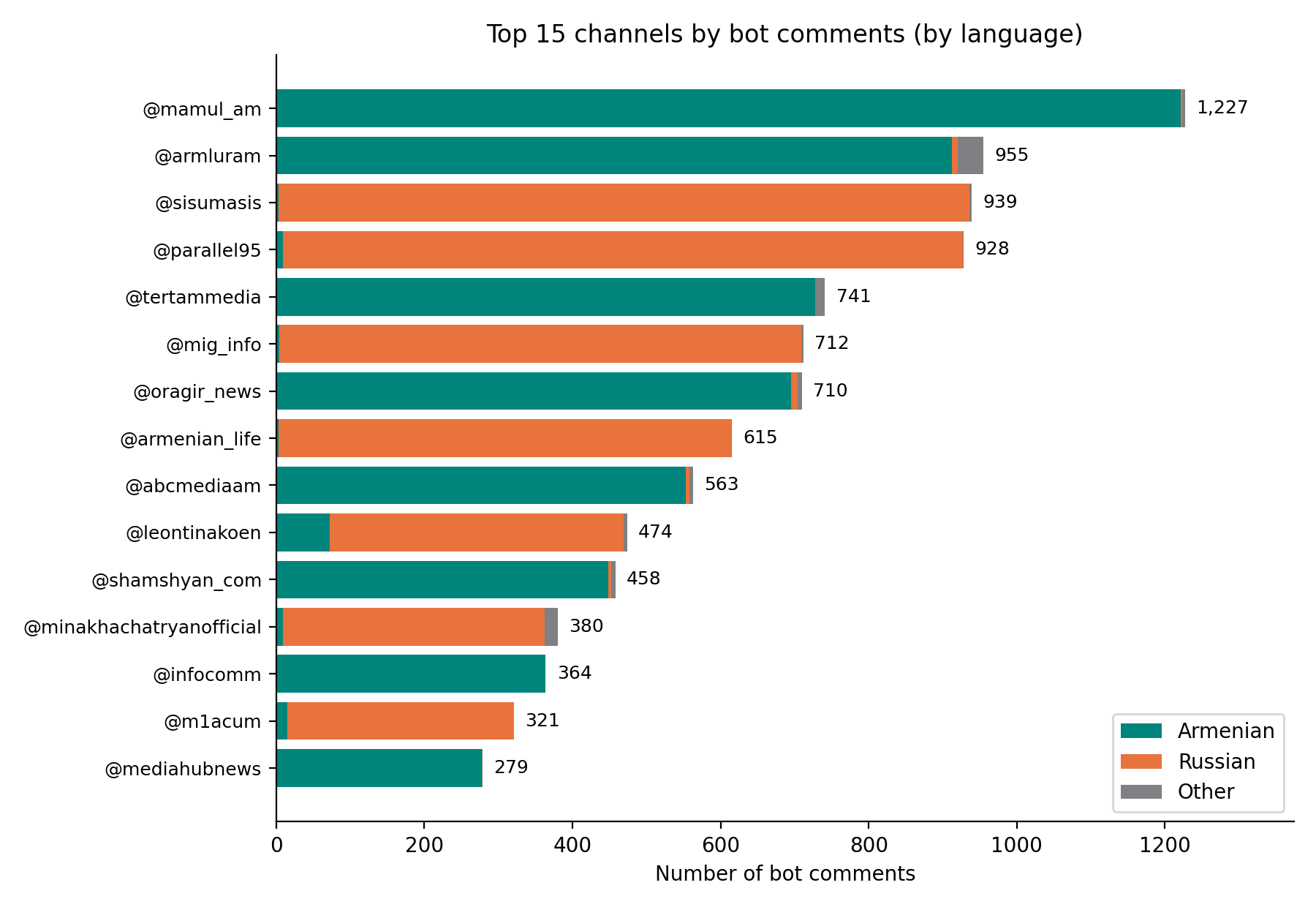
However, this whole campaign does not appear to be particularly effective. The bots generated a relatively small share of overall activity – their comments accounted for less than 2 percent of the full comment sample. Still, they left at least one comment on 7.5 percent of posts in the channels where they were active, “poisoning” those threads. Their comments also drew 14,617 reactions in total, of which 5,201 were negative (👎, 🖕, 💩, 🤡, 🥴, 🤮). Positive reactions, by contrast, clustered more in channels that already promoted the same narratives the bots were pushing, suggesting the bots reinforced existing audiences rather than persuaded new ones.
The bots pushed a wide range of narratives, of which the following were among the most common: discrediting Pashinyan, accusing the government of working on behalf of Azerbaijan and President Ilham Aliyev, urging support for the “Strong Armenia” party, and defending Garegin II, the Supreme Head of the Armenian Apostolic Church, who has at times clashed publicly with Pashinyan.
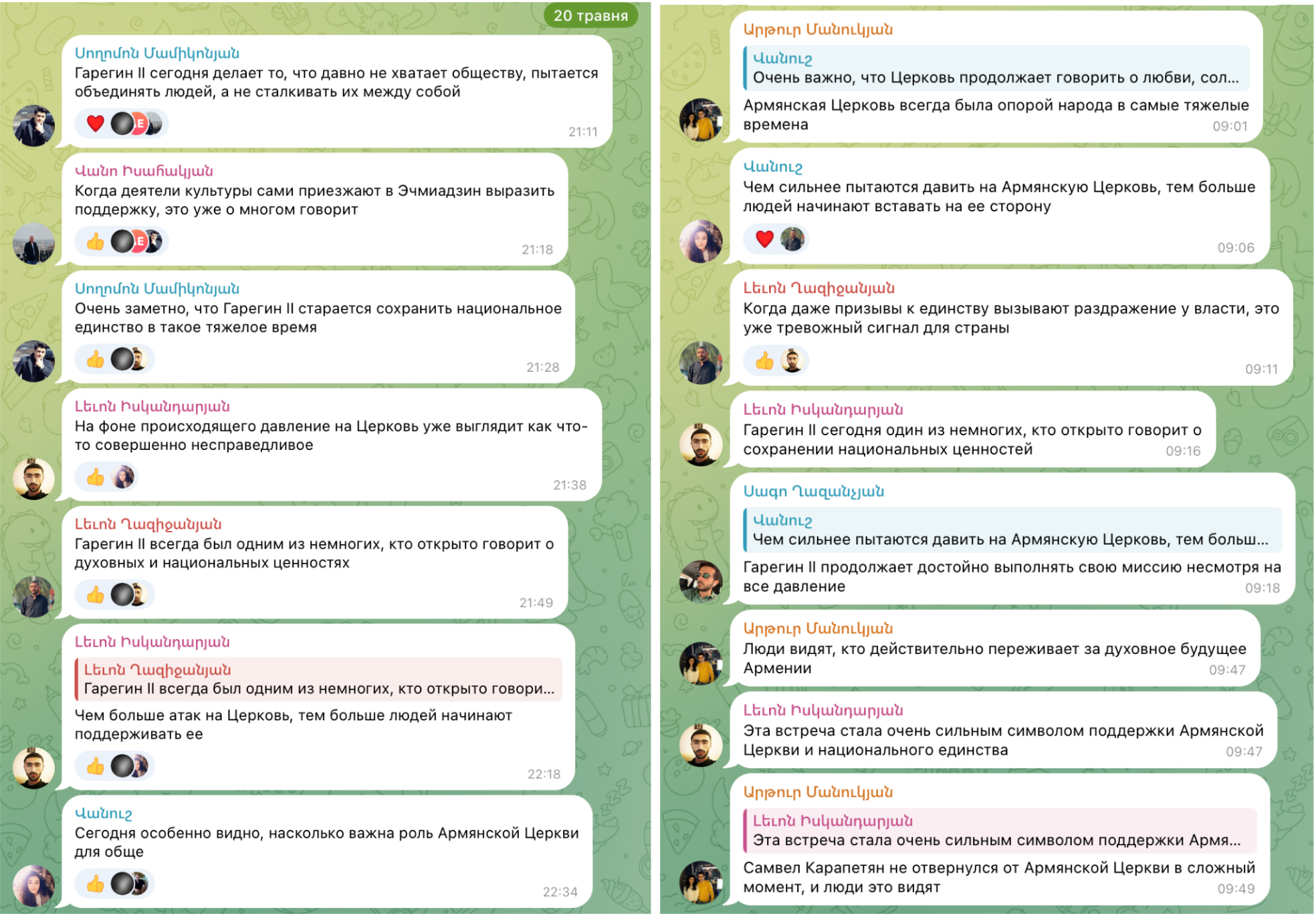
Some comments framed the prime minister as increasingly isolated and out of touch, or portrayed his handling of utility price hikes as proof he was disconnected from ordinary citizens. Others cast doubt on his authority more directly, suggesting that his attempts to project strength were instead a sign that he no longer commanded obedience.
A parallel thread promoted closer ties with Russia as being in Armenia’s security interest, framing Western, particularly EU, engagement with Armenian officials as a form of election interference dressed up as diplomatic support.
This thematic fixation was itself a marker of inauthentic behavior: some detected bots mentioned Pashinyan or Garegin II in roughly every second comment they posted, a far higher share than seen among genuine users active in the same channels. The chart below, plotting how often an account references these two figures against the number of unique channels it commented in, makes this pattern visible: bot accounts (red) cluster toward high mention rates while also spreading across dozens of channels, whereas ordinary users (gray) rarely combine both traits.
Conclusion
Pro-Russian media outlets and Telegram channels ramped up their activity in the run-up to Armenia’s June 7 election, publishing more content and leaning further into pro-Russian narratives than the year before. Behind this activity, infrastructure-level analysis uncovered a coordinated network of ownership signals linking these outlets together, even as they presented themselves publicly as independent. A separate relay network of pro-Russian Armenian Telegram channels also intensified their posting of pro-Russian content as the vote drew closer, alongside an automated bot layer operating in comment sections.
Despite this intensified activity, the pro-Russian channels’ and media’s rising campaign volume did not translate into success. Mainstream media’s direct citation of Russian-origin content fell rather than rose, and Armenian outlets grew less reliant on Russian sourcing than they were a year earlier, turning increasingly to Western outlets instead. Telegram amplification also stayed concentrated within the pro-Russian cluster rather than reaching mainstream channels. This analysis measured penetration through direct citation, sourcing, and reproduction of Russian-origin content, so it cannot rule out that mainstream outlets advanced Russia-aligned narratives independently, without any traceable link back to Russian or pro-Russian sourcing.
Contributors:
Sopo Gelava & Givi Gigitashvili (DFRLab)
Andra-Lucia Martinescu & Marius Dima (Qriton Technologies)
Nicolae Tibrigan (Digital Forensic Team)
Lusine Voskanyan (Media.am)
Yuliia Dukach (Molfar Intelligence Institute, with OpenMinds during Telegram data collection)
Cite this case study:
Sopo Gelava, Givi Gigitashvili, Andra-Lucia Martinescu. Marius Dima, Nicolae Tibrigan, Lusine Voskanyan, Yuliia Dukach, “How Russian content sought to influence Armenia’s electoral information space” Digital Forensic Research Lab (DFRLab), Qriton Technologies, Digital Forensic Team, Media.am, and Molfar Intelligence Institute, August 24, 2026, https://dfrlab.org/2026/08/24/how-russian-content-sought-to-influence-armenias-electoral-information-space/