How coordinated inauthentic networks amplified fears of war and national loss before Armenian elections
As Armenia and Azerbaijan moved toward peace, coordinated networks flooded Armenian social media with fears of war, resettlement, and national loss ahead of the June 2026 elections.
How coordinated inauthentic networks amplified fears of war and national loss before Armenian elections
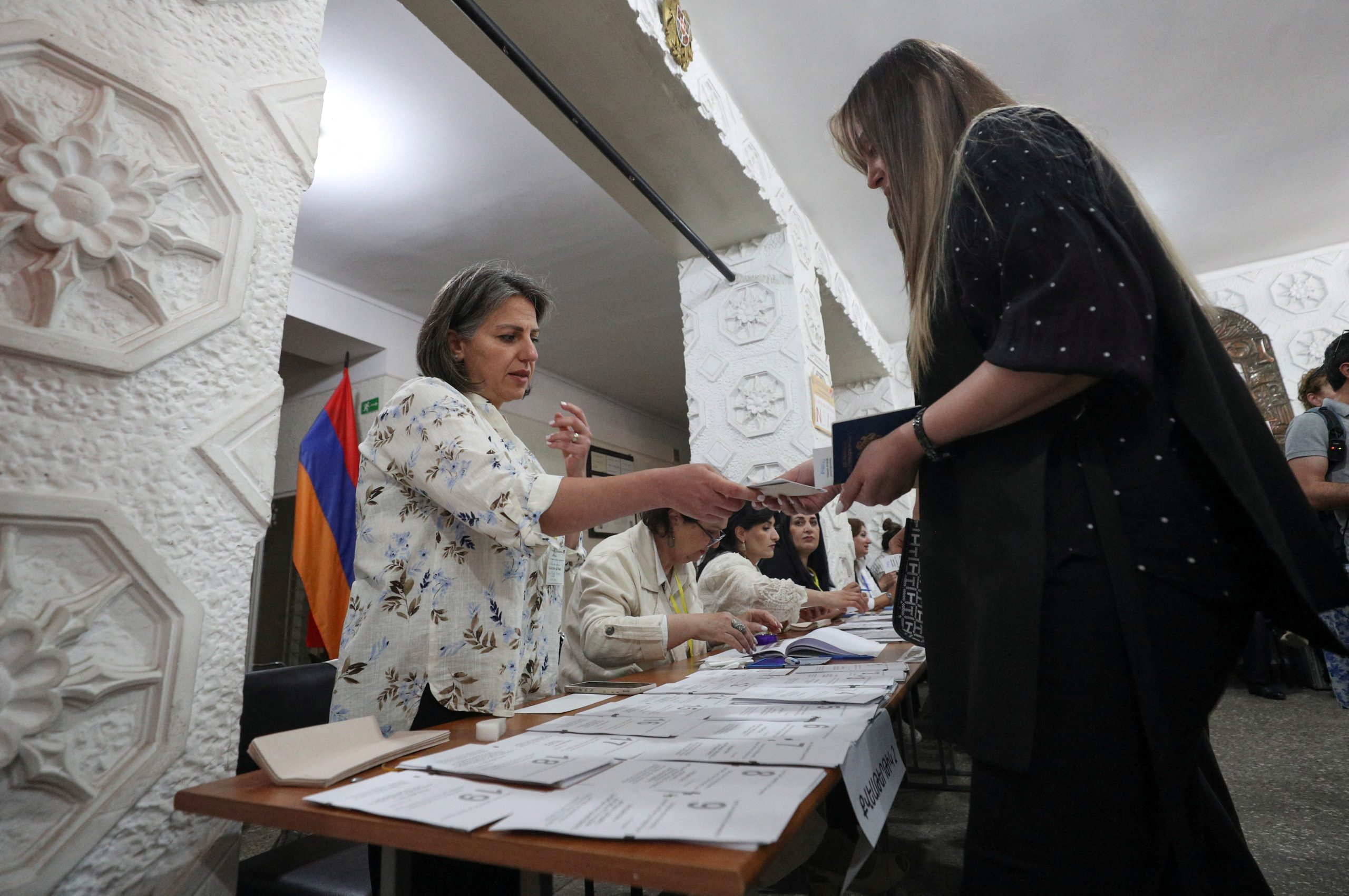
BANNER: A voter receives a ballot from an official at a polling station during a parliamentary election in Yerevan, Armenia, June 7, 2026. Hayk Baghdasaryan/Photolure via REUTERS.
Our investigation found that four networks of coordinated, often inauthentic Facebook pages and websites, as well as Telegram channels posting in synchronization, amplified claims that hundreds of thousands of Azerbaijanis would come to Armenia and that the election would bring war. The pages hid behind entertainment-style names, impersonated news outlets, and reposted content from interconnected websites. Much of this activity was built for the June 7 parliamentary election and some of these assets stopped posting shortly after the vote.
Armenia’s June 7, 2026 parliamentary elections took place against a background of a changed reality: after decades of protracted conflict over Karabakh, Armenia and Azerbaijan started to move toward normalization. Ahead of the June elections, this fragile process became a central target in Armenia’s information space as fears and historical grievances were weaponized for domestic political ends. We found that the coordinated and inauthentic social media networks pushed political messaging in a way to hide their coordination and mislead Armenian audiences. Achieving long-lasting peace between former enemies requires public support, and this support is frequently tested during elections. When such narratives are amplified by coordinated and inauthentic accounts, voters may find it difficult to distinguish genuine public discussion from manufactured amplification.
Examining the circulation of messages on the selected claims on social media
Using social media listening tools (Junkipedia, LetsData, Osavul, Meta Content Library), we initially collected messages around three election-related claims in Armenian, English and Russian between January 1 and June 7, 2026 and examined the mentions of these topics across Telegram, YouTube, TikTok, Facebook and websites. We selected these claims because each concerns the Armenia – Azerbaijan normalization process, circulated widely during the campaign, and targets different fears in Armenian society. (1) The claim that the Armenian government had agreed to resettle around 300,000 Azerbaijanis in Armenia as part of the peace process; (2) the claim that Armenia is becoming “Western Azerbaijan” and that Pashinyan’s government is either ignoring or enabling this; and (3) competing claims from both government and the opposition that the election outcome would bring a new war. Notably, most of the coordinated or inauthentic behavior we detected was related to the first and second claims.
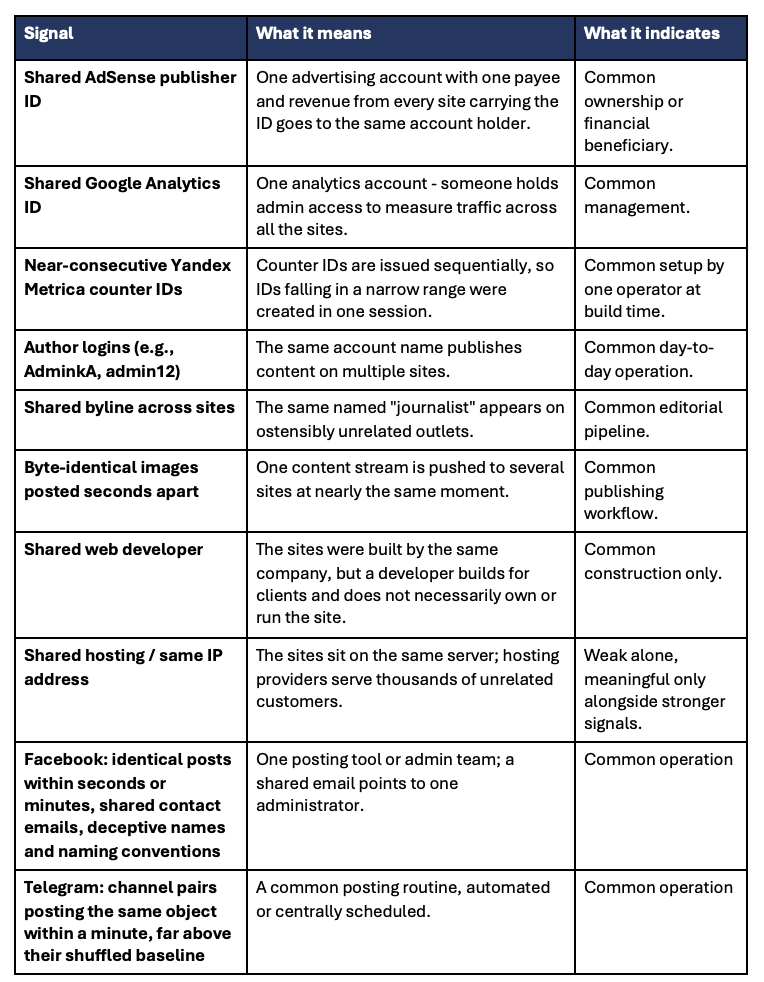
We identified coordination through behavioral and technical signals. On Facebook, the main signals were identical content posted across many separate pages within minutes or seconds of each other, deceptive page names, naming conventions, and shared contact emails, for example. For the websites, we looked for shared infrastructure: common AdSense publisher IDs, Yandex Metrica counter IDs, matching author logins, shared developers and hosting, and byte-identical images appearing across sites seconds apart. On Telegram, we measured how often channel pairs published the same object within a minute and compared this against a shuffled baseline of their own timelines. We treat coordination and inauthenticity separately: coordination rests on behavior (identical content posted across separate accounts within seconds or minutes), while inauthenticity rests on presentation, such as deceptive page names, impersonation of news outlets, and concealed affiliations. A network can show one without the other.
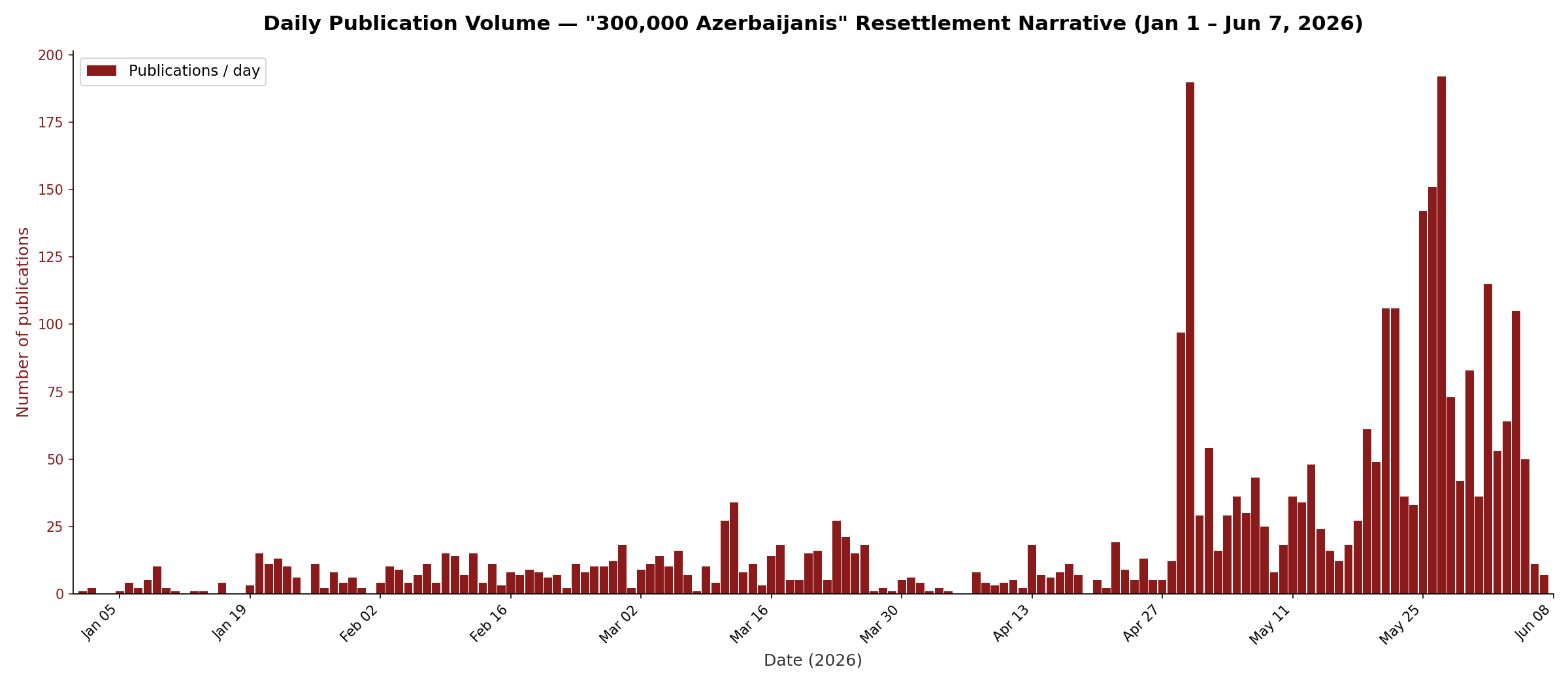
From January to late April 2026, mentions of “300,000 Azerbaijanis” stayed low, at about seventy-eight posts a week. In the week of April 27, the number of mentions nearly quadrupled, after pro-Russian Strong Armenia opposition party leader Samvel Karapetyan pledged that his party would create 300,000 jobs for the people, instead of bringing 300,000 Azerbaijanis to Armenia to take jobs. The volume of mentions kept growing every week and peaked at 1,344 in the week of May 25 – 31. Nearly 80 percent of all mentions about this narrative appeared in the last six weeks of the campaign.
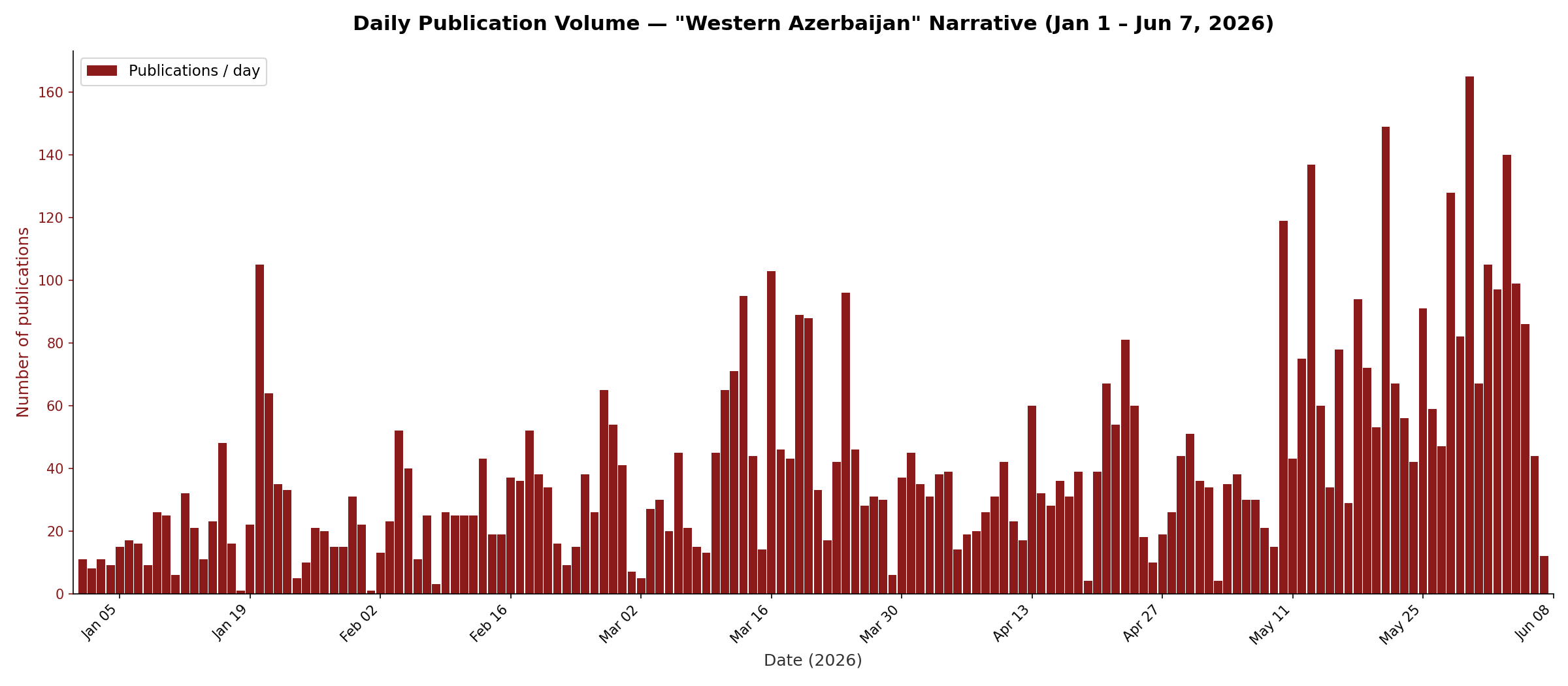
Between January and February 2026, mentions of Western Azerbaijan stayed at a low level: 100 to 190 mentions a week. The number of mentions almost doubled in mid-March during the week when former president Robert Kocharyan was named the opposition’s candidate for prime minister. The level of mentions increased again when he framed the election as a choice between Armenian statehood and “Western Azerbaijan.” Volume stayed high but uneven through April and increased again when the official pre-election campaign period began in May. It is notable that the number of accounts involved in the campaign nearly doubled from roughly 60 – 145 a week before May 11 to 142 – 231 after. Mentions of the narrative peaked in the final week before elections.
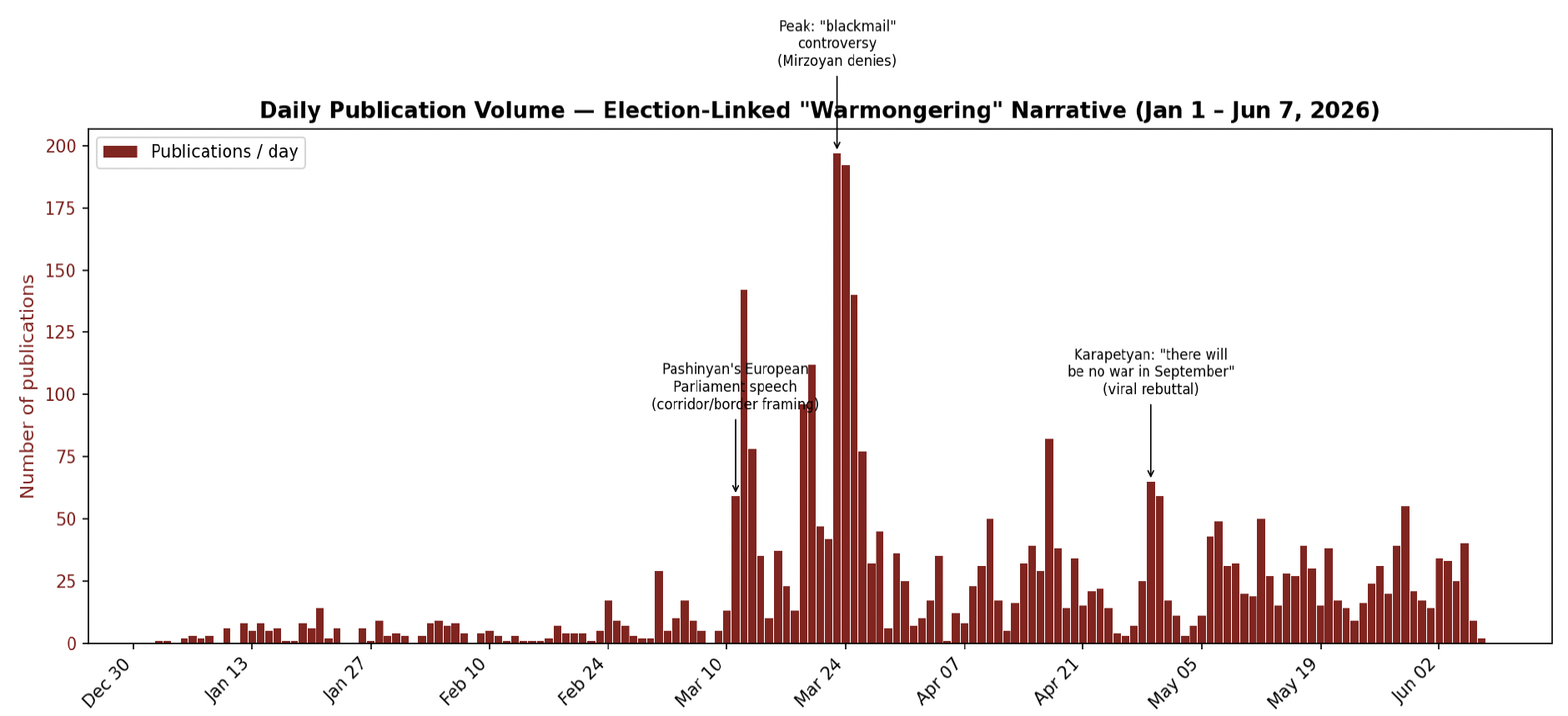
The warmongering narrative peaked early. Both government-aligned and opposition-aligned messages mobilized the same underlying fear. Rather than emphasizing territorial loss, pro-government messaging portrayed continued Civil Contract rule as the only realistic path toward avoiding renewed war, while opposition victory was presented as risking another military confrontation. Volume climbed slowly through late February and then jumped in the second week of March, driven almost entirely by one sequence of events: Pashinyan’s March 11 speech to the European Parliament defending the government’s decisions on the corridor and border, followed by his statement that there would be a war in September if his party failed to receive a constitutional majority. About 41 percent of all mentions fell in the three weeks of March 9 – 29. A later spike occurred when Samvel Karapetyan replied “there will be no war in September because Pashinyan will not be [Prime Minister] in September.”
Over a hundred coordinated inauthentic Facebook pages amplified pro-Russian and opposition messaging
Coordinated inauthentic networks comprise more than a hundred pages. They follow the same model: pages adopt apolitical, entertainment-style names that give no hint of political content or of any link to the outlets they promote. They publish identical posts within minutes or seconds of one another. What they amplify is content from suspicious websites and opaque news sites with no ownership information. The messaging of these networks leans toward opposition and pro-Russian positions. Some of these pages stopped posting on June 9, two days after the vote, indicating that the operation was built for the election. The full list of identified assets is available here.
First network
We found a network of over 30 coordinated Facebook pages, which amplified political and pro-opposition content ahead of the elections under the facade of apolitical and entertaining pages. Most notably, many assets in this network stopped posting content on June 9, two days after the elections took place in Armenia, which indicates that their primary activity focused on shaping perceptions ahead of the elections.
Many of these pages have names that sound apolitical and entertainment-focused, but they post mostly political content. These names give little indication that the pages primarily distribute political content. Such names include “Yerevan Estate Ձեր խոսքը,” “International Beauties,” “Armenia Cool,” “Smile and the Whole World Will Smile at You” etc. The pages publish identical posts at intervals of several minutes, which indicates the content is posted manually rather than cross-posted automatically. Facebook has applied an AI label to some of the pages, flagging that they use AI-generated content.
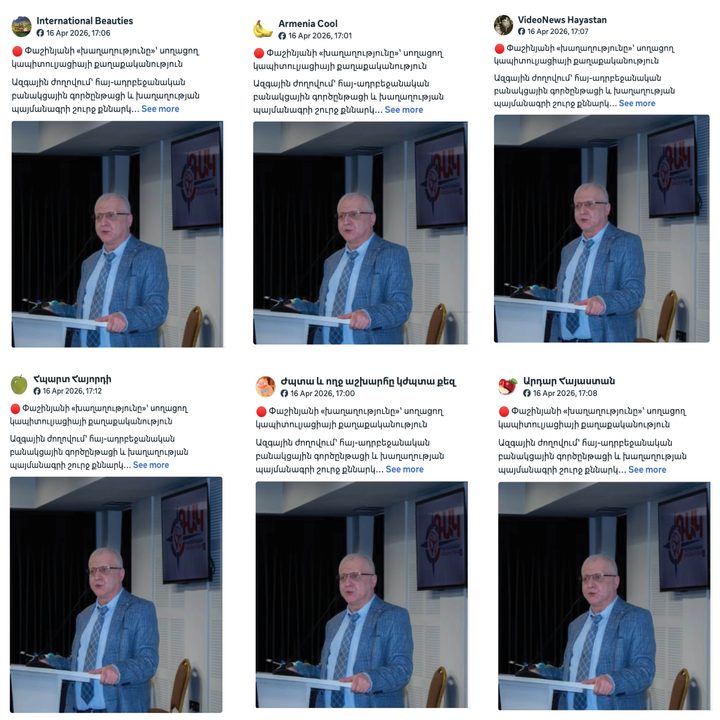
Ahead of the parliamentary elections, these pages actively amplified statements from Suren Surenyants, leader of the Democratic Alternative party, which contested the elections on a joint list with Prosperous Armenia. Prosperous Armenia is led by Gagik Tsarukyan, who is widely seen as pro-Russian: he has called for closer ties with Russia and publicly described it as the main guarantor of peace and security in the region. The pages also published content favorable toward Edmon Marukyan, leader of the Bright Armenia party. The cover image of one entertainment page, Smile and the Whole World Will Smile at You, featured campaign branding from the Aprelu Yerkir party’s 2023 Yerevan municipal election campaign, despite the page not being formally affiliated with the party.
One statement made by Suren Surenyants and promoted by the network claimed that June 7 was not an election day but “a referendum on independence.” The post alleges that “Western Azerbaijan” had already been established in Armenia through the collaborator government (here, here, here, here). The same network also promoted another statement from Surenyants, who claimed that Pashinyan’s government has caused an “unprecedented crisis in Armenian-Russian relations” and called for voters to reject the “War Party” led by Pashinyan and avoid repeating the “Ukrainian model” (here, here, here).
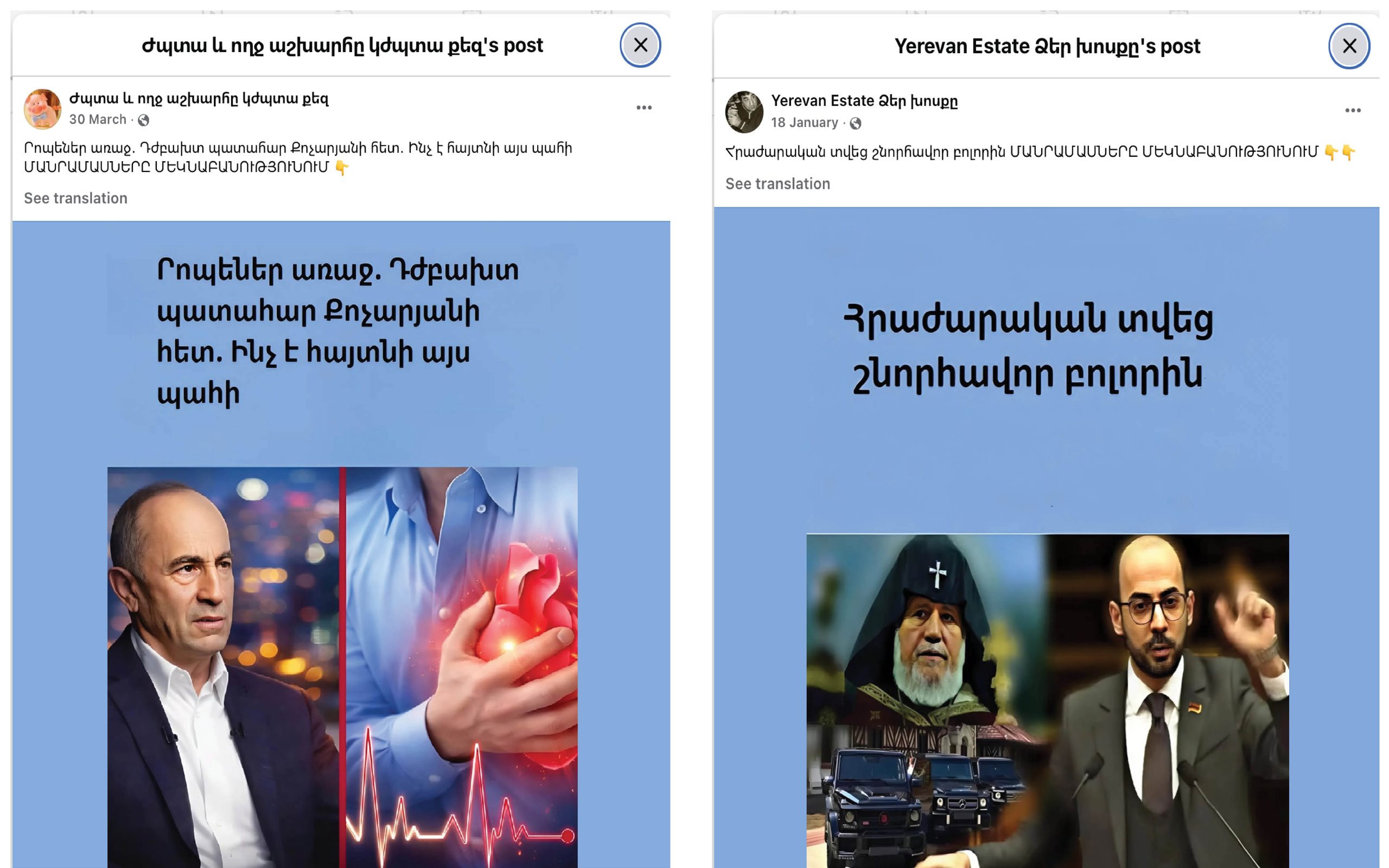
Some of these pages have published invented stories. In February 2026, some pages published a post claiming that Armenia’s second president, Robert Kocharyan, had been involved in an accident (here and here). In January 2026, the page published a collage featuring Catholicos Karekin II and Civil Contract MP Artur Hovhannisyan with the caption “He resigned. Congratulations to everyone” (here and here). None of these claims are true.
Ahead of the elections, pages mostly amplified the appearance of the above-mentioned politicians in videos and interviews posted by three YouTube channels: @ArmatMedia, @hayqNews and @Hayeliakumb.
All three outlets show a clear leaning toward opposition and pro-Russian actors. Armat Media was established in September 2025 by Aleksan Aleksanyan, founder of the pro-Russian Strong Armenia party, and consistently publishes content favorable to it. Aleksanyan is now in pre-trial detention over alleged payments to rally participants and large-scale money laundering. HayqNews, registered in December 2023, mainly features opposition voices favoring closer ties with Russia and covered Strong Armenia’s campaign extensively. Former Dashnaktsutyun-affiliated journalist Armine Simonyan serves as its editor-in-chief. Hayeli Club, a news website and press club, regularly hosts Strong Armenia representatives, opposition MPs, and government critics, and devotes substantial attention to pro-Russian political content.
Some of the pages in this network include the email address armantumasyan2017@gmail.com in the contact section. According to CivilNet, this email belongs to Arman Tumasyan, who was engaged in the development of social media pages. In 2017, Tumasyan argued that Facebook blocked hundreds of pages developed by him.
FIP contacted Tumasyan, who confirmed that he previously developed and managed Facebook pages and groups with large audiences, which he used to distribute content. He said he no longer operates Armenian Facebook pages, claiming that he sold all of them in mid-2025. According to Tumasyan, the portfolio consisted of around 100 pages with a combined audience of three to four million followers. He said the buyers were based in Russia, but declined to identify them.
Second network
We identified over fifty deceptive Facebook pages that repost content primarily from the pro-Russian website Past.am. Many of them stopped posting on June 9, two days after the elections, which suggests that their main purpose was to shape opinion ahead of the vote. Identical texts appear across the pages within the same minute, which most likely means the posts are cross-posted automatically. Past.am is the online edition of the Armenian newspaper Past. The newspaper is published by an individual enterprise belonging to Varuzhan Babajanyan, who served as Past‘s editor-in-chief until 2018, when he stepped down to enter politics and subsequently ran in the 2018 parliamentary elections on the pro-Russian Prosperous Armenia party ticket.
During the 2026 election period, Past.am gave substantial visibility to opposition actors, including representatives of the Strong Armenia party. In one of the videos posted by Past.am, Narek Karapetyan claims that “not going to polls means bringing 300,000 Azerbaijanis to Armenia.” In another statement, Alik Aleksanyan, a member of the Strong Armenia party, says “go to the polls so that 300,000 Azerbaijanis do not come to Armenia.” The outlet’s editorial choices also suggest proximity to Russia-aligned political narratives and actors.
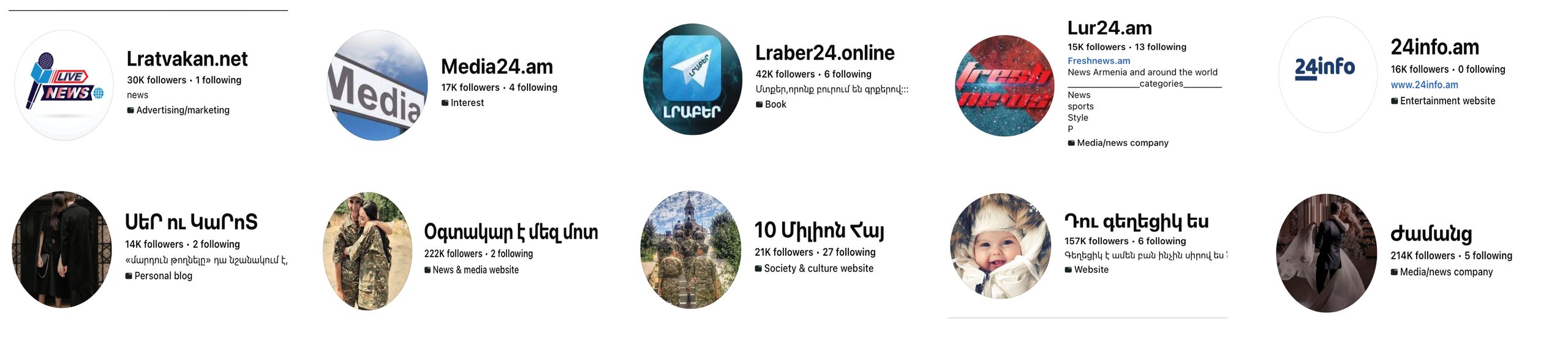
Around eighteen pages in this network have misleading names showing no connection with Past.am. These names of Facebook pages that amplified Past.am are unrelated to media or politics and include “Entertainment,” “You are beautiful,” “10 million Armenians,” “It is useful for us” etc. Another subgroup of around fifteen pages has names that masquerade as media outlets. Examples include 24info.am, Pressclub.club, Lur24.am, The Fast Media etc. Some pages primarily amplified Past.am before parliamentary elections, but then switched to amplify content from another website, Pressmedia.am.
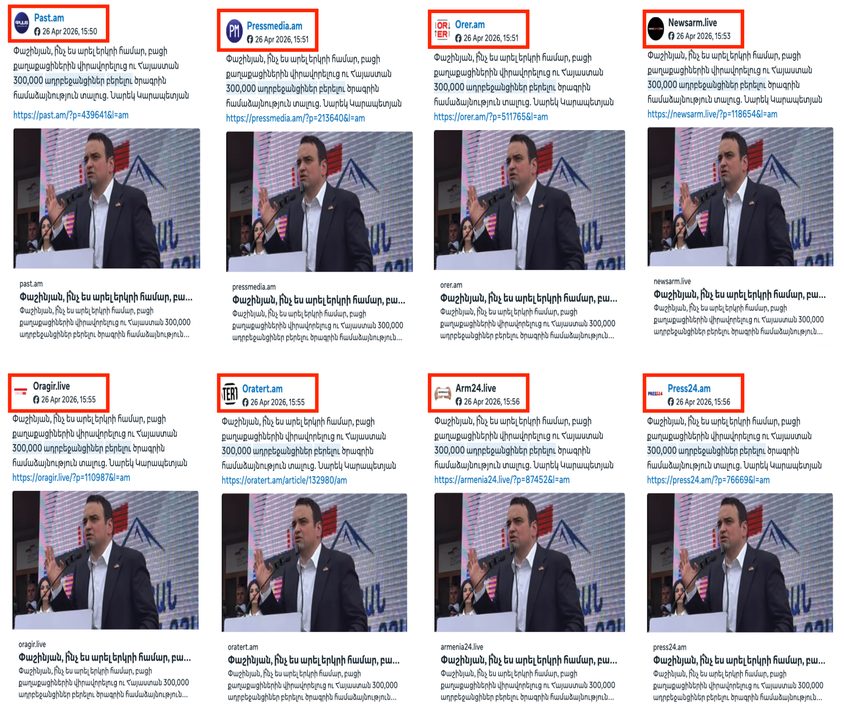
On April 26, the Past.am Facebook page posted an article quoting the leader of pro-Russian Strong Armenia party, Narek Karapetyan: “Pashinyan, what have you done to our country, besides insulting our country and agreeing to the plan to bring 300,000 Azerbaijanis to Armenia?” Within five minutes, the Facebook pages of the eight other news websites posted identical articles from their own sites. At least half of these websites were developed by Sargssyan Studio, owned by Suren Sargssyan. His website, sargssyan.com, lists the portfolio of websites created by the studio.
A common developer does not by itself establish common ownership or control of the content. However, combined with the identical content and synchronized posting in social media, there is a high likelihood that there is a single coordinated operation behind the network rather than eight independent outlets.
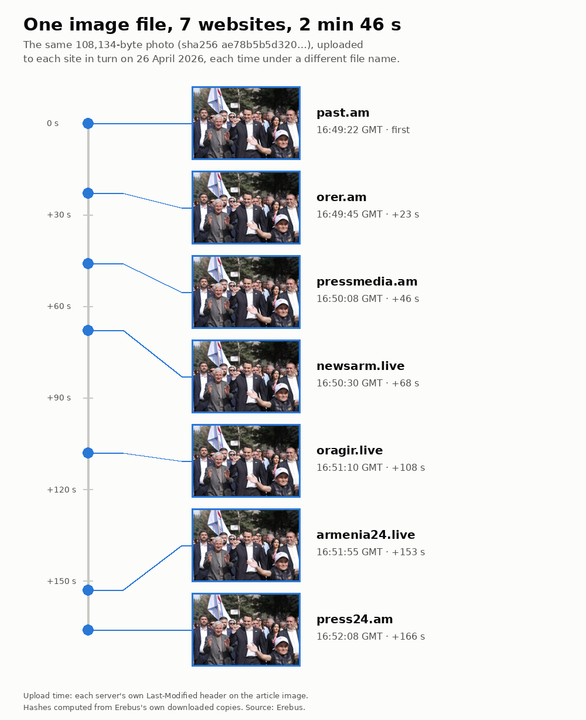
We also found that the same image file of Narek Karapetyan appeared on seven of those websites, one after another, within two minutes and forty-six seconds. The file is identical on all seven websites byte for byte (SHA-256 ae78b5b5d320…, 108,134 bytes), which we were able to confirm by hashing our own copies rather than comparing file names. The most likely explanation is that a single publishing system feeds all seven sites.
Third network
The third network we identified serves as an amplifier of at least five fringe media websites: Armdaily.news, newsone.am, Firstnews.am, Newszone.am and Analytic.am. The websites provide little transparency about their operations: information about ownership, management, editorial teams, or institutional affiliations is absent. Their political coverage is predominantly critical of the Armenian government and frequently consists of the republication of statements, interviews, and social media posts by opposition politicians and other government critics. These websites devote considerable attention to Russia and Armenia-Russia relations, frequently republishing statements by Russian officials and Armenian political actors advocating closer ties with Moscow. Some of the content reproduces narratives portraying Russia as economically or strategically indispensable to Armenia, while presenting Armenia’s rapprochement with the EU as costly or risky. However, the pattern is not uniform across all five outlets: some also publish content explicitly critical of Russia.
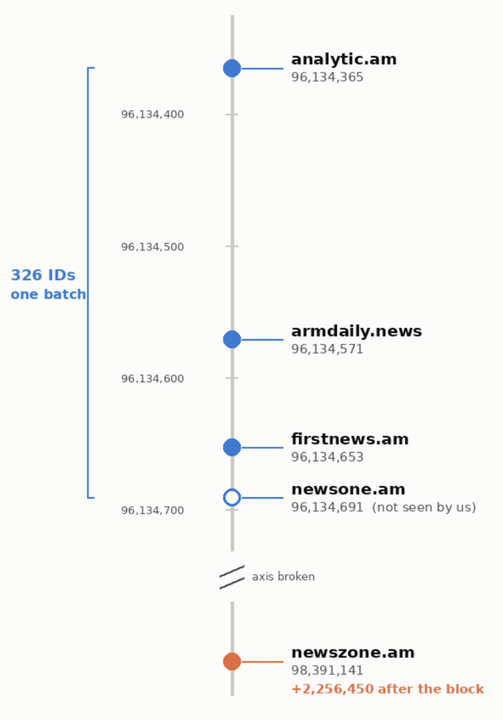
Although these websites do not disclose that they are interconnected, multiple pieces of evidence indicate that they compose a single network. One of the strongest proofs that these websites share a common origin comes from their Yandex Metrica IDs – the numbers given to the analytics counters built into each site’s code. Four of the five websites have almost consecutive IDs: analytic.am (96,134,365), armdaily.news (96,134,571), firstnews.am (96,134,653), and newsone.am (96,134,691) – a gap of just 326 between the first and the last. Yandex hands out these numbers in order as new counters are created, so IDs this close together mean the four websites were possibly set up in one batch, within a short time, by the same operator. The fifth site, newszone.am (98,391,141), has an ID more than two million higher, which suggests its counter was created later and the site joined the network after the first batch.
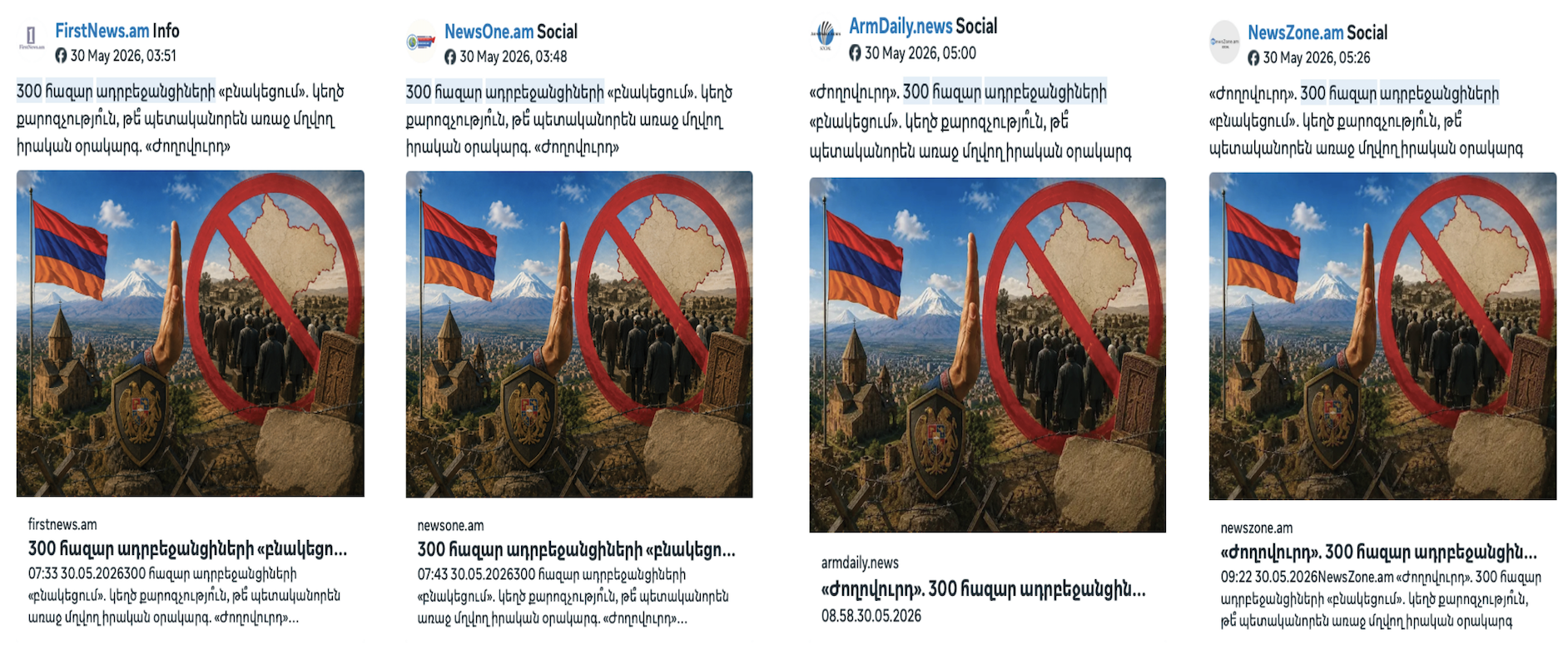
The websites in this network publish identical texts, and their Facebook pages publish identical posts. Moreover, although each website runs several Facebook pages under different names, all of them post the same content and URL, most likely to increase the reach and visibility of the content. Each website runs several Facebook pages, which have very similar naming structures. Facebook pages associated with Newszone.am have names such as NewsZone.am Info, NewsZone.am Portal, NewsZone.am Social, among others. Similarly, pages associated with NewsOne.am have names such as NewsOne.am Social, NewsOne.am Info, NewsOne.am Portal, among others. Pages associated with Firstnews.am have names such as FirstNews.am Info, FirstNews.am Social etc. This naming pattern is a common tactic for multiplying an outlet’s footprint across Facebook. By running several near-identical pages rather than one, an operator can post the same content simultaneously across multiple pages, widening its reach.
Fourth network
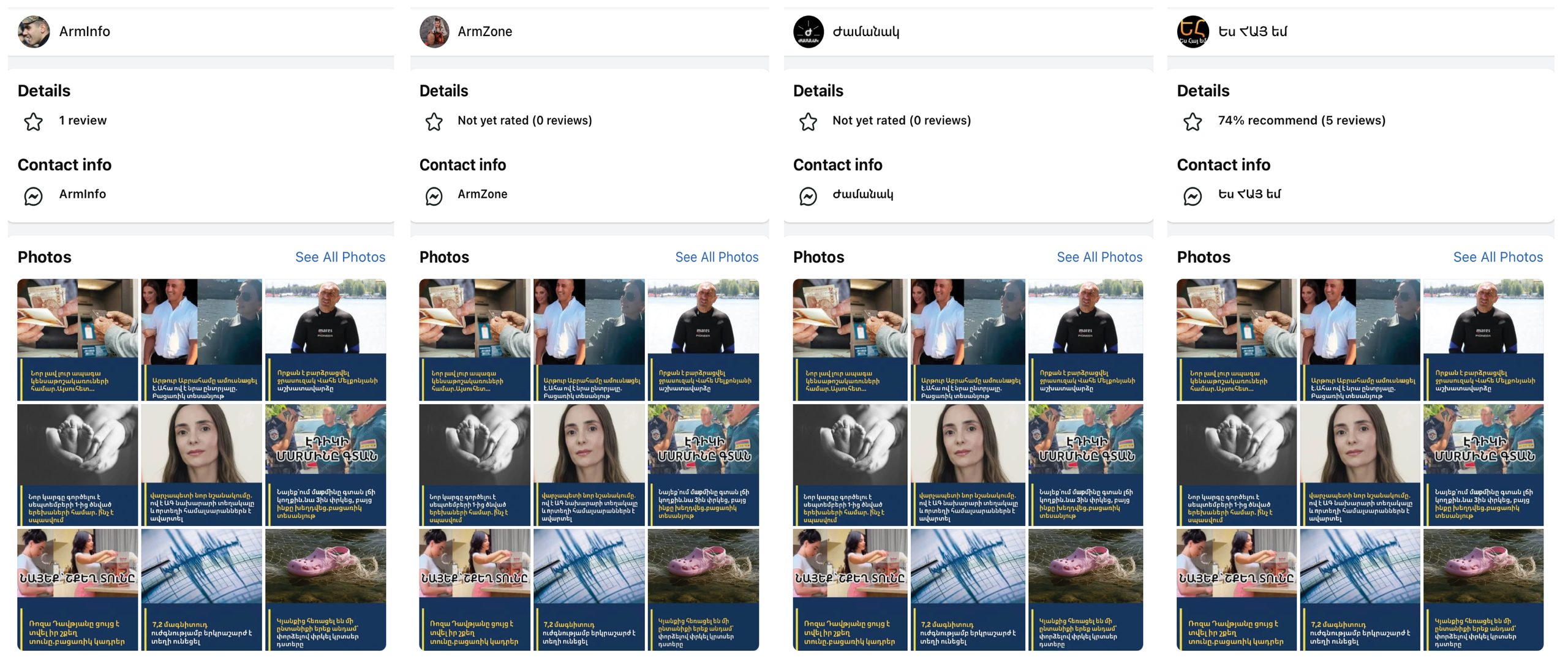
We also found a network of around twenty Facebook pages, which have names unrelated to media or politics, such as “I am Armenian,” “I am proud to be Armenian,” “Time,” “ArmZone” etc. and consistently amplify content from multiple websites, including Russian websites. This includes websites, such as mediatime.am, 1in.arm24news.ru, arm24news.ru, 24newsarm.ru and 1in.tejlurer.online.
Mediatime.am portrayed Samvel Karapetyan in a positive light, depicting him as a generous person and a strong rival to Pashinyan. The website also posted a comment from Karapetyan saying that a military parade would not protect Armenia when “300 thousand Azerbaijanis come.” Most of the Facebook pages publish identical cards with news stories and the URLs linking to the news stories are provided in the comments’ section.
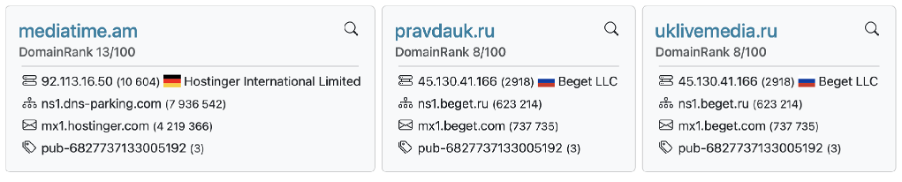
Mediatime.am shares its Google AdSense publisher ID (ca-pub-6827737133005192) with two other websites, pravdauk.ru and uklivemedia.ru. A publisher ID corresponds to a single AdSense account, so revenue from all three sites flows to one account and this represents one of the strongest available indicators of a shared advertising account. The ID has been present on mediatime.am since March 2023 and on the other two since September 2025 and 2026 respectively.
Neither of the two.ru sites is an Armenian outlet: pravdauk.ru publishes viral human-interest stories in Polish, and uklivemedia.ru publishes the same kind of content in Hungarian. The two are closely linked to each other – they share a Google Analytics ID (GT-PJRDQCR3), an author byline (“Bethany Lewis”) and identical image files and both carry traces of a Russian-language operator, including default WordPress categories in Russian. The link therefore points to an Armenian political site sharing an advertising account with a multi-language, cross-border content-farm operation. In other words, the three sites are monetized by the same account holder, but it does not necessarily mean that the same people write, edit, or direct the content. The two.ru sites additionally show operator-level overlap and mediatime.am’s connection rests primarily on the shared monetization.
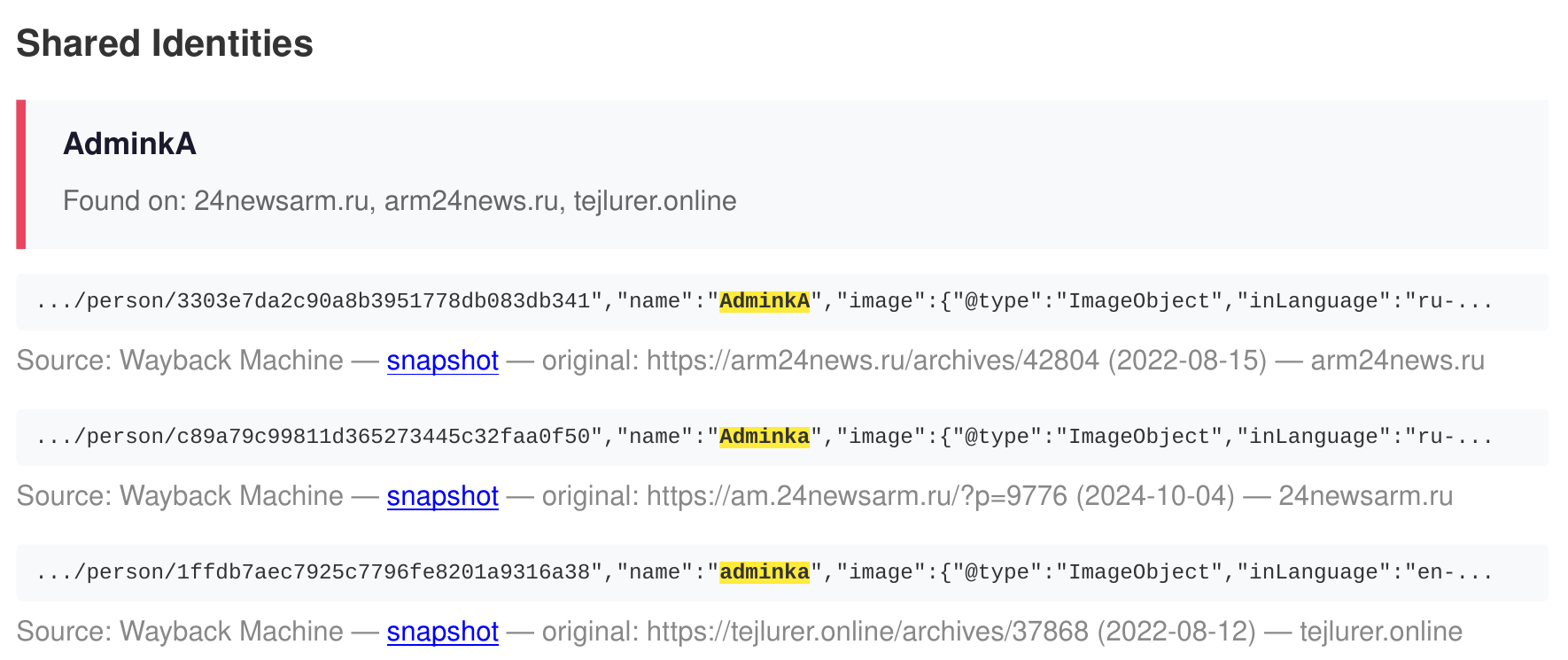
Pages in this Facebook network have also amplified content from at least six fringe media websites, which seem to be interconnected. These websites include 24newsarm.ru, arm24news.ru, medianews.site, mediatime.am, tejlurer.online and tejlurer.site.
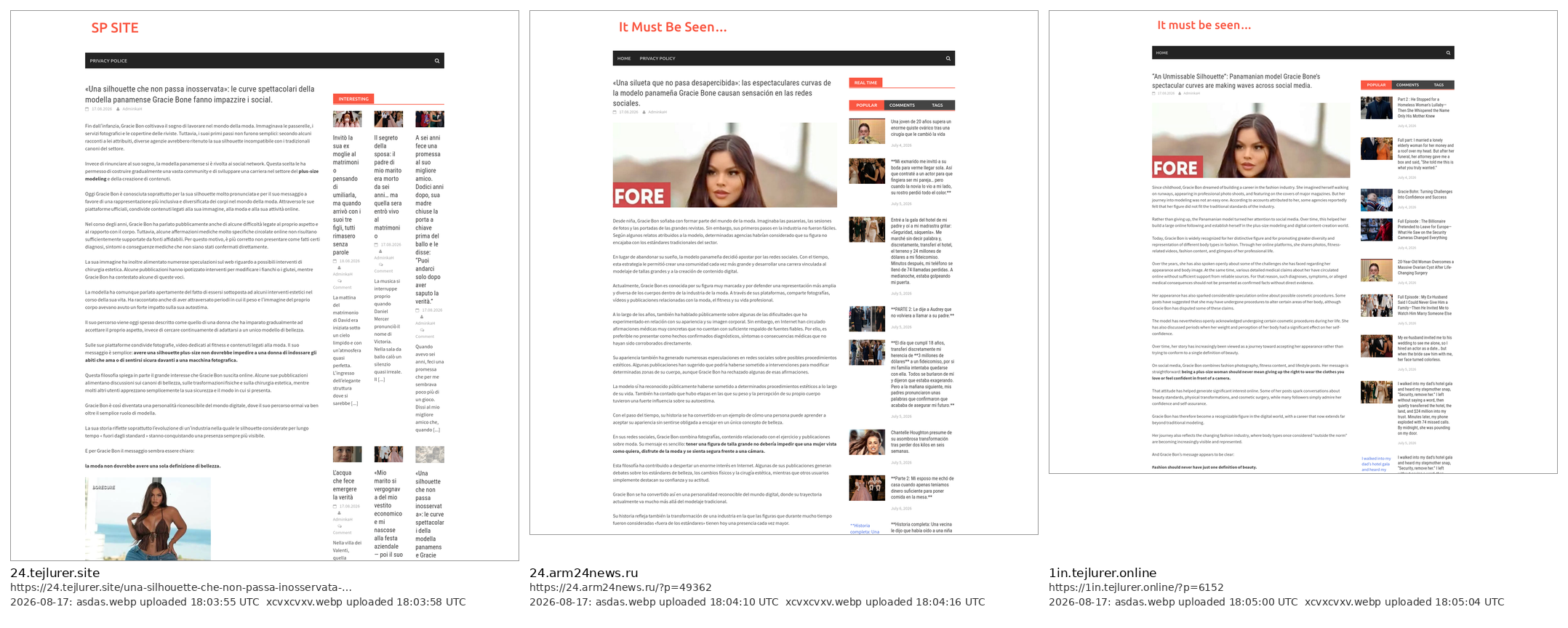
The available evidence indicates that these six websites share the same operator. Favicon filename shows that three of them (tejlurer.site, tejlurer.online and arm24news.ru) got AI-generated logos made in the same ChatGPT session seven minutes apart on 12 May 2026, still visible in the filename.
They also use identical placeholder images with the same misspelled label, run on the same website software (WordPress with the Awaken theme), and use similar admin account names (“Adminka” and variants). Adminka is the Russian diminutive for an admin panel. We found variations of it across websites: Adminka (arm.tejlurer.site), AdminkaD (tejlurer.online), AdminkaDV (tejlurer.site), AdminkaH (arm.arm24news.ru). This points to a Russian-language operator running multiple sites from one workflow. Whoever was setting them up was also reusing logins. In addition, four sites (arm24news.ru, 24newsarm.ru, tejlurer.site, and tejlurer.online) are hosted by the Russian provider Beget on the same IP address (188.127.230.197), and the two Armenian-language tejlurer sites retain Russian interface text in their page structure: the breadcrumb “Главная страница” (“Home page”) appears in 64 and 66 archived articles respectively.
The four networks mostly differ in size and sources. The first network consists of over 30 pages with entertainment-style names that promoted opposition politician Suren Surenyants, and published posts minutes apart. Many stopped posting after the election. The second network is the largest and most automated: over 50 pages reposting Past.am with identical texts within the same minute. The third rests on the websites rather than the pages: five outlets with no ownership information, linked by near-consecutive Yandex Metrica IDs showing they were built in one batch. The fourth, around twenty pages, amplifies a cluster of six interconnected Armenian and Russian websites.
Coordinated amplification on Telegram
We also detected coordinated distribution of messages on Telegram about the topics we analyzed: multiple, seemingly unconnected channels posting the same or near-identical text within a very short window. The “Western Azerbaijan” topic was widely discussed on Telegram and posting activity peaked in the weeks immediately before the June 7, 2026 election.
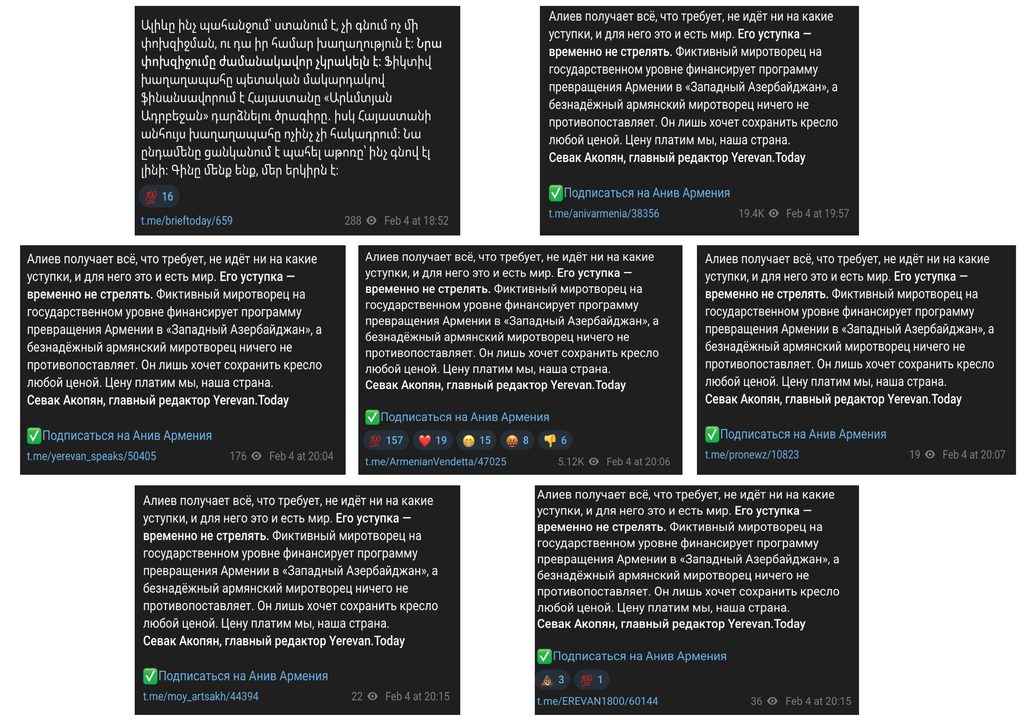
On February 4, Sevak Akopyan, editor-in-chief of the pro-Russian outlet Yerevan Today, accused Prime Minister Pashinyan in a Telegram post of surrendering Armenian territories to Azerbaijan, claiming that Aliyev has a plan to turn Armenia into “Western Azerbaijan” and that Armenia’s prime minister does not oppose it – he only wants to keep his seat at any cost. The post appeared on Akopyan’s Telegram channel at 17:52. About an hour later, the post was published in Russian on the @anivarmenia channel, with Akopyan clearly credited as the author. Shortly afterward, three channels – @yerevan_speaks, @ArmenianVendetta, and @pronewz – reposted it within three minutes, which suggests possible coordination between them. A few minutes later, @moy_artsakh and @EREVAN1800 reposted it one second apart, which most likely indicates that posting on these two channels is automated.
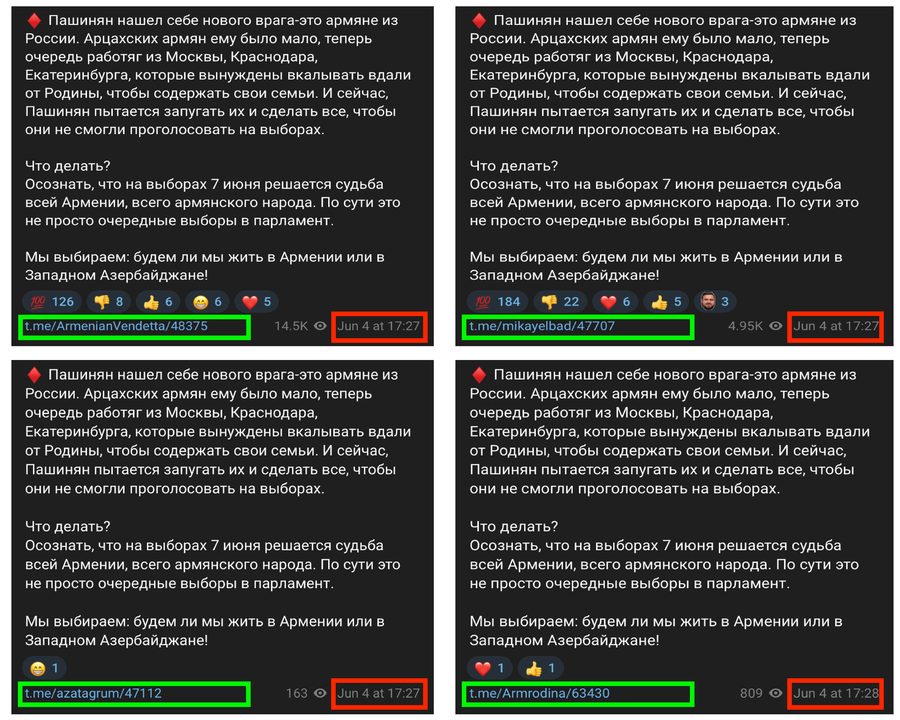
On June 4, a post published by the @ArmenianVendetta channel claimed that Armenians needed to go and vote on June 7 in order to decide where they wanted to live: in Armenia or in Western Azerbaijan. Within the same minute, the post was reposted by the @mikayelbad and @azatagrum channels. Remarkably, these two channels reposted it at exactly the same second. Around thirty seconds later, the post was republished by the @Armrodina channel. Such a close posting pattern strongly suggests coordination between these channels.
Apart from @mikayelbad (which belongs to Mika Badalyan, leader of the Armenian branch of the Russian NGO Evrazia) and @azatagrum, we have also noticed that identical posts were published regularly by two other channels – @abovyanarman, which belongs to Arman Abovyan, a program host at Sputnik Armenia, and @armsens, a channel registered in Russia, according to TGStat’s catalog of Telegram channels.
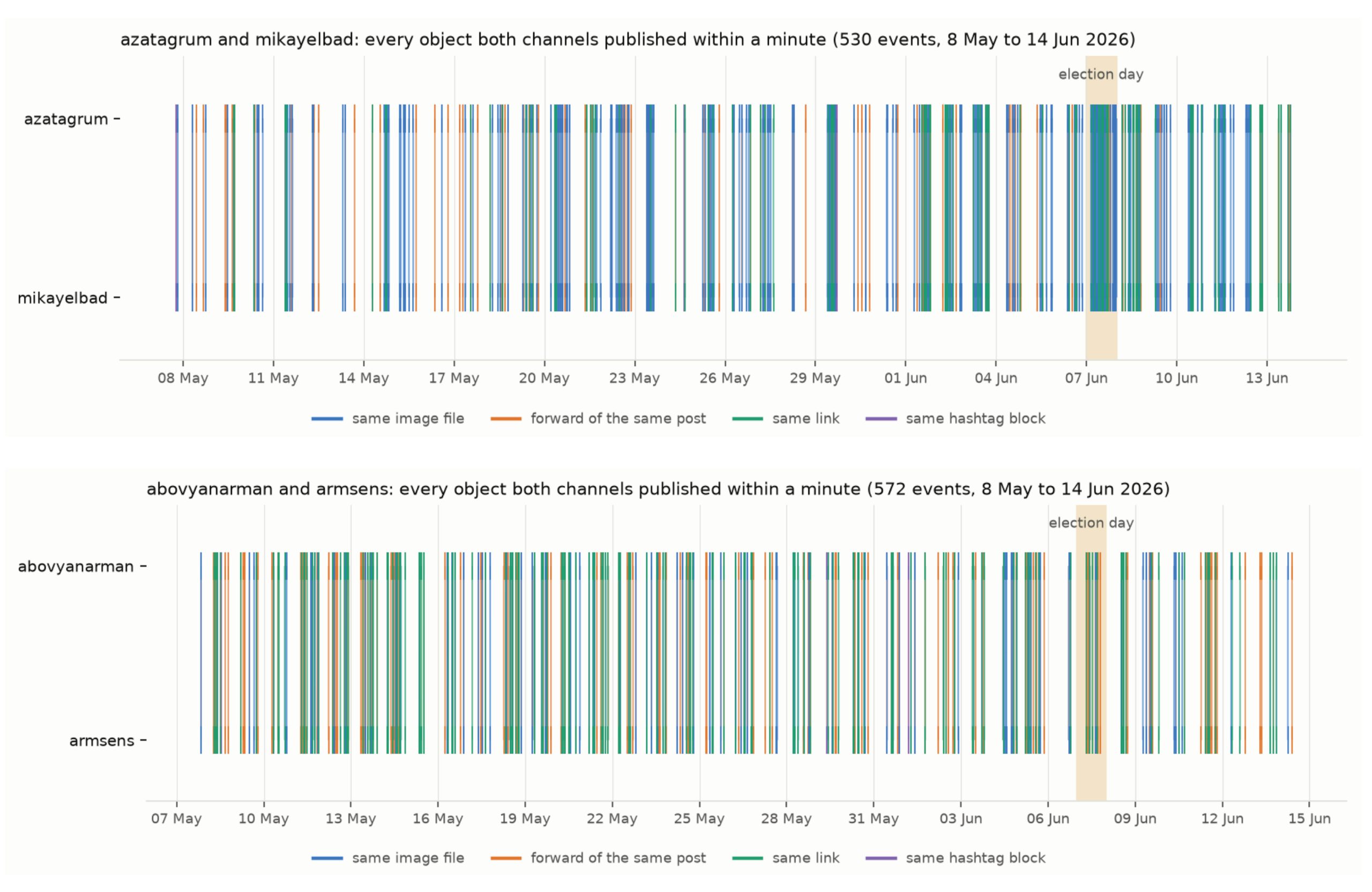
We scraped posts published by @abovyanarman and @armsens between 8 May and 14 June 2026 and found that they published the same object within a minute of each other 572 times, across 519 distinct objects – in 374 cases in the very same second. Neither channel consistently leads: where the order differs, one is first ninety-seven times, the other 101. The shared objects are 261 forwards of the same post, 157 identical links, 146 identical images, and eight identical hashtag blocks. The pair posts every day, mostly in the evening, and goes quiet between 23:00 and 03:00 UTC.
We did the same for the second pair of @mikayelbad and @azatagrum and found that over the same time period, they published the same object within a minute 530 times, across 487 distinct objects; in 290 cases in the same second. Here the order is one-sided: mikayelbad is first 225 times, azatagrum fifteen. Roughly four of every five posts published by either channel have a matching post on the other.
This pattern suggests that it is possible that one operator operates both channels in each pair. On Telegram a single forward can be sent to two channels at once, which is why so many posts land in the same second; a person uploading the same file to two channels takes a few seconds longer. The timeline below shows near-simultaneous posting by the two channel pairs. Each vertical line is one object – an image, forward, link, or hashtag block – published by both channels in a pair within a minute: 530 matching instances for azatagrum/mikayelbad (top) and 572 for abovyanarman/armsens (bottom).
Our analysis showed that the same core channels are at the center of every narrative we analyzed. @abovyanarman and @armsens appear as the top or near-top pair in all three – Warmongering, Western Azerbaijan, and 300,000 Azerbaijanis. @tzitzak, @azatagrum, @mikayelbad, and @rusyerevantoday show a similar pattern. These are not separate groups that formed around single claims. They are one small, stable set of accounts that picks up whichever narrative is live at the moment and spreads it, each time with the same speed and identical wording.
Conclusion
Our investigation shows that ahead of Armenia’s June 2026 elections, hostile narratives about Armenian-Azerbaijani relations were pushed by coordinated networks of fake Facebook pages, connected websites, and Telegram channels. The same accounts and pages often carried more than one narrative and much of the activity was tied to the election: several networks went quiet right after election day. As Armenia and Azerbaijan continue to move toward peace, elections may remain easy targets for manufactured campaigns that play on fears of war and national loss.
Contributors
Givi Gigitashvili & Victoria Olari (DFRLab)
Hasmik Hambardzumyan (FIP.am)
Roman Osadchuk & Tetyana Prokopiv (LetsData)
Andreas Sjöstedt (Erebus)
Cite this case study:
Givi Gigitashvili, Hasmik Hambardzumyan, Victoria Olari, Roman Osadchuk, Tetyana Prokopiv and Andreas Sjöstedt “How coordinated inauthentic networks amplified fears of war and national loss before Armenian elections,” Digital Forensic Research Lab (DFRLab), October 12, 2026, https://dfrlab.org/2026/10/12/inauthentic-networks-amplify-fears-of-war-before-armenian-elections/.