How political messaging spread in Armenian diaspora Facebook groups before the 2026 elections
Inside the Armenian diaspora’s Facebook groups before the 2026 elections.
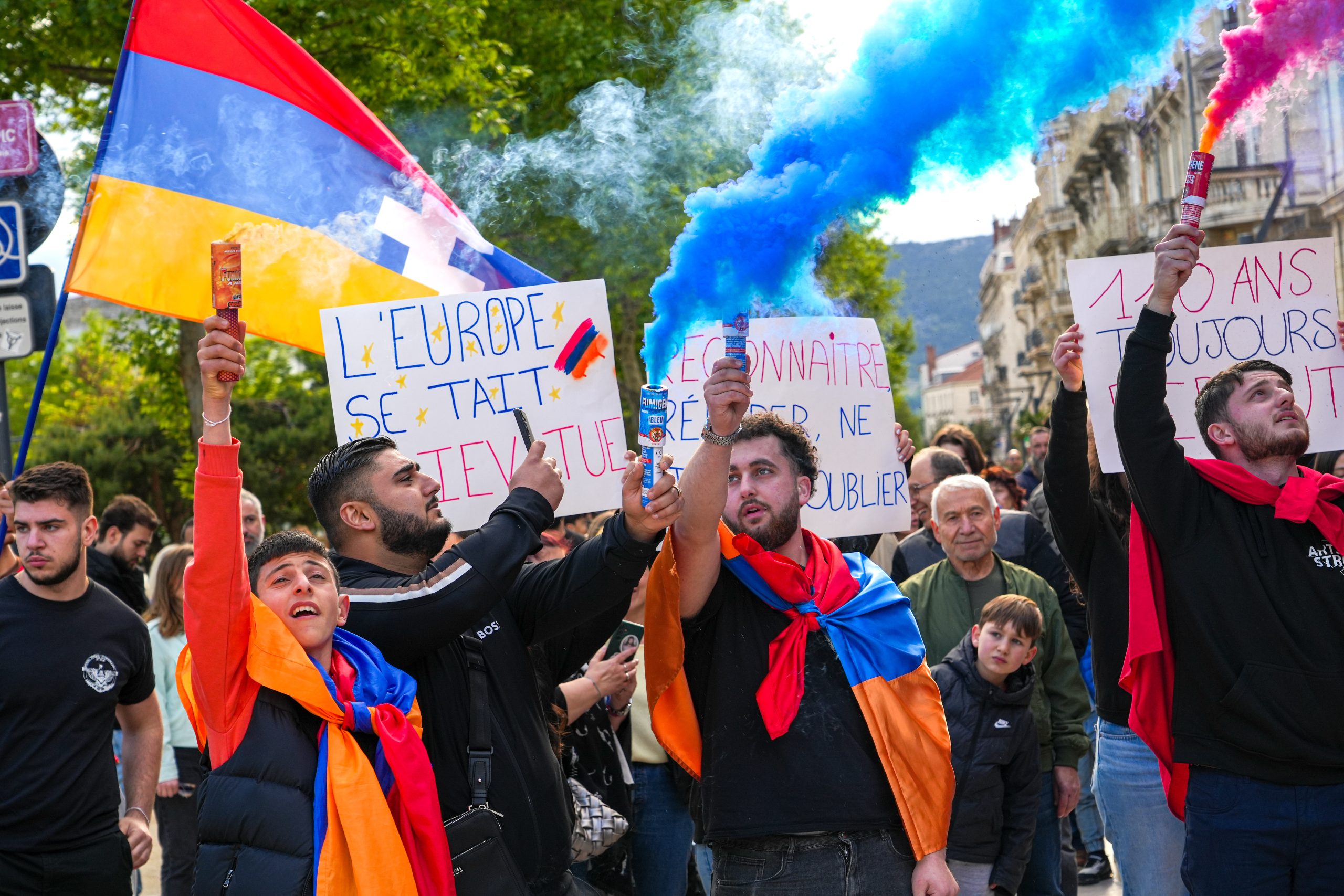
BANNER: Armenian Genocide commemoration in Valence, France, April 24, 2025. Nicolas Guyonnet / Hans Lucas via Reuters Connect.
Before Armenia’s June 7, 2026, parliamentary elections, political content circulated in Armenian diaspora Facebook groups. This report analyzes what messages were disseminated in these groups and whether any of these messages were coordinated. Our analysis showed that a relatively small number of accounts produced a large share of posts in these groups, and most of the accounts we documented and their messages were critical of the Armenian government. We also found a network of seemingly inauthentic accounts that promoted opposition leader Gagik Tsarukyan and his political party.
Armenian citizens were not allowed to vote from abroad in the June election—except diplomats and military personnel serving abroad and their family members, who could vote electronically. To vote on the election day, other Armenians living abroad needed to be in Armenia. So most members of the analyzed Facebook groups could not vote in June unless they traveled home. However, political messaging in these groups could still have several other purposes in the context of elections, such as influencing relatives and networks inside Armenia, mobilizing the diaspora to travel home to vote, shaping how diaspora members saw the election, and increasing divisions between the diaspora and the government.
Our data essentially capture how online accounts politicized diaspora issues by using vocabularies of belonging and identity and instrumentalizing the inner tensions within these globally dispersed communities—a dynamic by no means unique to Armenia. In this respect, the Armenian case exemplifies a broader aspect of homeland politics: the diaspora constitutes a reservoir of legitimacy, resources, and grievance that electoral competition (domestic and foreign alike) has learned to address.
Corpus of analyzed posts and research methodology
Our Facebook data corpus comprised 204,552 posts collected from eighty-three public Armenian diaspora groups that, based on the group names, signaled they were for the Armenian diaspora. The posts spanned March 1–June 18 (days after the elections) and were produced by 7,395 distinct authors. Meta’s Content Library was used to identify Facebook groups from which to collect messages and Apify was used to scrape messages from those groups. Two groups were covered only from later dates (March 24 and May 12), as it was not possible for the Apify team to scrape earlier content from them. The five largest groups by membership contained 31 percent of all posts and the ten largest held 49 percent. The most active 1 percent of authors produced 38 percent of the posts and 30 percent of authors posted in more than one group, with 7.7 percent active in five or more. Almost two-thirds of posts (65 percent) were reshares with little or no text of their own. Only 12 percent received any comment and the mean was 0.6 comments per post. Posts deleted before collection were not included in the data.
This report names accounts but not the people behind them. Accounts that appear to belong to real individuals are shown with a pseudonymous code (for example, “account 7QKD”) instead of their name. Each code was derived from the account’s fixed platform identifier, not from its display name. The same account is therefore identified by the same code throughout the report. This is pseudonymization rather than anonymization. The research team did not pseudonymize seemingly inauthentic accounts.
Thematic focus of the discussions in diaspora groups
We began with a broad view of how Armenian communities abroad were addressed in these groups, which we call community signaling: the ways posts invoked, appealed to, and mobilized the diaspora both directly and indirectly. Direct references capture the explicit vocabulary: սփյուռք/սփիւռք (spyurk, whose reformed and classical spellings are themselves indicative of provenance—Armenia- and Russia-based rather than Western diaspora production), գաղութ (gaghut, the older Western term for a diaspora community), արտերկրի հայեր (“Armenians abroad”), диаспора, соотечественники (“compatriots,” the term the Russian state applies to co-ethnics abroad), and Latin-script diaspora and spyurk. Indirect references include five ways through which Armenian communities abroad are reached: homeland and compatriot appeals (e.g., հայրենիք, հայրենակից, repatriation), community and organizations (e.g., the Armenian General Benevolent Union, the Hamazkayin Armenian Educational and Cultural Society, the Armenian National Committee of America (ANCA), the Armenian Revolutionary Federation (ARF/Dashnaktsutyun), and Armenian schools), the church (e.g., the catholicos, the liturgy, the dioceses, and Etchmiadzin—the Apostolic Church’s seat and spiritual center), donations and remittances (e.g., fundraising, telethons, monetization channels), and calls to participate in the election. A further set of contextual references captures the setting rather than the audience: genocide memory (the year 1915, the annual Remembrance Day on April 24, Tsitsernakaberd), Artsakh (Karabakh), the government, the opposition, Russia, and the West (the United States, European Union, NATO, the TRIPP (Trump Route for International Peace and Prosperity) Corridor). Their role is interpretive and, read against them, a diaspora reference reveals itself as commemorative, humanitarian, or partisan, disclosing the geopolitical orientation a post might carry. Together, direct naming, indirect community signaling, and contextual vocabulary map who is addressed and in what setting.
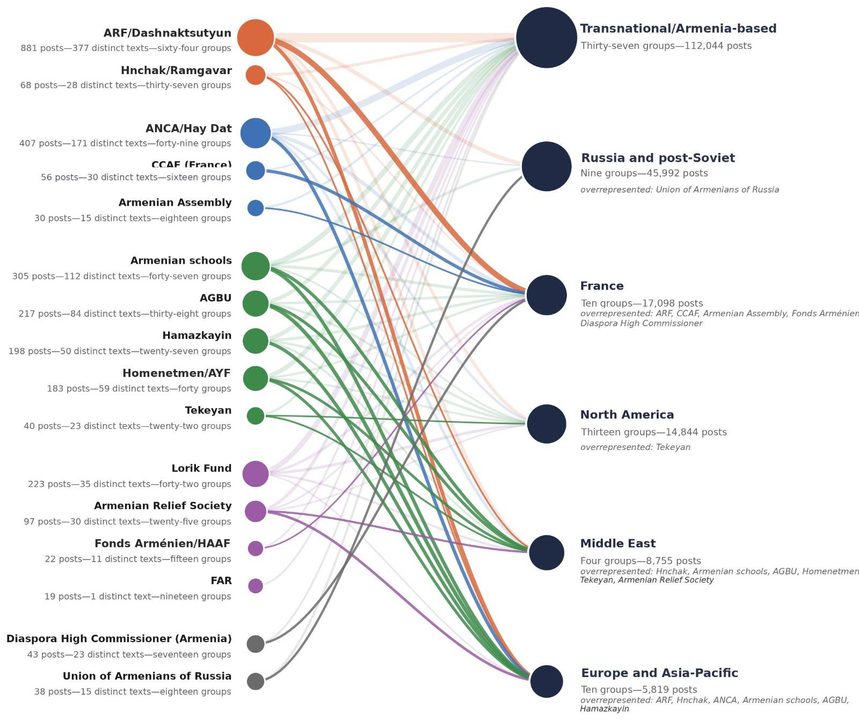
References to specific topics spiked around certain events in the pre-election period. We flagged a spike when the number of distinct posts referencing a vocabulary category on a given day reached at least twice that category’s baseline—its median daily output of distinct texts over the preceding fourteen days—so reposting alone did not register as a spike. The same measure applied to the diaspora category itself: posts that directly named or addressed the diaspora, in text or hashtags, in any script (Armenian in both reformed and classical spelling, Russian and Latin transliteration), so a spike in references to the diaspora marked a genuine surge in texts invoking or mobilizing the community. In mid-March, genocide vocabulary nearly tripled its typical daily level of the previous two weeks (x2.9), driven by Tehlirian anniversary essays and claims that the Armenian Genocide Museum’s Artsakh section would close. Artsakh vocabulary surged on a single account’s claim, reposted in eight groups, that schools in the region were closed “to accommodate 300,000 Azeris.” On April 2–3, Russia vocabulary reached its first peak (x3.8) around the meeting in Moscow between Armenian Prime Minister Nikol Pashinyan and Russian President Vladimir Putin. The rally in support of the Armenian Apostolic Church held outside Armenia’s embassy there, and the claim that Putin called opposition leader Samvel Karapetyan “his man,” echoed in online groups. The Paris Spyurk Conference drove references to the diaspora (x2.7) and community and organizations (x2.8) families between April 11–14. The 111th Genocide Remembrance Day on April 24 produced the strongest spike in the corpus (x13.9), with direct diaspora references also reaching their highest point that same day. A donations spike (x2.4) followed on May 15, with calls to raise funds for monastery renovations and for Armenian soldiers who had been held captive and released. The key issues analysis below reverses the lens, classifying not how the diaspora is reached or the mode of address but which political subjects the groups discussed.
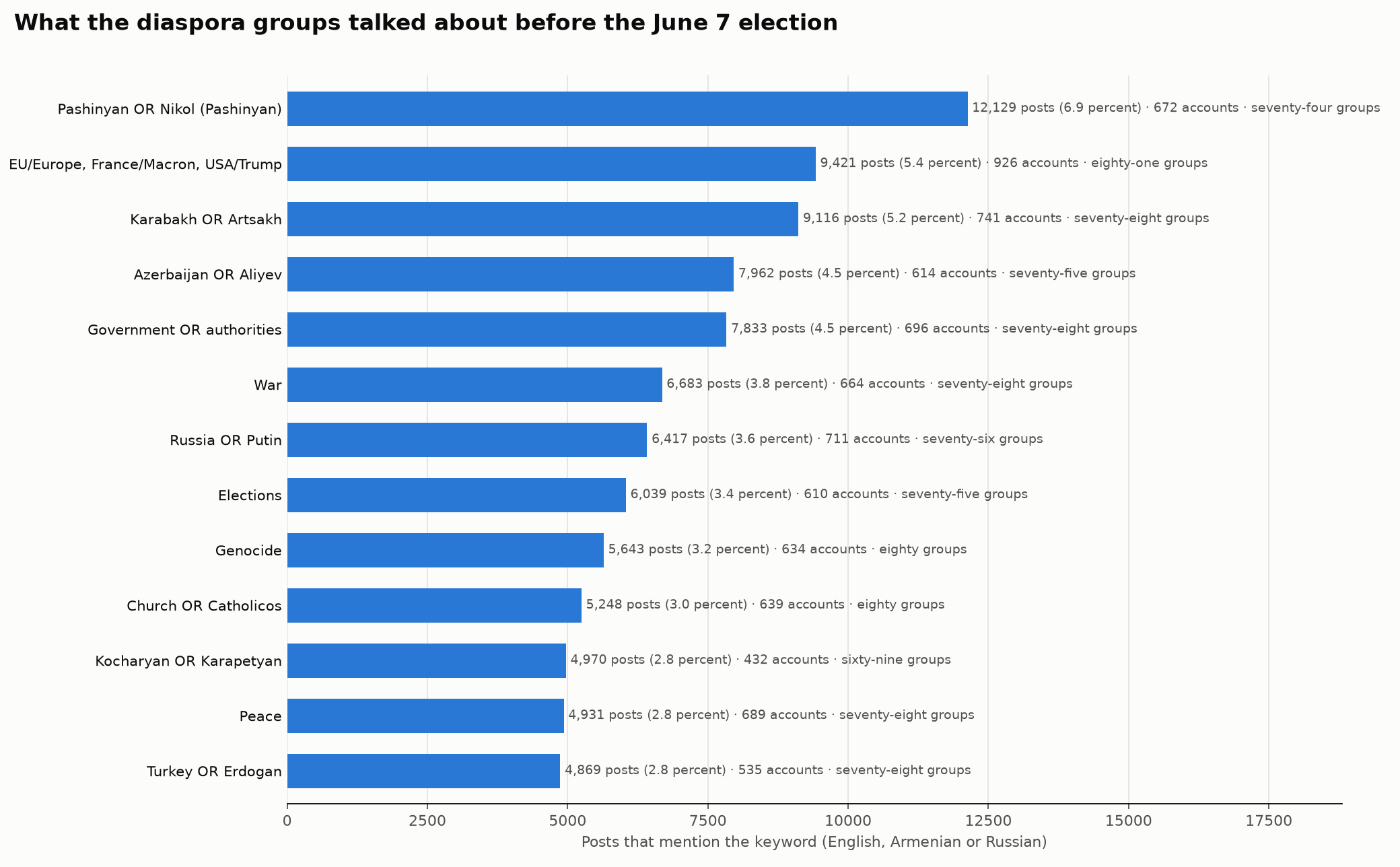
Within this broader picture, we narrowed the focus to thirteen key political issues (mentioned as key issues in this text) and counted the posts that mentioned each one. Therefore, the list reflects our own selection of topics and each issue is a keyword or set of keywords in English, Armenian, and Russian. A post counted when a keyword appeared in its text or in the text of a post it shared. A post could mention several issues, so the percentages sometimes overlap. Notably, we counted how often each issue came up, not whether a post took a specific side of an issue.
To see whether political messaging was directed toward the upcoming elections, we first focused on posts published before the election day. Before the June 7, 2026, parliamentary elections, posts in the eighty-three diaspora Facebook groups focused on Armenia’s leadership and its conflict with Azerbaijan. Of 175,797 posts published between March 1–June 6, 2026, Pashinyan was the most mentioned topic, followed by the Western states and their leaders, Nagorno-Karabakh or Artsakh, and Azerbaijan or Aliyev. These topics appeared in 4.4–6.9 percent of analyzed posts. A second tier of keywords each appeared in 3–4 percent of posts: war, Russia, Putin, elections, and the genocide. After them came the church, the catholicos, opposition leaders Robert Kocharyan and Samvel Karapetyan, peace, Turkey, or Turkish Prime Minister Recep Tayyip Erdogan, each appearing in just below 3 percent of posts.
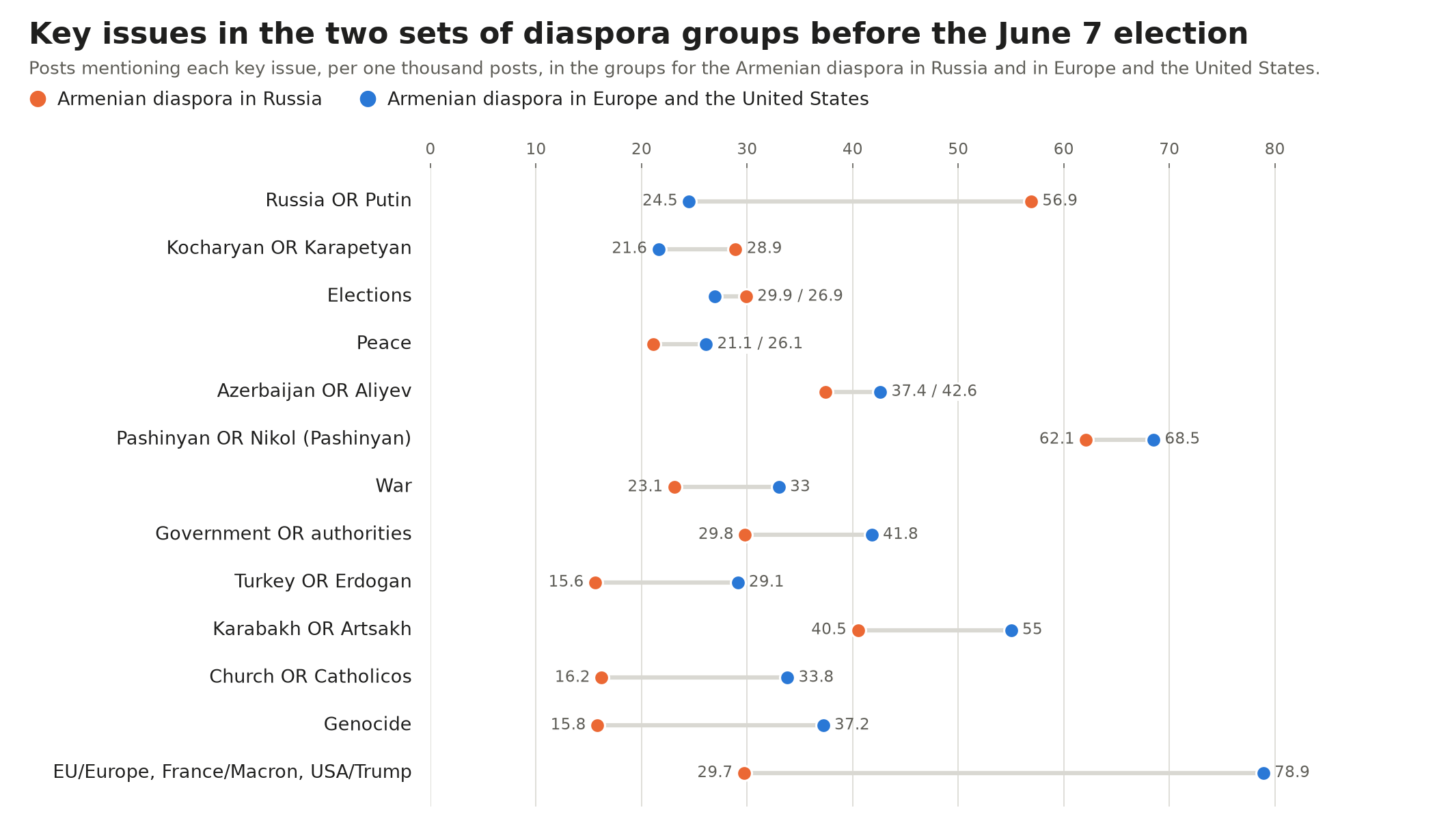
We then compared two sets of Facebook groups. The first set consisted of groups for the Armenian diaspora in Russia; for this we selected eight groups with 39,477 posts. The second set consisted of thirty Facebook groups for the Armenian diaspora in Europe and the United States, with 32,788 posts published in these groups in total. We selected groups that mentioned the specific location in their names (e.g., Armenians in Moscow or Armenians in France). Post counts covered March 1–June 6, 2026, and included each post or share placed in a group; the original posts were not counted separately. We measured how often each key issue appeared in the two sets of groups. For this comparison, we counted the posts published in each set between March 1–June 6, before the June 7 elections.
A post counted if one of the issue’s keywords (in English, Armenian, or Russian) appeared in its text or in the text of the post it shared. For example, the genocide was mentioned in 622 posts in the Russia groups and in 1,221 posts in the Europe and US groups. The two sets had different numbers of posts, so we could not compare these counts directly. Instead, we calculated how many posts per one thousand mentioned the issue. We divided the count by the total number of posts in the set and multiplied by one thousand (for the Russia groups, 622 ÷ 39,477 × 1,000 = 15.8; for the Europe and US groups, 1,221 ÷ 32,788 × 1,000 = 37.2). Thus about sixteen of every thousand posts mentioned the genocide in the Russia groups, compared to about thirty-seven in the Europe and US groups. One post could mention several issues, so the rates for different issues cannot be added together.
Beyond what these groups discussed, we also looked at how the diaspora was mobilized, specifically how the vocabulary of belonging—such as homeland, compatriot, church, and remembrance—became the channel through which the elections and its competing actors (parties, candidates) reached the diaspora. To capture electoral mobilization and calls for participation, we isolated posts that combined diaspora references and identity vocabulary with political vocabulary, whether those posts came from parties, candidates, supportive organizations, or any type of political or electoral positioning featured in the corpus. Dynamics were mapped against three periods: early spring (March 1–April 19), coinciding with the April 24 genocide commemoration window, the campaign proper (May 1–June 6), and the post-elections window (June 7–18 June), interspersed with events identified from the corpus.
The share of diaspora-related posts carrying any political messaging rose steadily from 30 percent in early spring to 54 percent after the vote. The messages fit several categories. Some treated the diaspora as an electorate to be mobilized (by returning to Armenia to vote) while others mirrored them by discouraging that same return and were aimed particularly at Armenians resident in Russia, whose arrival was cast as pro-Russian and opposition interference (one post said, “if you come to Armenia to vote, remember why you left”). Some treated diaspora rights as a grievance (focusing on disenfranchisement, entry bans, and the “foreign agents” label) and the church as the diaspora’s anchor against the government. Others addressed: competing political parties posing as diaspora champions, Kocharyan most systematically; the contest over who speaks for the diaspora, centered on tensions and debates within the community regarding the ARF’s Diaspora Mobilzsation Conference in Paris; diaspora money recast as vote buying; and geopolitical orientation, from Armenia’s neutrality to Russia and the West.
The diaspora was also mobilized as a political resource. References to the opposition bloc National Democratic Pole were highly concentrated. Of 403 posts in twenty-five groups, roughly half came from a single amplifying account posting in the pan-diaspora groups, which was linked to the party’s page and its affiliated US organization, the National Democratic Alliance. The content focused on campaign infrastructure: political fundraising appeals among the US-based diaspora as well as self-reported outreach to US officials (e.g., meetings with the US Congress). Activity peaked in the final fortnight before the elections and stopped after the vote. The same pattern appeared in a general-purpose diaspora Facebook group (“Armenians of All Countries, Unite”) in which the opposition was named twice as often as in other Facebook groups (10.2 percent against 5.8 percent). One-third of its diaspora posts joined identity with political and electoral vocabulary, and nine in ten posts circulated verbatim through a Russian-language reposting network—“ЕСЛИ ЛЮБИШЬ АРМЕНИЮ,” “Armenians of the World,” “Hayer Moskvayum,” and the Moscow groups—which functioned as a relay for the opposition parties and their campaign material, from the National Pole’s campaign declaration to content about Kocharyan and Tsarukyan’s Prosperous Armenia party.
A set of posts in this stream focused on the free-transport allegation and captured the Facebook propagation layer. On March 15, a post titled “Armenians of Russia, attention” invited “those who want to take part in the elections but lack the means” to write to a Telegram contact: “I will try help everyone . . . on 7 June we must all be in Armenia.” This was a reshare of a post by Mika Badalyan, a vocal representative of Evrazia’s Armenian office, the sanctioned organization linked to pro-Russia fugitive oligarch Ilan Shor, and was published earlier on Telegram. The diffusion pattern was also revealing. Identical text appeared within a single day across five groups in the same reposting network.
Analyzing the ten widest-reaching key issue accounts
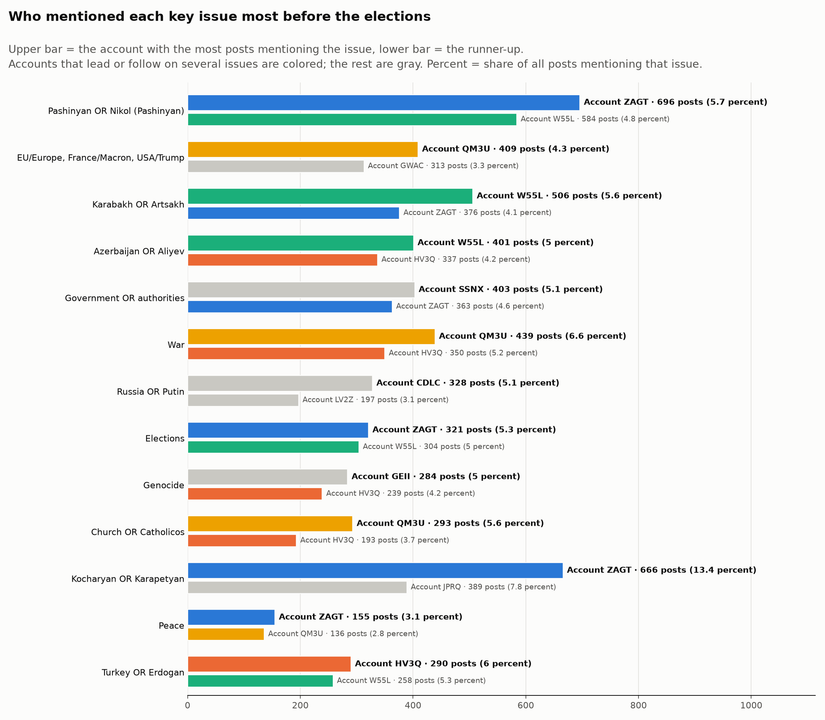
Before the elections, the same few accounts dominated the conversation about most key issues. Account ZAGT appeared six times and had the most mentions of Pashinyan (696 posts), the elections (321), Kocharyan and Karapetyan (666), and peace (155). Account W55L appeared five times and led on mentions of Karabakh (506) and Azerbaijan (401). Account HV3Q also appeared five times and led on mentions of Turkey (290). Account QM3U appeared four times and led on mentions of the West (409), war (439), and the church (293). Even these leaders accounted for only a small number of posts about each issue, usually 3–7 percent of the posts mentioning it. The exceptions were Kocharyan and Karapetyan, as 13.4 percent of posts by account ZAGT and 7.8 percent of posts by account JPRQ were about them.
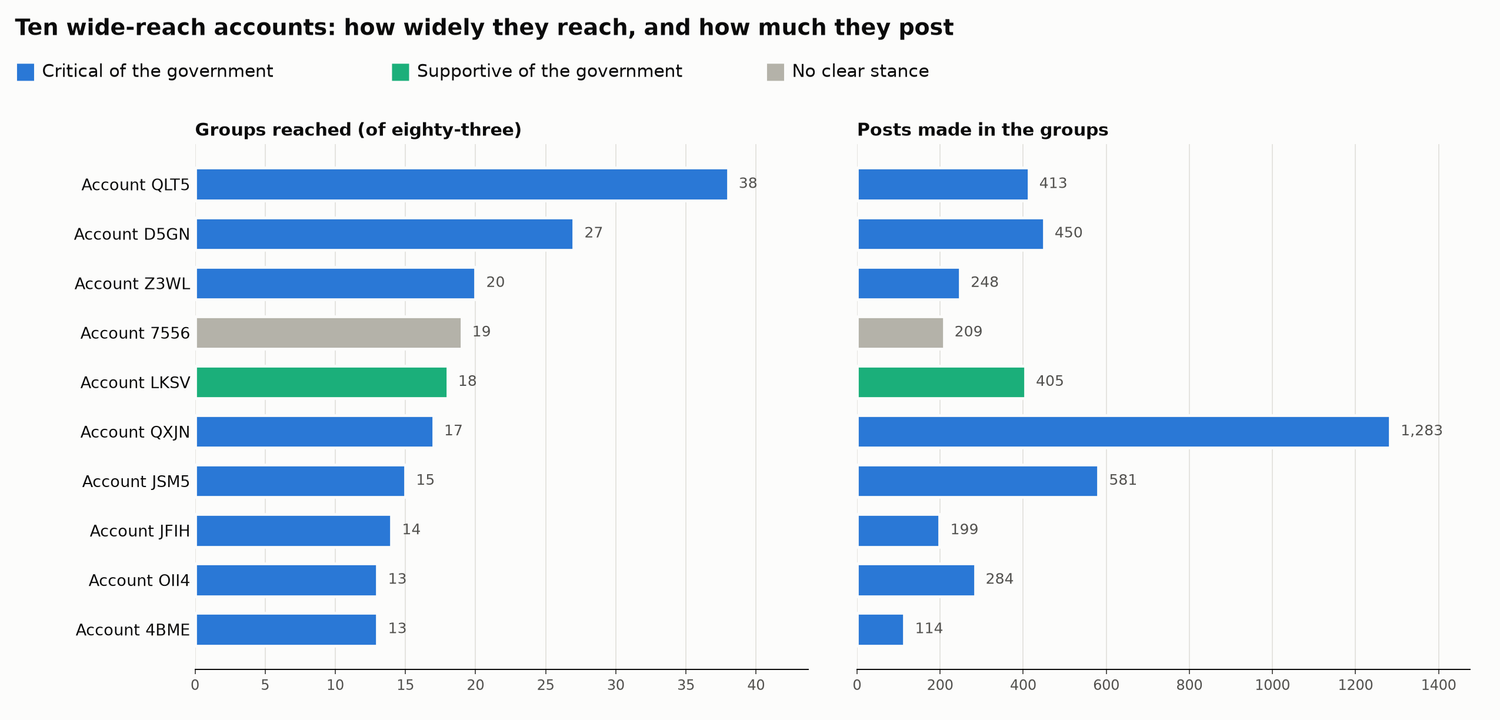
After that, we took the accounts whose posts most often mentioned the key issues (in English, Russian, or Armenian) and selected the ten among them that reached the largest number of groups. None of the ten accounts reached even half of the eighty-three groups: the widest reach was thirty-eight groups and the next was twenty-seven groups. For example, account QLT5 posted in thirty-eight groups in our dataset, account DSGN posted in twenty-seven groups, etc. Reach across groups and volume of posts are different things; the account with the most posts (1,283 in total) reached only seventeen groups, while the widest-reaching account posted 413 times but reached thirty-eight groups. Based on our reading of their posts, most of the ten widest-reaching accounts were critical of the Armenian government. Only one wrote against the opposition and one did not show a clear political stance.
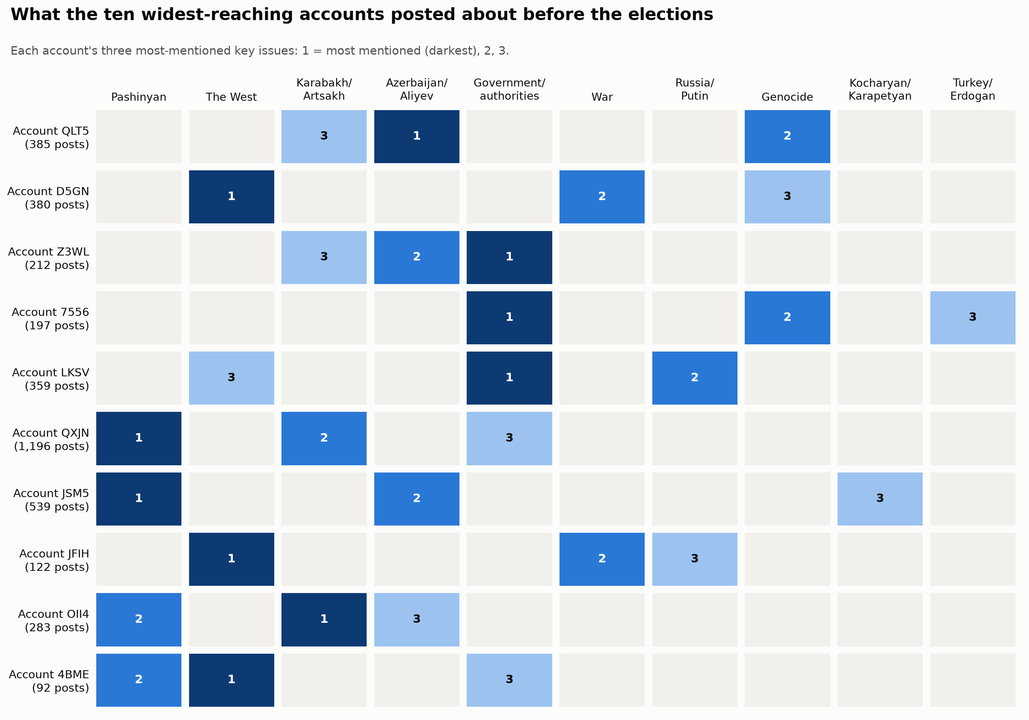
The ten widest-reaching accounts, as shown in the chart above, wrote about a few main themes. The most mentioned was Pashinyan, followed by the government and authorities, Nagorno-Karabakh or Artsakh, and the Armenian Genocide. Most of the posts came from a few accounts: account QXJN wrote 1,196 of the 3,765 posts from all ten accounts and these posts mentioned key issues. Account QLT5 posted about Azerbaijan and Aliyev together with genocide-related content. Accounts OII4 and Z3WL posted anti-government content. Account 7556 posted about the genocide and Turkey and Erdogan, connecting them to historical memory more than to the current election campaign. Account LKSV described the opposition as dependent on post-Soviet oligarchic networks linked to Russia. The chart below shows how often key issues were mentioned, not what position the accounts took.
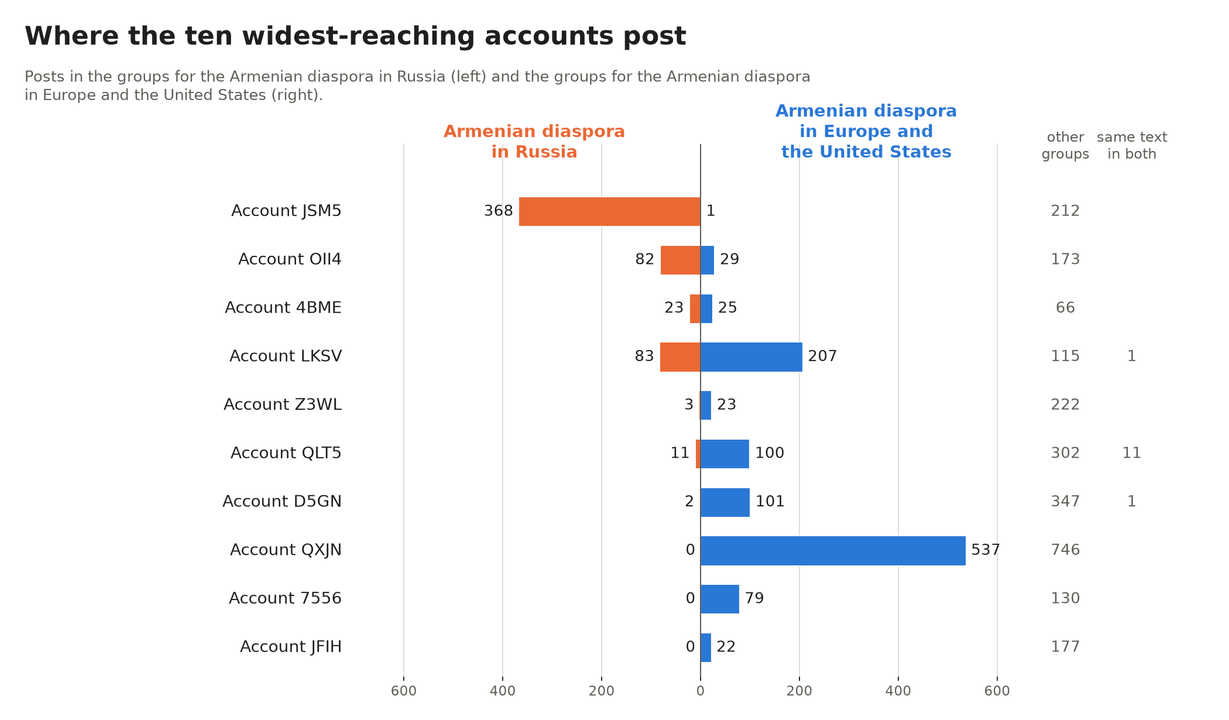
We also checked where these accounts posted—in the groups for Armenian diaspora in Russia or in the West. Our analysis found that most of the ten accounts posted mainly in groups for the Armenian diaspora in Europe and the United States—and seven of them posted in both those groups and Russia groups, mostly in the same language. Three accounts never posted in the Russia groups, and three did so only 2–11 times. Account JSM5 posted almost exclusively in the Russia groups. Account LKSV posted eighty-three times in the Russia groups and 207 in the Europe and US groups, OII4 posted to those groups eighty-two and twenty-nine times, respectively, and 4BME posted twenty-three and twenty-five times.
The posting pattern across these groups suggests that the accounts that showed the widest reach worked mainly in the groups for Armenians in Europe and the United States. Only one account focused mainly on the groups for Armenians in Russia. However, the research limitation here was that we chose accounts that reached many groups, and the Europe and US set had more groups. Therefore, accounts leaned toward these groups by definition.
Account QLT5, the widest-reaching account in our dataset, published 413 posts in thirty-eight groups. Most of this (84 percent) was shares from a Global Peace International page belonging to the account owner’s organization; posts from this page carried the account’s own English-language analyses. The account’s posts argued that Armenia’s leadership was surrendering to Azerbaijan, described the TRIPP transit route as “de facto surrender,” and “Western Azerbaijan” was the next step after Artsakh. The posts were strongly critical of Pashinyan’s government, and a Facebook post published on April 27 criticized him for condemning the burning of Turkey’s flag.
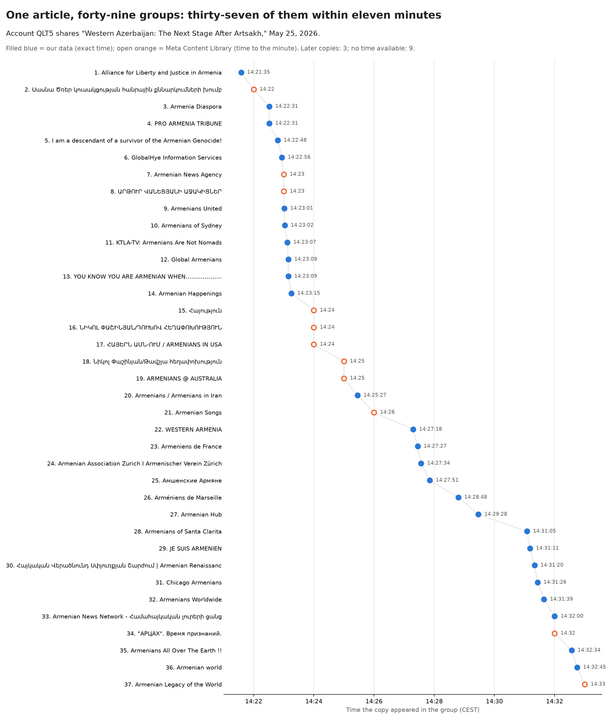
The account published identical posts in many groups within minutes. On May 25, one article about Western Azerbaijan was posted in at least forty-nine groups—in thirty-seven of them within eleven minutes. Posts often appeared seconds apart; in two cases, the same article was posted in the same second. This speed can be achieved by using Facebook’s built-in multi-group sharing or posting tools, but our data could not confirm which of these the account used. While we found this article in forty-nine groups, our data did not include posts from all groups, so we used Meta Content Library to find copies in others. We had a posting time for forty of the forty-nine copies: thirty-seven were posted within eleven minutes and three later. Our data gave exact times, and the Meta Content Library gave them to the minute. For nine copies, we had no time because the posts had been removed before we analyzed them.
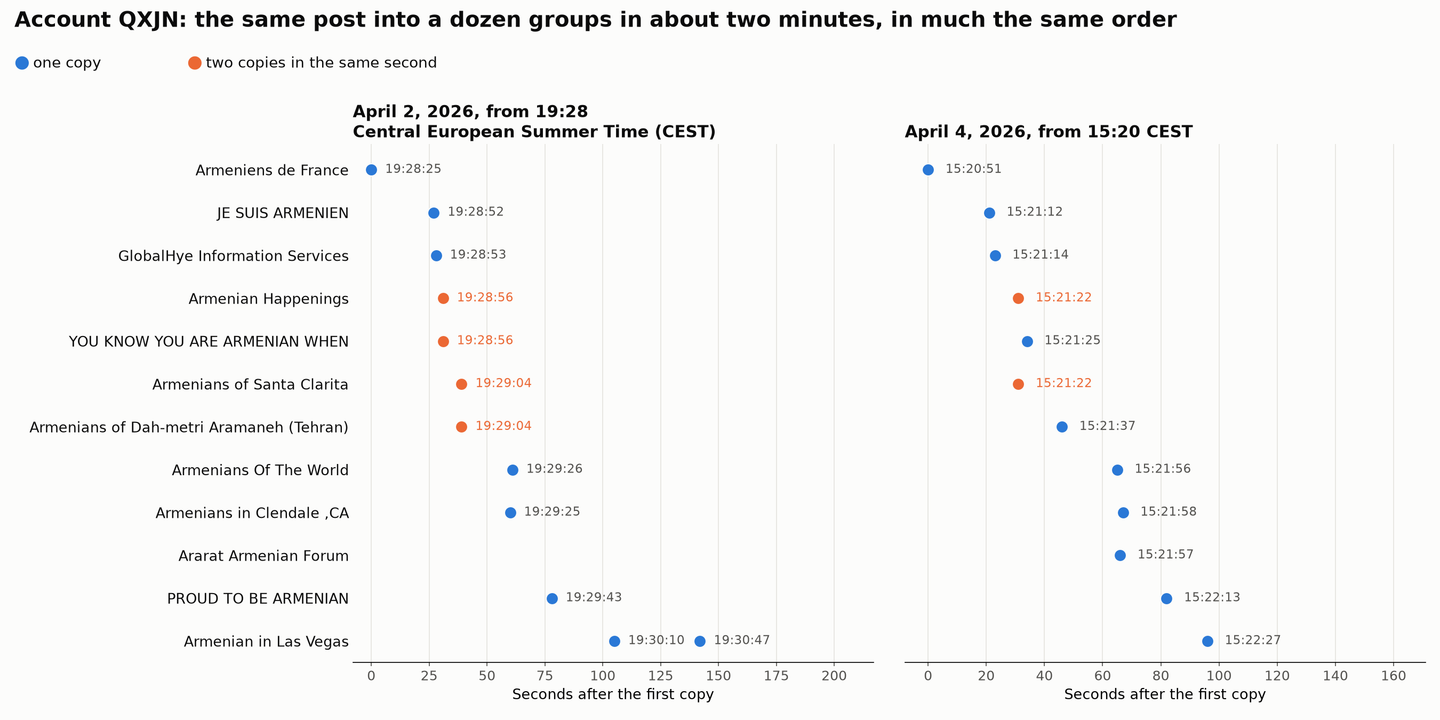
Another account, QXJN, was the heaviest cross-poster in this set, with 1,283 posts published in seventeen groups. This account pushed key issues posts most widely. Posts were critical of Pashinyan. Some posts reached two groups within the same second, which suggests the use of Facebook’s multi-group sharing or posting tools. Moreover, the account was the single most active poster in three of the analyzed groups: it wrote 84 percent of all posts in a small Tehran-based group, and it posted more than any other member in two larger groups (17 percent of 898 posts and 15 percent of 550 posts).
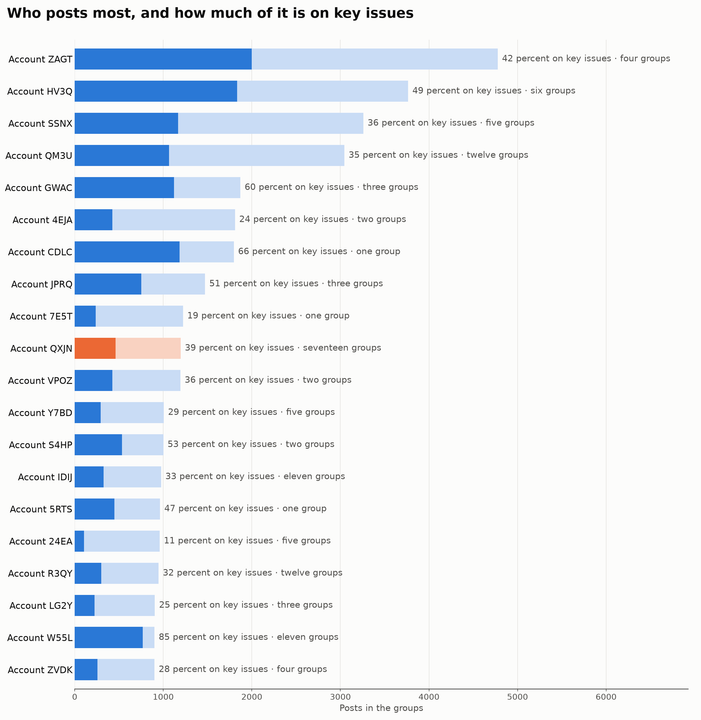
Our research also showed that ahead of the election, a relatively small set of accounts produced a large share of posts about the key issue—as a result, posting activity in the analyzed groups was highly concentrated. Twenty of the 6,586 active accounts, fewer than 0.4 percent, published almost 20 percent of all posts before the election day (33,969 of 175,797). These heavy posters also focused on the key issues we covered: 41 percent of their posts mentioned at least one of the thirteen key issues.
However, the volume of posts is not the same as the reach of groups. Only one of the twenty heavy posters (account QXJN) was among the ten widest-reaching accounts by groups, and most of the heaviest posters (fourteen of twenty) stayed in one to five groups. So there were two different patterns: accounts that were loud in a few groups and accounts spread thinly across many.
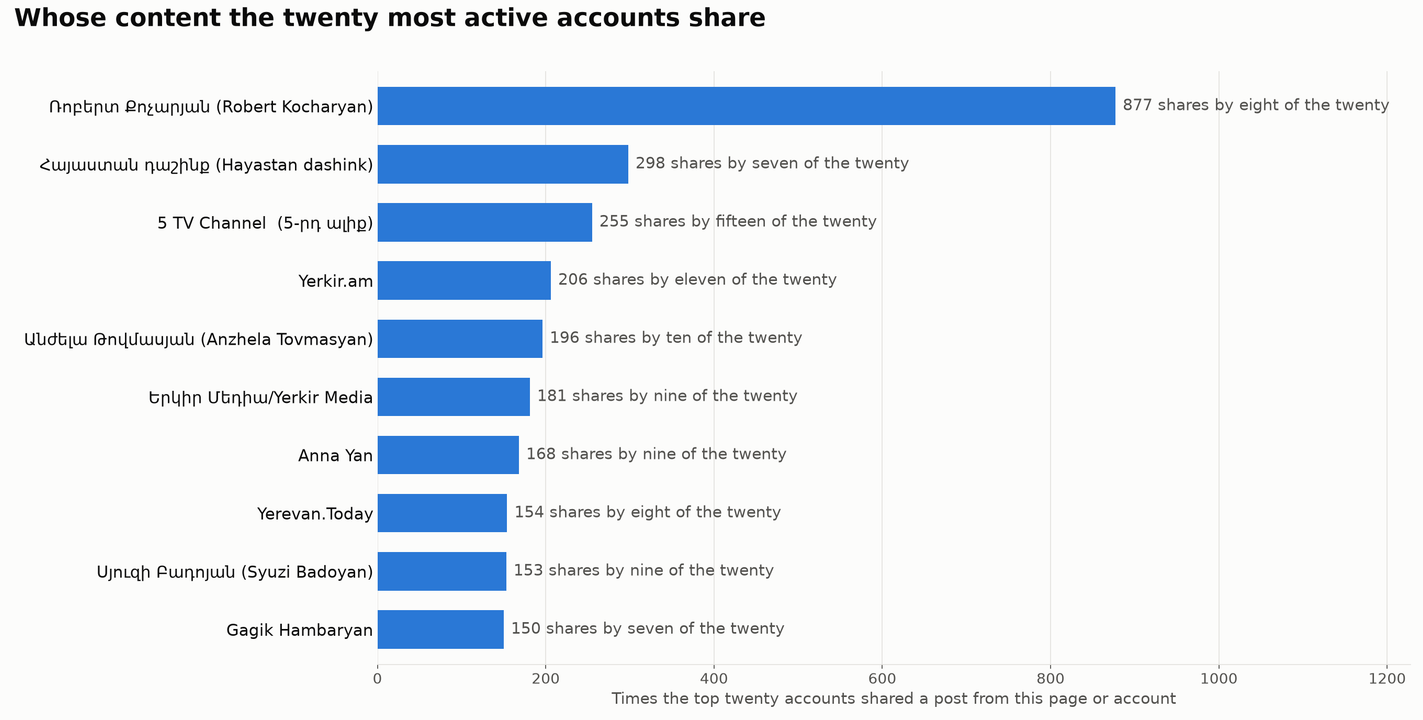
We also examined the sources that were shared by these heavy posters and found that Facebook assets of former President Kocharyan and his Armenia Alliance were shared most frequently. Kocharyan’s Facebook page was by far the most shared source, with 877 shares from eight of the twenty heavy-poster accounts. The Armenia Alliance’s Facebook page, Հայաստան դաշինք, came second with 298 shares. The third most shared asset was pro-opposition 5th Channel, which was shared by fifteen of the twenty accounts (more widely than any other source). Two outlets affiliated with the Armenian Revolutionary Federation (Dashnaktsutyun) political party, Yerkir.am and Yerkir Media, were shared 387 times combined. Heavy posters also shared content from pro-Russian outlet Yerevan.Today, whose shared posts mostly covered Kocharyan’s campaign. Another widely shared figure was Anzhela Tovmasyan from Hayeli Club, an Armenian media platform that frequently hosted opposition politicians, political commentators, and public figures critical of the government. Other sources shared by the top twenty included pro-opposition journalist Syuzi Badoyan and government critics such as political commentator Gagik Hambaryan and social media influencer Anna Yan (Anna Oganezova). Thus, the available evidence indicates that the twenty most active accounts mostly amplified content from anti-government and pro-opposition sources.
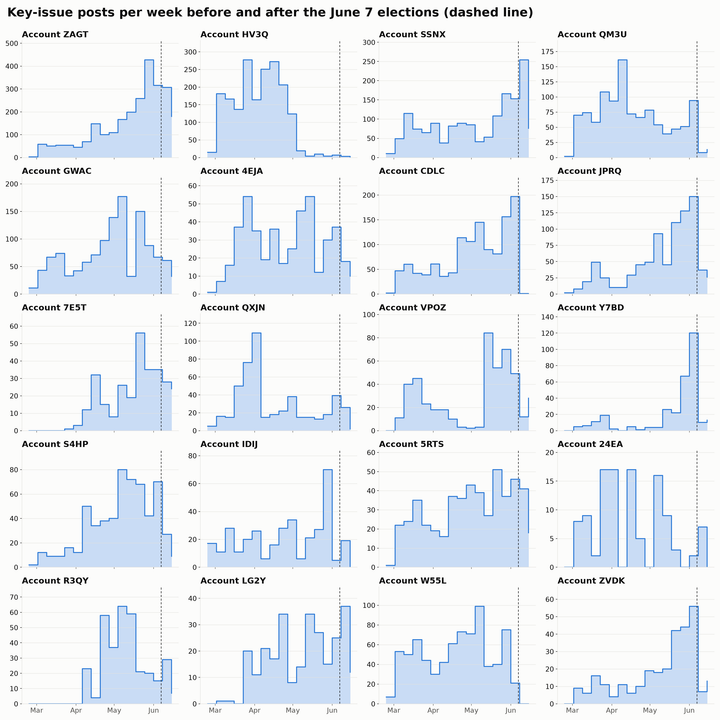
Most of the twenty heavy posters published more about key issues as the election drew closer. In the last three weeks before June 7, fourteen of the twenty accounts posted at least 50 percent more key-issue posts per week than in March. For several accounts, the number of key-issue posts increased five to seven times. After the election, the accounts went in different directions. Eight accounts reduced the number of key-issue posts significantly in the ten days after the vote, and some completely stopped posting about key issues. Some accounts kept posting at about the same level, including the most active account (account ZAGT). For most of these accounts, key-issue posting was aligned with the election calendar: it rose before the vote and, for many, fell sharply afterward.
Inauthentic network promoting Tsarukyan and his Prosperous Armenia political party
We also found a network of seemingly inauthentic Facebook accounts that promoted opposition party leader Tsarukyan. The network consisted of two clusters—the first cluster included eleven accounts and the second cluster included six accounts. These accounts did not contain much personal information about the owners. Some of them used profile photos taken from various websites online (here and here) and they all posted nearly identical content about Tsarukyan.
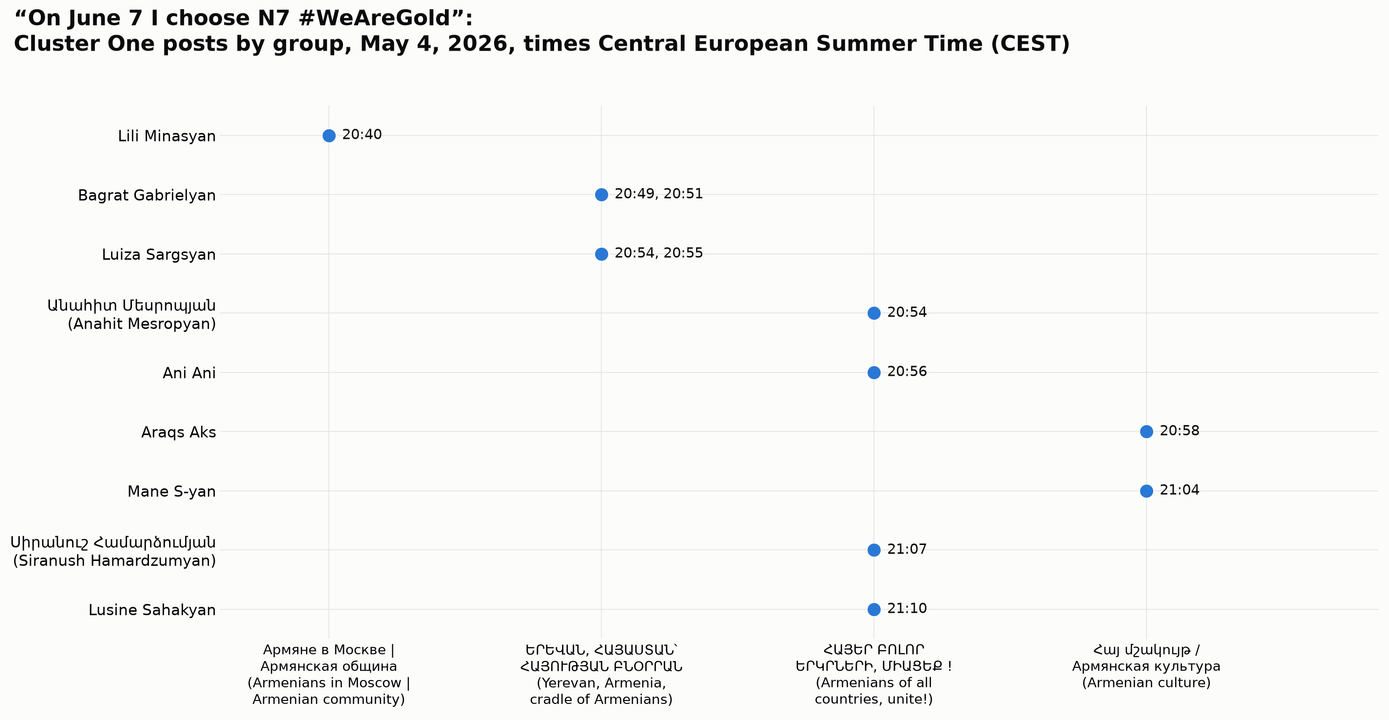
On the evening of May 4, 2026, ten accounts from the first cluster posted the same slogan, “Հունիսի 7-ին ընտրում եմ N7 #գոլդ_ենք” (“On 7 June I choose N7 #we_are_gold”). Between 20:40 and 21:13 CEST, they posted fifteen copies of this post into six diaspora groups. Every post had the same wording and hashtag, and each account posted the text as its own post without sharing from other accounts. The accounts posted one by one rather than all at once. A new account picked up the text every two to four minutes. Most accounts used only one group, and each group was covered by its own small set of accounts. This suggests the groups were divided among the accounts.
Apart from this post, we also did a manual check of accounts and found one identical photo, featuring Tsarukyan and posted by eleven accounts on August 13, 2026 (here, here, here, here, here, here, here, here, here, here and here). Posts with this photo were not included in our scraped messages. Another cluster of six accounts also promoted Tsarukyan and his party. On May 25, all of them posted an identical image of Andranik Tevanyan, a candidate from Tsarukyan’s party who was arrested on May 23 and charged with “high treason and espionage” (here, here, here, here, here, here and here).
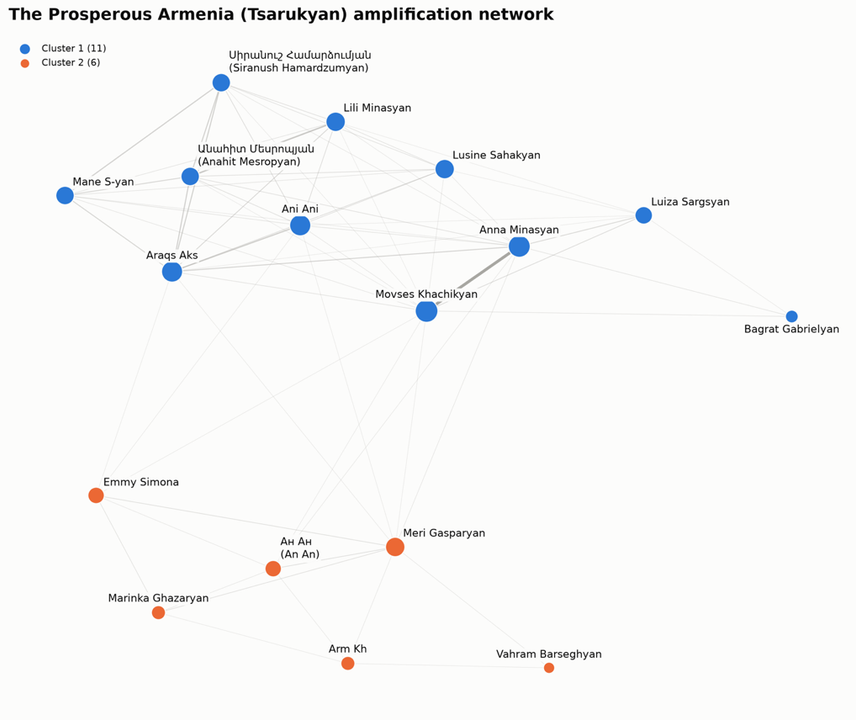
The graph shows the network’s seventeen accounts in two clusters: eleven in cluster one (blue) and six in cluster two (orange). A line connects two accounts when we found evidence that they posted together. This evidence is one of three types: sharing the same post within seconds or minutes of each other, publishing identical text with very short intervals, or taking part in the same wave of posting, meaning one post pushed into five or more groups within ten minutes. Thicker lines mean more of this evidence between the pair of accounts, and larger dots mean an account is linked to more of the other accounts.
Cluster two is looser and has thinner links. Meri Gasparyan is its most connected account; she is also the main bridge to cluster one. Several weak links join the two clusters. A few accounts, such as Bagrat Gabrielyan and Vahram Barseghyan, are connected by only two or three lines.
Conclusion
Before the June 7 elections, Armenia’s leadership and the conflict with Azerbaijan were the most frequently mentioned political topics in the Armenian diaspora Facebook groups we analyzed. A small number of accounts produced a large share of the conversation in analyzed groups. The most active accounts focused heavily on publishing posts about the key issues and mostly shared anti-government and pro-opposition sources. Most of their activity followed the election calendar. Most of the widest-reaching accounts were critical of the government and mainly posted in Facebook groups for the Armenian diaspora in Europe and the United States.
Contributors
Givi Gigitashvili (DFRLab)
Andra Martinescu & Marius Dima (Qriton Technologies)
Andreas Sjöstedt (Erebus)
Data collection: Matous Marik, Nashteh Mouradian, and Matyas Cimbulka (Apify)
Cite this case study:
Givi Gigitashvili, Andra Martinescu & Marius Dima and Andreas Sjöstedt “How political messaging spread in Armenian diaspora Facebook groups before the 2026 elections,” Digital Forensic Research Lab (DFRLab), November 4, 2026, https://dfrlab.org/how-political-messaging-spread-in-armenian-diaspora-facebook-groups-before-the-2026-elections