AI, memes, and hashtags: How China is battling the US online over Venezuela
Chinese state media and inauthentic accounts promoted narratives of US decline
AI, memes, and hashtags: How China is battling the US online over Venezuela
Share this story
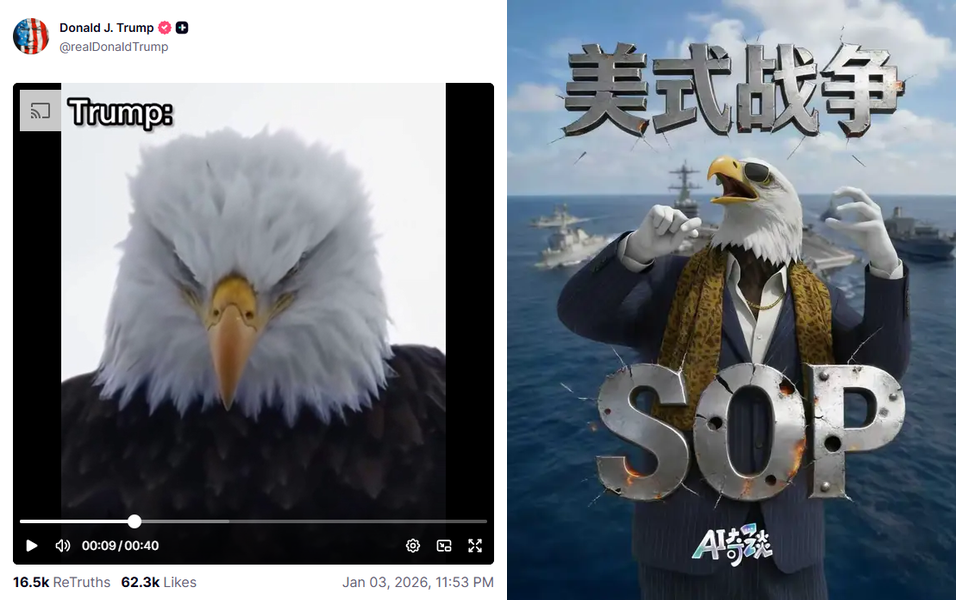
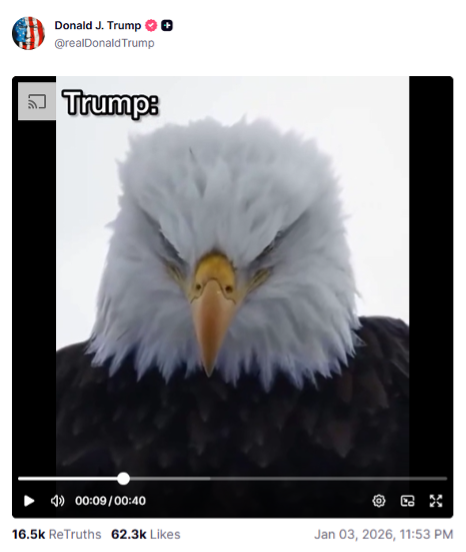
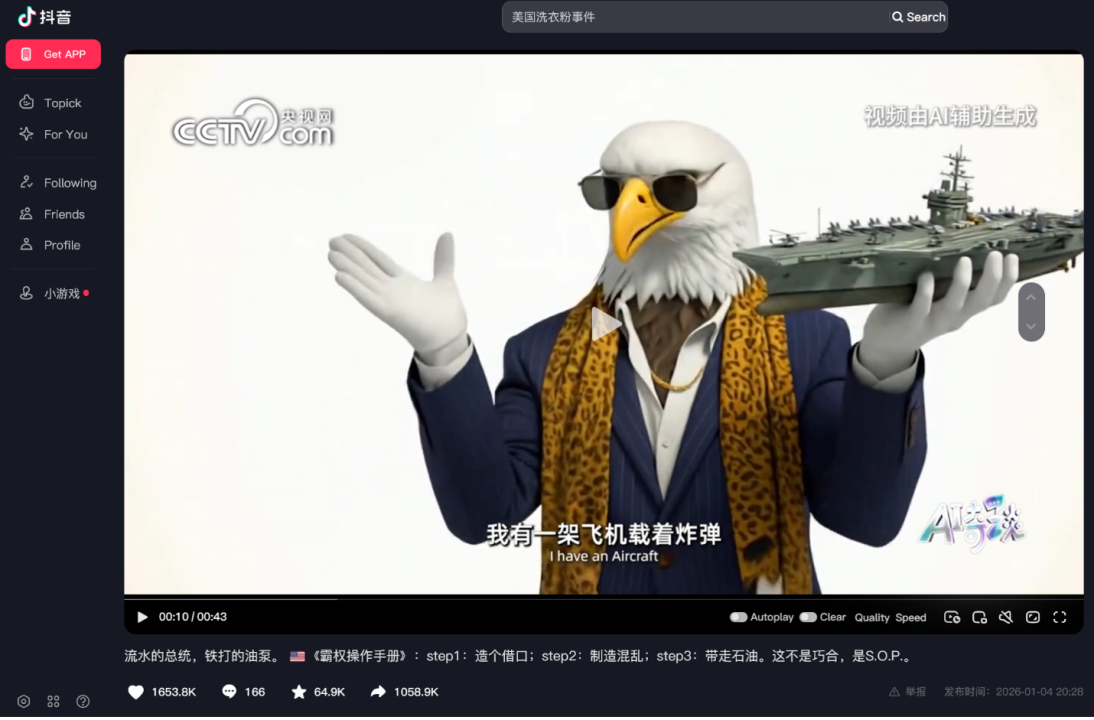
BANNER: Social media content shared by Donald Trump, left, and Chinese state broadcaster CCTV, right. (Source: @realDonaldTrump/Truth Social, left; CCTV/Douyin, right)
Chinese state-linked social media accounts deployed a unique strategic response to the US capture of Venezuelan President Nicolás Maduro: AI-generated meme content designed to undermine US credibility. State-linked actors engaged in memefied political dialogue, directly adopting the irreverent aesthetic that US President Donald Trump is known for using in his political messaging. This represents a new era of state-sponsored discourse, moving away from traditional messaging toward digitally native content optimized for meme culture and virality.
Beyond the immediate regional shockwaves that followed Maduro’s capture, the episode carries broader strategic significance, especially in Beijing. Chinese state-linked actors have used the incident to bolster narratives of the United States as an unstable and unreliable actor on the world stage, while Beijing is positioned as a stable force upholding the rules-based international order. Beijing’s emphasis is not simply on the legality of the strikes, but on the pattern they are said to represent—an America that acts unilaterally and leaves disorder in its wake. This is a storyline Beijing has refined over years of US military interventions, and the Venezuela operation reinforces this core strategic narrative.
“We have never believed that any country can act as the world’s police, nor do we accept that any nation can claim to be the world’s judge,” Chinese Foreign Minister Wang Yi said on Sunday.
China’s broader information ecosystem moved quickly to reinforce this strategic messaging. State-linked outlets and official commentators began shaping the familiar narrative: China as the defender of international law and multilateral norms, and the United States as a destabilizing, unilateral hegemon.
On the Chinese social media platform Weibo, hashtags referencing the Chinese foreign ministries’ responses to the US operation in Venezuela held the number one position on the hashtag leaderboards for many hours. The accompanying top posts repeated official statements opposing hegemonic actions against sovereign nations and calling for the immediate release of Maduro and his wife.
The top question on the Chinese question and answer site Zhihu (similar to Quora) asked, “Trump announced the arrest of the Venezuelan president and his wife, and the US Attorney General stated that they have been indicted in the United States. What does this mean? Why can the US arrest people so easily?” The page had been viewed over 43 million times at the time of writing. The top two answers highlighted the difficulties of China’s future cooperation with smaller countries and noted that regime change in Venezuela could result in a pro-US government.
Hours before his capture, Maduro posted on Instagram about a meeting held in Venezuela with President Xi Jinping’s Special Envoy for Latin America and the Caribbean, Qiu Xiaoqi. He captioned the post, “A fraternal encounter that reaffirms the strong bonds of brotherhood and friendship between China and Venezuela. All-weather strategic partnership!”
AI-generated political dialogue
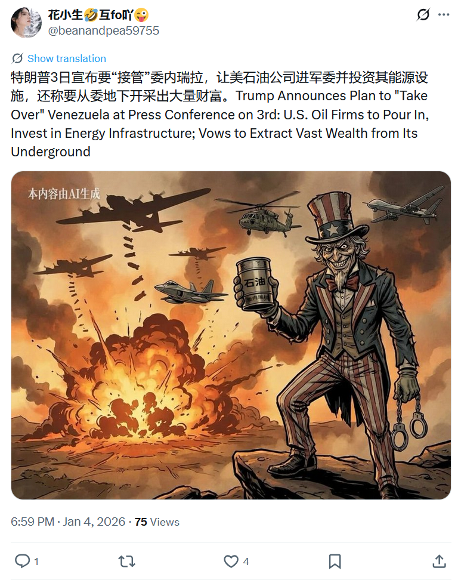
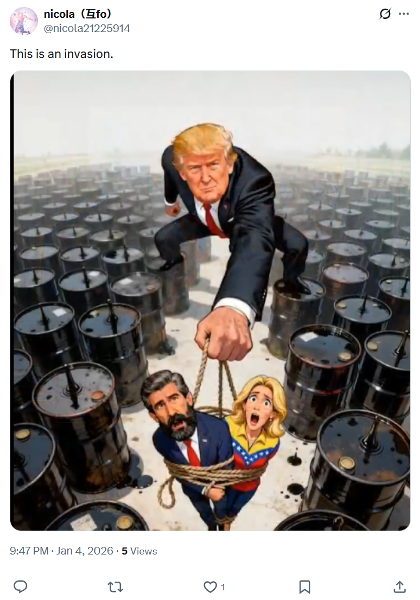
As the People’s Republic of China (PRC) condemned the US operation, inauthentic social media activity on X, likely linked to Chinese sources, helped boost this messaging. A dominant narrative promoted by various AI-generated media sought to pin the United States’ motives on oil extraction. The accounts sharing this narrative exhibited bot-like behavior, resembling the Chinese Spamouflage influence campaign, which the DFRLab previously documented. Hallmarks of the Spamouflage operation include posting political content interspersed with generic spam-like content.
Additionally, inauthentic X accounts promoted a video produced by the Chinese state broadcaster CCTV. The original video, initially published on Douyin (the Chinese equivalent of TikTok), features an AI-generated parody of a popular meme song that derides US foreign military interventions, citing Iraq, Syria, and Venezuela. The English-language meme video represents an attempt by Chinese state media to target international audiences. However, the video, which received over 2.1 million likes in China, received barely any organic traction on X. The video adopted the AI-fueled memeified form of political messaging favored by Trump in his Truth Social posts, signaling a new form of political dialogue that has emerged to serve digital audiences and chase virality.
China’s strategic opening
For China, the value of this episode is not about defending Maduro or endorsing his rule. Beijing will likely officially stay out of the matter of succession, though the toppling of a friendly partner in a country with a significant PRC presence, and a region where the PRC is aiming to deepen its strategic footprint, has no doubt shocked the leadership of China and will force a recalibration of its presence.
However, there is strategic value for Beijing in the diplomatic and narrative opportunity this represents. An opportunity to reinforce Beijing’s higher-order long-term goals. First, it strengthens China’s effort to undermine US alliances. From Beijing’s perspective, US alliance networks are the single most important structural obstacle to China’s rise. By highlighting allied unease, legal criticism, and perceived hypocrisy, Chinese messaging aims to widen existing cracks—casting alliances not as sources of stability, but as liabilities that entangle partners in US adventurism. An example is PRC state sources highlighting the divide between Denmark and the United States over Greenland, with PRC sources amplifying narratives speculating about a potential forcible seizure of the territory by an emboldened United States.
Second, the episode supports China’s self-positioning as a “responsible global power.” In contrast to what PRC commentators depict as US coercion and chaos, Beijing presents itself as a provider of global public goods: respect for sovereignty, non-interference, development financing, and institutional order. This narrative particularly resonates in parts of the Global South, where memories of US interventionism are acute and where China is competing most aggressively for influence.
Crucially, China does not need universal acceptance of this framing for it to be effective. It only needs enough doubt among allies, partners, and those with some existing skepticism to erode confidence in US leadership. Events like Venezuela accelerate that process by supplying a concrete example that can be cited, amplified, and woven into a broader story that paints the United States as a nation in decline.
Whether or not Washington views the operation as justified or successful, the strategic information effects are already in motion. In the PRC’s telling, Venezuela is not an isolated incident; it is further proof that US power is destabilizing, self-interested, and out of step with a changing international order. For China, that perception is the real strategic opportunity.
Additional DFRLab staff contributed to this report.
Cite this case study:
Kenton Thibaut, “AI, memes, and hashtags: How China is battling the US online over Venezuela ,” Digital Forensic Research Lab (DFRLab), January 10, 2025, https://dfrlab.org/2026/01/10/how-china-is-battling-us-online-over-venezuela/.