From Delhi to Geneva, what’s next for AI governance?
India’s AI Impact Summit 2026 spotlighted Global South leadership in AI governance, but the upcoming UN Global Dialogue will determine whether its principles translate into enforceable global standards.
From Delhi to Geneva, what’s next for AI governance?
Share this story
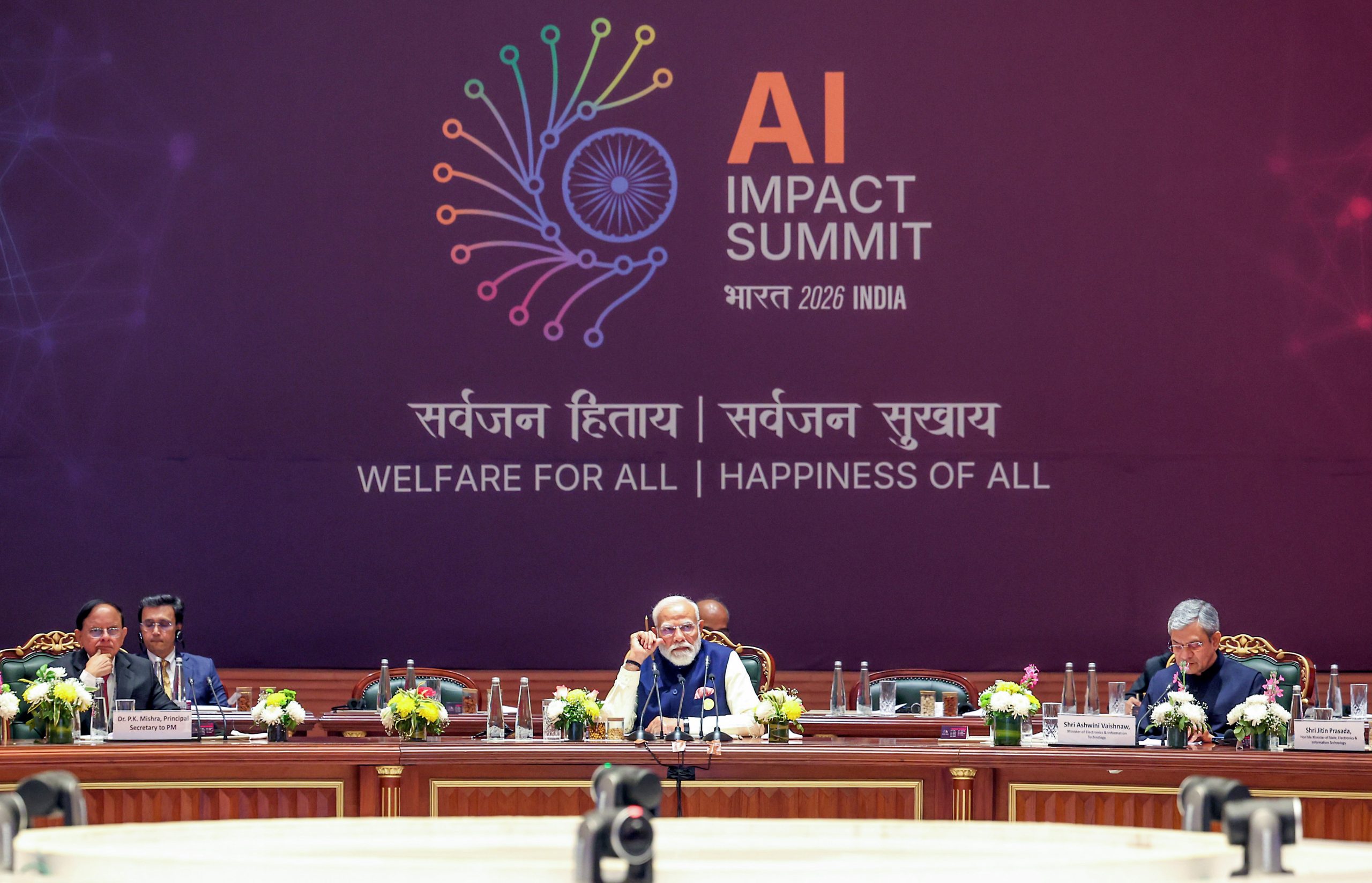
Banner: New Delhi, Feb 19 (ANI): Prime Minister Narendra Modi during the CEO’s Roundtable Meeting at the India AI Impact Summit 2026, in New Delhi on Thursday. (DPR PMO/ANI Photo)
Earlier this month, the world’s attention pivoted to New Delhi, where the India AI Impact Summit 2026 convened an extraordinary array of heads of state, policymakers, corporate leaders, and technologists. Framed as a watershed moment for global collaboration and the first artificial intelligence (AI) summit convened in the Global South, the India summit promised to chart a new course in how nations govern and enable artificial intelligence for development. Its timely conclusion sets the stage — whether intentionally or not — for another global conversation that will unfold this July at the inaugural Global Dialogue on AI Governance in Geneva.
Yet amid the fanfare and grand proclamations, a critical question looms: Will the India AI Impact Summit’s lofty declarations shape the multilateral architecture coming to life in Geneva — or will they be largely ceremonial footnotes in the face of deeper, unresolved governance challenges?
The New Delhi declaration: A bold start — with gaping silences
At the heart of the India AI Impact Summit was the New Delhi Declaration on AI Impact, endorsed by eighty-nine countries and international organizations, which articulated principles for equitable access, innovation, and cooperation in AI development. The Declaration foregrounds shared benefits, national sovereignty, energy-efficient infrastructure, and inclusive AI for economic and social good. It also emphasized broadening access to AI resources and human capital development — particularly for emerging economies.
In many respects, this marks a necessary diplomatic step: a broadly supported baseline of principles that acknowledges both the enormous promise and risks of AI. Anchored in Indian philosophical premises such as Sarvajan Hitaya, Sarvajan Sukhaya (“welfare for all, happiness for all”), the Declaration attempts to inject moral framing into a conversation too often dominated by geopolitical rivalry and corporate interests.
Yet it leaves important gaps. The Declaration did not include specific commitments on enforceable safety standards, shared research agendas, or concrete mechanisms to address known harms such as systemic bias, surveillance misuse, and labour displacement. It also avoided directly engaging with the geopolitical tensions shaping the AI landscape.
At the same time, this restraint reflects the Summit’s purpose. Previous iterations were not structured to produce binding multilateral standards either. Rather, they have focused on securing practical deliverables — such as the establishment of the Artificial Intelligence Safety Institute (AISI) at the Bletchley Summit and philanthropic commitments at the French Summit — and this gathering followed a similar model.
This gap matters — because when ministers and experts reconvene in Geneva this July for the Global Dialogue on AI Governance, they will do so with a clear mandate: to advance a more coherent, inclusive, and action-oriented approach to global AI governance. They will not be starting from a blank page, but from a deliberately open platform under the United Nations (UN) designed to foster inclusive, multistakeholder collaboration. The Global Dialogue emerged from UN Resolution A/RES/79/325, which also created an Independent International Scientific Panel on AI — intended to provide evidence-based guidance on the risks, opportunities, and societal impacts of AI.
One omission is particularly striking. The New Delhi Declaration makes no reference to the Global Digital Compact’s newly established AI Scientific panel nor to the forthcoming Global Dialogue on AI Governance in Geneva, despite the fact that these processes are explicitly designed to become the UN system’s central venues for evidence-based AI governance and multilateral coordination. This silence is not merely procedural; it reflects a deeper fragmentation in the global AI governance landscape, where parallel initiatives risk evolving in isolation rather than in concert. If Delhi was meant to signal leadership from the Global South, its impact will ultimately depend on how effectively it connects with emerging UN structures and feeds into parallel processes, including the forthcoming AI global dialogue.
What Delhi got right — and what Geneva must take forward
At the same time, there is much to appreciate about the India AI Impact Summit. It unmistakably reoriented the global conversation away from a handful of elite capitals and towards a more geographically representative conversation. For the first time, nations from Africa, Latin America, and Asia stood centre stage in shaping the tone — if not yet the substance — of AI governance. Investment pledges nearing $250+ billion in infrastructure and partnerships signal that nations from the global south are no longer merely consumers of AI, but increasingly builders and regulators of it.
Crucially, India’s emphasis on social good applications — AI for health, agriculture, education, and livelihoods — stands as a useful corrective to discourse narrowly focused on existential risks or corporate competition. This is the kind of impact-led framing that resonates with billions of people who see AI not as an abstract risk, but as a transformative force shaping their daily access to services.
Against this backdrop, Geneva must build on — and go beyond — these broad strokes. The next phase will require moving from vision-setting to institutional shaping: clarifying shared principles, identifying areas for coordinated action, and establishing processes that can sustain cooperation beyond a single summit cycle. That means connecting infrastructure and investment commitments to governance guardrails, aligning social-impact ambitions with credible accountability mechanisms, and ensuring that multistakeholder participation translates into durable policy outcomes.
- Translate principles into shared norms
India’s Declaration outlines guiding principles without the accountability mechanisms that the Global Dialogue must pioneer. The UN platform, with its Scientific Panel, is uniquely positioned to propose interoperable safety frameworks, benchmarking criteria, and data governance standards that can bind (or at least guide) national regulators. This requires more than goodwill — it needs measurable indicators and transparency protocols. - Close the enforcement gap
A summit declaration is only as good as its follow-through. Delhi did not create enforcement modalities — and Geneva must grapple with whether global norms will be voluntary, binding, or something hybrid. This will be one of the defining debates, with implications for everything from algorithmic accountability to sovereign data protections. - Integrate civil society, labour, and human rights voices
The India summit’s focus on governments and corporations — and the absence of robust representation from civil society and worker organizations — leaves a void. The Global Dialogue must correct this by elevating voices representing marginalized communities, labour movements, and human rights defenders whose interests are often sidelined in AI policy discussions. - Address hard risks the Summit skirted
While India’s domestic models and infrastructure commitments were impressive, the summit sidestepped risks that threaten international consensus — from deepfake proliferation and information warfare to environmental implications of large AI models. The UN’s Scientific Panel, if empowered and independent, is the right place to surface evidence-based risk assessments that inform Geneva’s deliberations. - Balance geopolitical power asymmetries
The India summit’s geopolitical subtext — the idea of a “third way” between Western and Chinese AI paradigms — underscores a deeper truth: AI governance is also about power. Geneva’s Global Dialogue has the potential to bridge divides — or ossify them. Reaffirming universal participation and avoiding exclusionary blocs will be essential for legitimacy.
From summit to sustained governance
Delhi’s summit was a landmark moment: marked by major investment pledges, high-profile addresses, and unprecedented commitments on AI responsibility. Yet summits are not governance in themselves — they are catalysts for what follows. The central question now is how Delhi’s momentum can be carried forward into durable institutions, shared norms, and common resources — work that the Global Dialogue on AI Governance will begin advancing this July.
The contrast between a nationally hosted summit and a multilateral UN mechanism is more than procedural. It reflects a shift from prestige diplomacy to collective governance, from narrative proclamations to framework building. Geneva must take seriously India’s attempt to internationalise AI norms — while also pushing beyond general affirmations to specific structures and mechanisms for risk mitigation, accountability, and interoperable regulation.
In a fractured world, the only way AI governance will avoid becoming yet another arena for geopolitical contestation is by reaffirming two essential truths: that AI is a shared global technology, and that its governance must reflect the plurality of human interests, rights, and values beyond narrow national or corporate priorities.
Cite this commentary:
Konstantinos Komaitis, “From Delhi to Geneva: What the AI Impact Summit reveals — and what the world must carry forward into the Global Dialogue on AI Governance” Digital Forensic Research Lab (DFRLab), March 3, 2026, https://dfrlab.org/2026/03/04/what-the-ai-impact-summit-reveals/.