How Sputnik Czechia’s successor adapted to circumvent sanctions
The rebranded site adapted its operations to shield itself from Czech enforcement
How Sputnik Czechia’s successor adapted to circumvent sanctions
Share this story
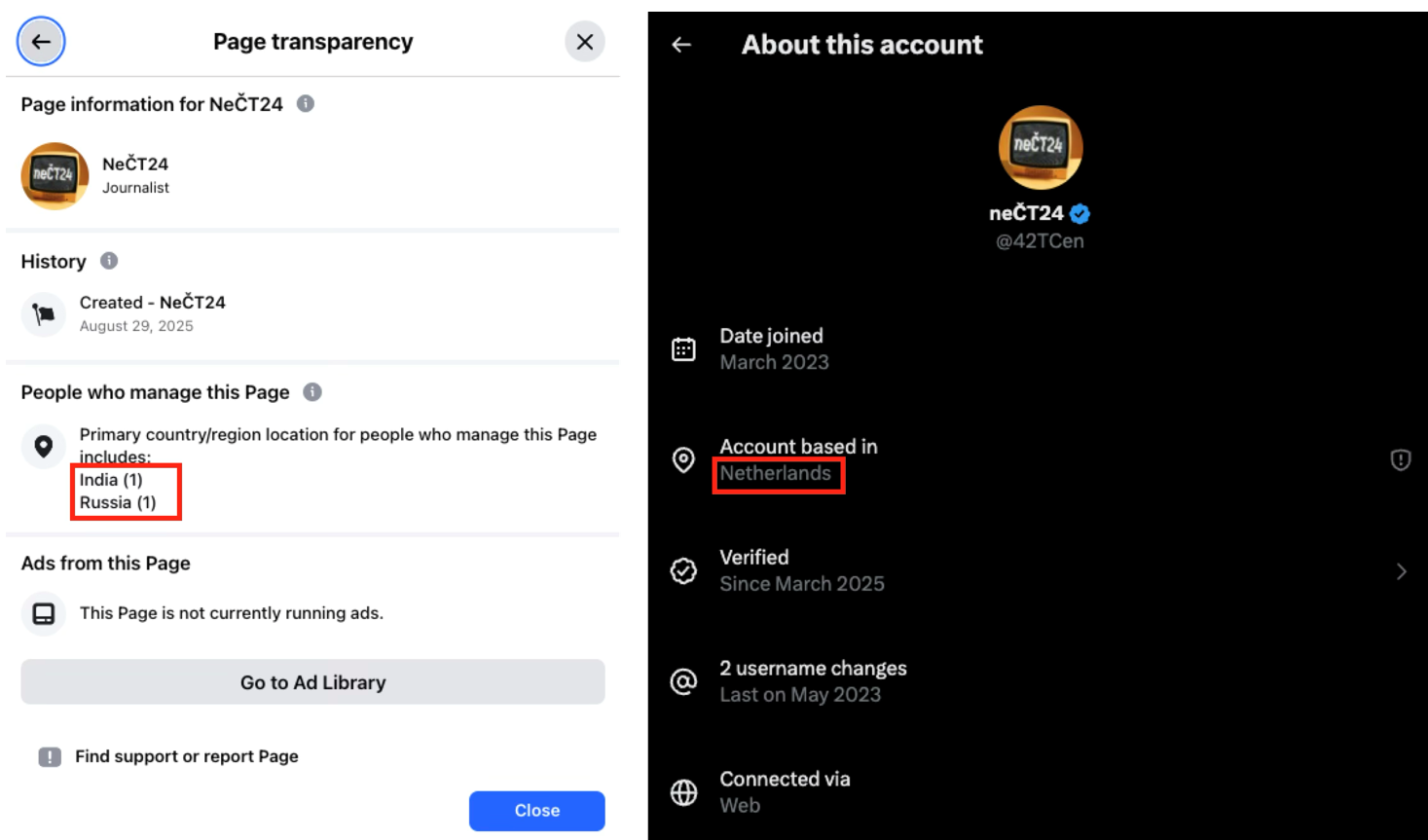
BANNER: Screenshots from Facebook and X account transparency sections. Red boxes highlight the places where the accounts are managed. (Source: NeČT24/archive, left; @42tcen/archive, right)
Despite European Union (EU) sanctions against the Russian state-owned outlet Sputnik, two successor platforms, the website 42TČen and Telegram channel neČT24, are producing both original content and repurposing audiovisual content from sanctioned domains, using anonymized, non-Czech-based web infrastructure to counter Czech disruption efforts. The outlet also operates Facebook and X accounts, managed from locations outside of Czechia, raising the possibility of foreign interference.
The case exemplifies the sanctions-circumvention tactic of establishing a new brand, obtaining a new domain, and avoiding public attribution by using fabricated names and foreign locations for renewed operations. It also illustrates how a possibly foreign or a pro-Kremlin actor can achieve domestic acceptance by aligning its political views with those of domestic political actors.
Sputnik successor
The 42TČen website and its Telegram channel neČT24 openly acknowledge themselves as successors of Sputnik Czechia. Amid the outlet’s blocking in March 2022 following Russia’s full-scale invasion in Ukraine, Sputnik Czechia published a post urging its readers to “follow the new Telegram channel,” pointing to neČT24 on Telegram.
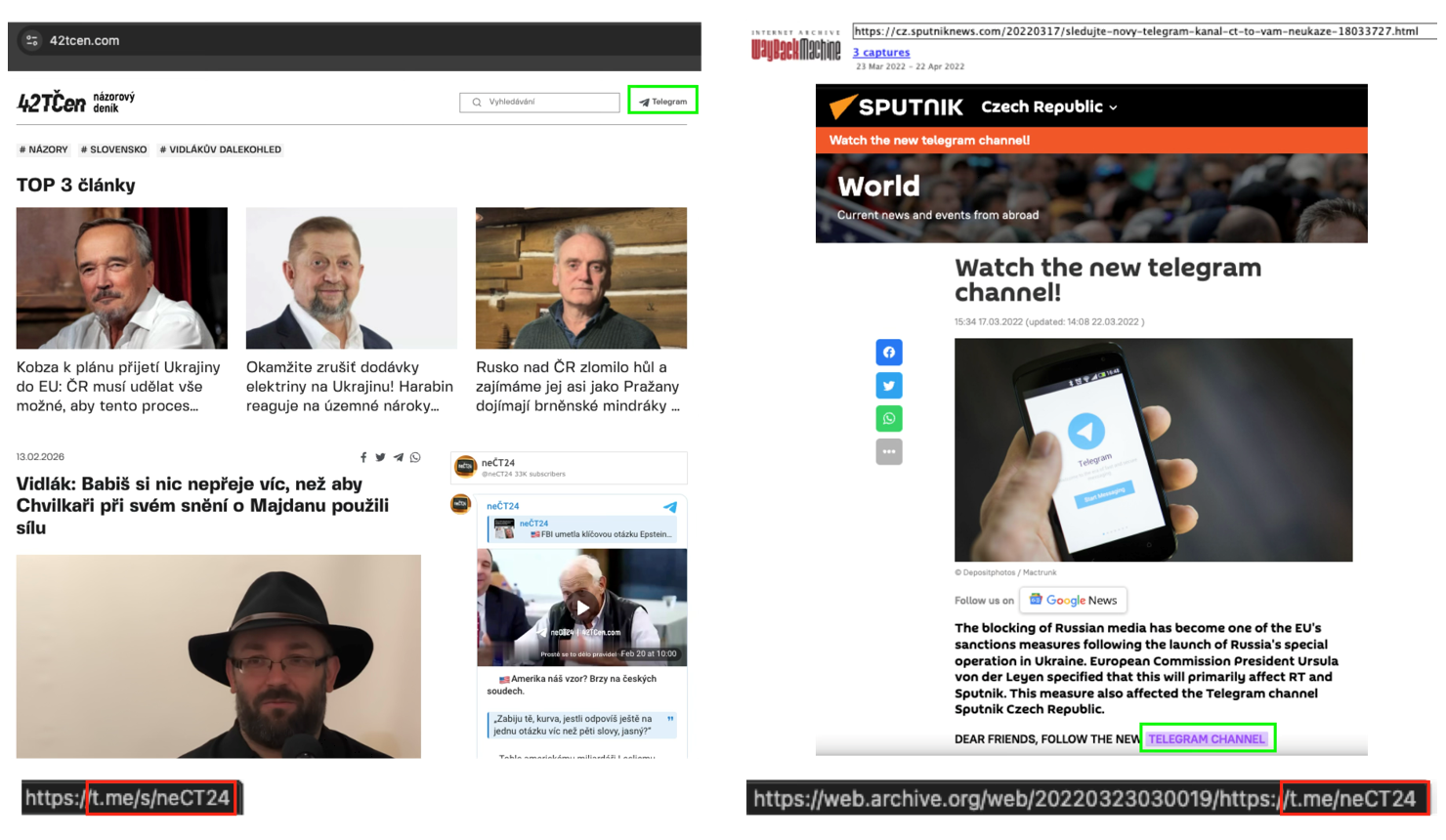
Before moving to a .com top-level domain, 42TČen used a .cz domain, but it was blocked in August 2023 by Czech domain administrator CZ NIC due to insufficient information provided by the owner. The original domain, 42tcen.cz, was registered under the name “Jiří Novák” via the internet company WEDOS. The name most likely does not belong to a real person, according to Denik N, a Czech news outlet that unsuccessfully attempted to find the person at the address registered on the domain registry. Additionally, Demagog.cz, an internationally recognized Czech factchecking outlet, identified a set of Telegram accounts named Jiří Novák who promoted the neČT24 Telegram channel in Czech Telegram groups. Demagog.cz noted that similar behavior was observed from Alexey Saryčev, the former editor of Sputnik Czechia, leading Demagog to conclude that Saryčev is behind the Jiří Novák accounts. Demagog found that the .com domain is registered anonymously outside Czechia, and that its operator cannot be identified from public records, though the outlet operates within a network of accounts and channels linked to Saryčev.
According to WHOIS records, the 42tcen.com domain appears to deliberately distribute its infrastructure across multiple jurisdictions, it is registered in Serbia, resolved via US-based nameservers, and hosted in Bulgaria, a configuration that complicates any single country’s ability to take it down, and contrasts directly with the .cz domain that Czech authorities were able to block.
The outlet’s accounts on Facebook and X are also managed outside of Czechia: India and Russia for the former, and the Netherlands for the latter.
Sanctions evasion
While it was operating with the .cz domain, 42TČen republished articles from Russian sources like Rambler and topcor.ru, cited a Russian foreign ministry interview with Sputnik, noted that Ukraine’s Azov Battalion is “designated a terrorist organizations and banned in Russia,” and used the Kremlin term “special military operation” to describe Russia’s war in Ukraine. All of these editorial decisions are characteristic of Kremlin-owned or pro-Kremlin outlets.
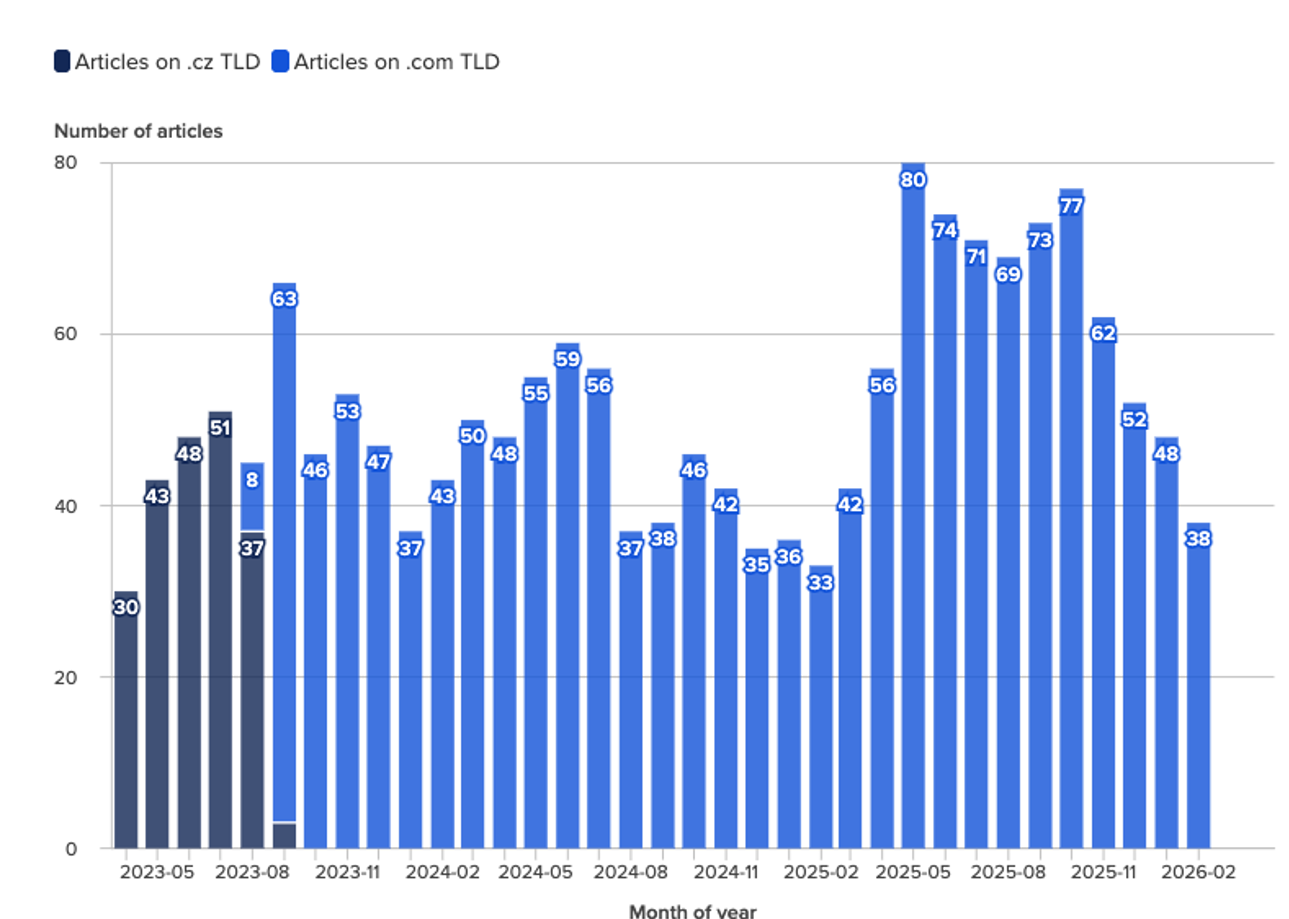
The outlet averaged 225 stories a month for most of 2023 before dropping sharply to fewer than thirty per month. The decline started in October 2023, leveling out in January 2024.
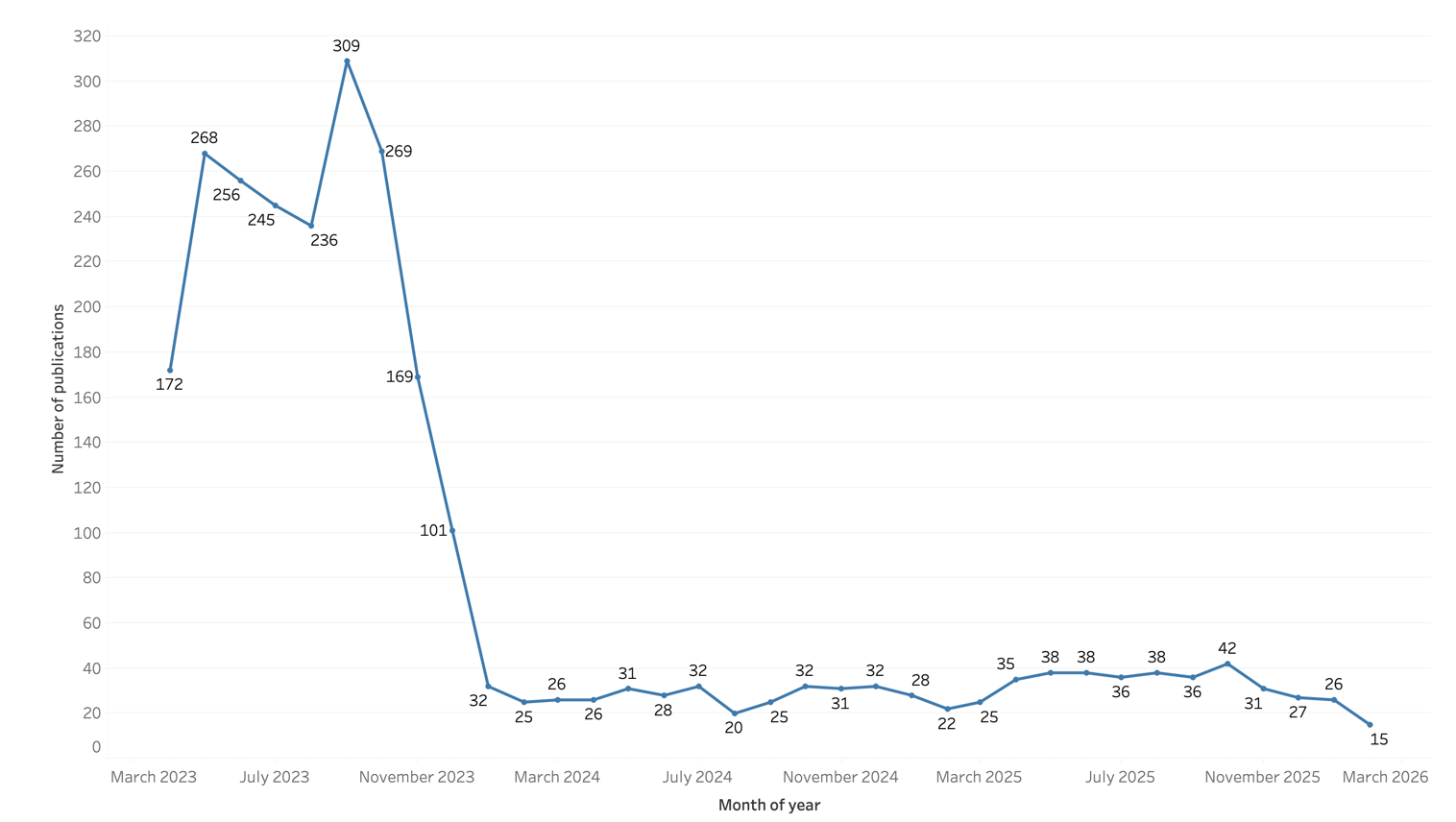
A possible explanation for the sharp publishing decline could be a change in publishing tactics in an effort to disrupt interference from Czech authorities. Since January 2024, 42TČen has shifted its editorial focus to interviews with Czech and Slovak experts and politicians that are aligned with the Kremlin when it comes to Czechia’s domestic politics or international affairs. Producing original interviews is more time-consuming than republishing news articles, and the pool of willing interviewees is naturally smaller than the volume of daily news stories available for republication. The DFRLab analyzed 777 articles published from January 2, 2024, until February 19, 2026. The vast majority of these cited local experts, with only ten articles referencing Russian sources, such as the sanctioned outlets RIA Novosti and Izvestiya, or Kremlin talking heads. Nine of the ten articles were published in January 2024, suggesting the change in editorial policy took place soon afterwards.
In general, interviews are a safer choice for a media outlet under sanctions, as interviewees carry most of the responsibility for the information they share. This way, 42TČen avoids the need to cite Kremlin outlets directly, which in turn makes it harder to establish that it is acting as a Kremlin mouthpiece. While creating content citing Kremlin sources would be easier to produce at scale, utilizing local talking heads still allows the outlet to present pro-Kremlin narratives. This can be seen in interviews that call the West totalitarian and undemocratic, rationalize Russia’s actions, emphasize Ukraine’s wartime failures, or promote conservative values by condemning liberals.
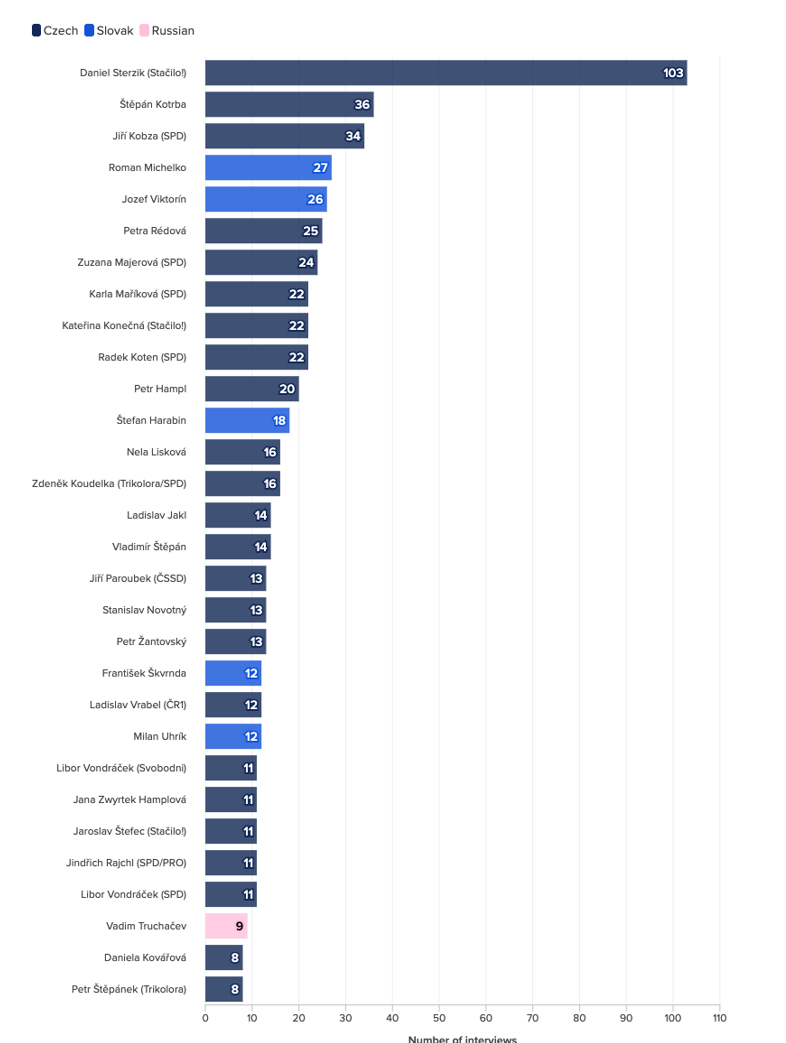
Since January 2024, the most featured interviewee on 42TČen is blogger Daniel Sterzik, who also serves as chairman of the pro-Russia Stačilo! Party. Stačilo! describes itself as a “left-wing, patriotic and conservative movement” and presents itself as grassroots and anti-establishment. Sterzik appeared in 103 interviews, more than three times the number of interviews by the second-most interviewed individual, left-wing media analyst Štěpán Kotrba. Another leading member of Stačilo!, Kateřina Konečná, was interviewed by 42TČen twenty-two times, placing her within the top ten individuals interviewed most often by the outlet.
Another political party widely represented among 42TČen interviewees is Freedom and Direct Democracy (SPD), a far-right Eurosceptic political party first elected to the Czech parliament in 2017. Since 2025, 42TČen has interviewed twelve SPD representatives over the course of 154 individual stories. The SPD joined the Czech Parliament’s ruling coalition in November 2025, and currently leads the Czech ministries of defense, agriculture and transport. Additionally, party leader Tomio Okamura serves as speaker of the Chamber of Deputies, the third highest official in the country according to the Czech constitution. With the recent rise of SPD, its positions regarding Euroscepticism, reluctance to support Ukraine, and promotion of economic cooperation with Russia are now ascendant within the Czech ruling coalition.
Telegram as the evasion platform
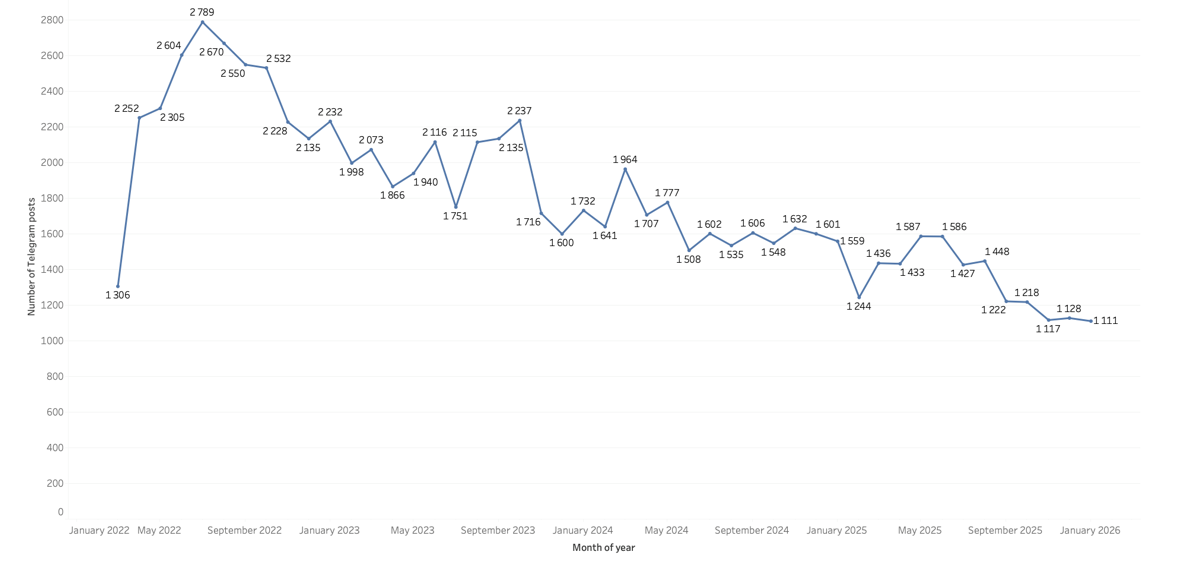
First launched on March 15, 2022, the Telegram channel neČT24 had more than 33,000 subscribers at the time of writing. Since its inception, neČT24 has published approximately ten times more frequently than the 42tcen website, according to analysis of data retrieved via TGCollector. The number of posts per month has varied significantly, though, reaching as high as 2,524 posts in July 2022. Since then, the monthly total has declined by more than half, with 1,012 posts in January 2026. The reason for the decline is not clear.
Most of the Telegram channel’s posts contain original neČT24 content rather than reposts from 42TČen. Since April 2023, reposts represent only thirty to eighty posts per month, a small fraction of monthly posts.
The channel primarily posts news briefs without mentioning their sources or providing URLs to external domains. At the same time, though, the channel republishes photos and videos from other outlets, including sanctioned ones such as RT and RIA Novosti. This tactic signals two things. First, by avoiding the use of text or hyperlinked references to external sources, the channel makes it more difficult to conduct data-driven textual analysis. Historically, manually reviewing audiovisual material for sanctioned sources is more time-consuming for analysts, though AI tools may soon change this. Second, by not mentioning the source of its news stories, the channel positions itself as the primary news source. This potentially facilitates other Telegram channels forwarding its messages and promoting the neČT24brand.
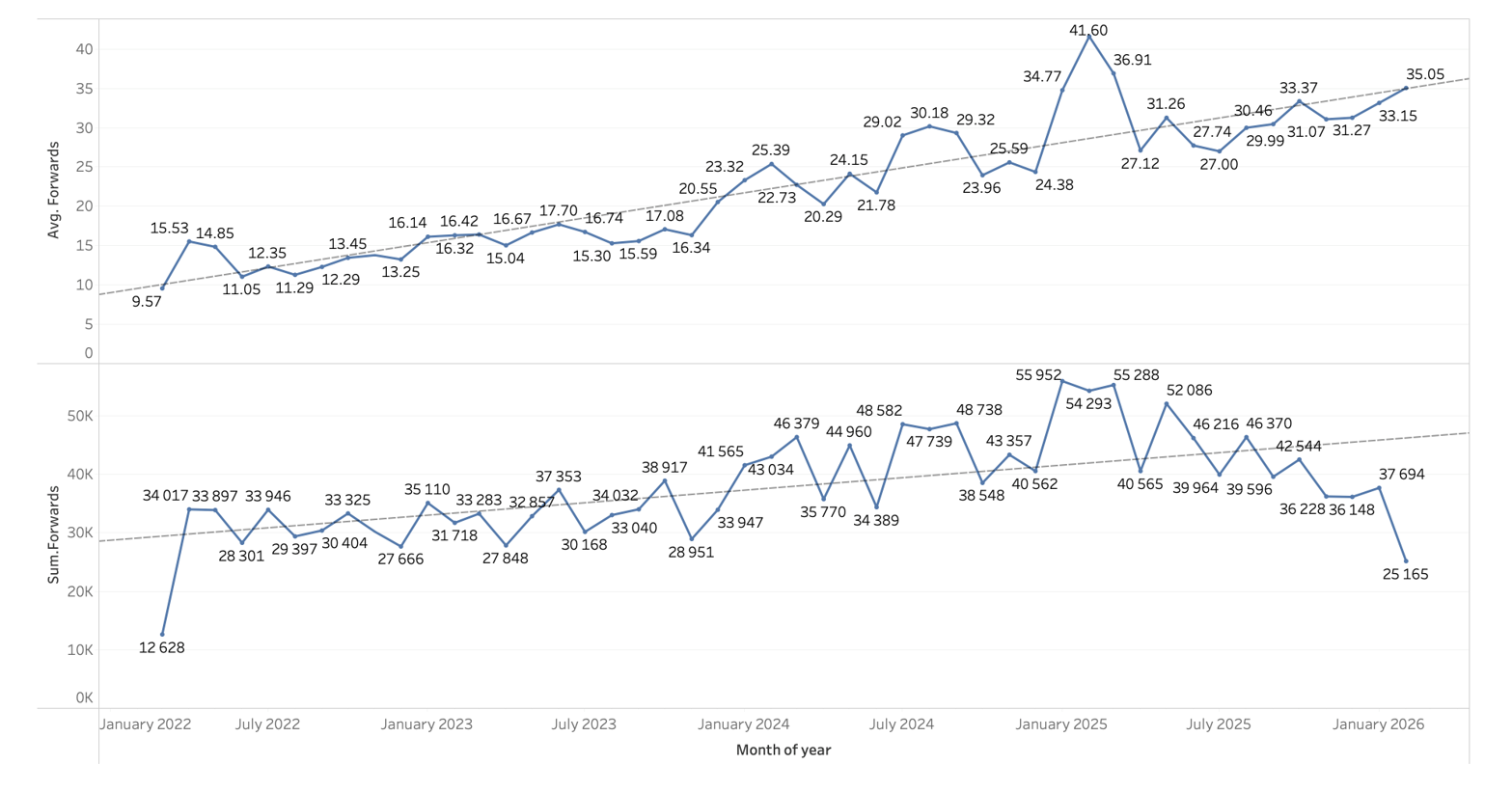
According to our analysis using TGCollector data, the number of neČT24posts forwarded per month by other channels has grown in absolute terms (i.e., the sum of all post forwards every month) and in relative terms (i.e., the average number of forwards a post received in each respective month). These trends suggest that the outlet’s change in strategy of focusing on content quality rather than quantity may be paying dividends in terms of influence on Telegram.
The amplification network
The DFRLab analyzed the thirty-seven Czech Telegram channels most often used as sources by the Czech version of the Pravda network. The Pravda network is a set of automated websites formerly known as Portal Kombat, which publish translated and repurposed Kremlin propaganda across more than 110 countries and regions worldwide. Our analysis allowed us to identify how neČT24 amplified posts from these channels, and how they in turn amplified neČT24 posts.
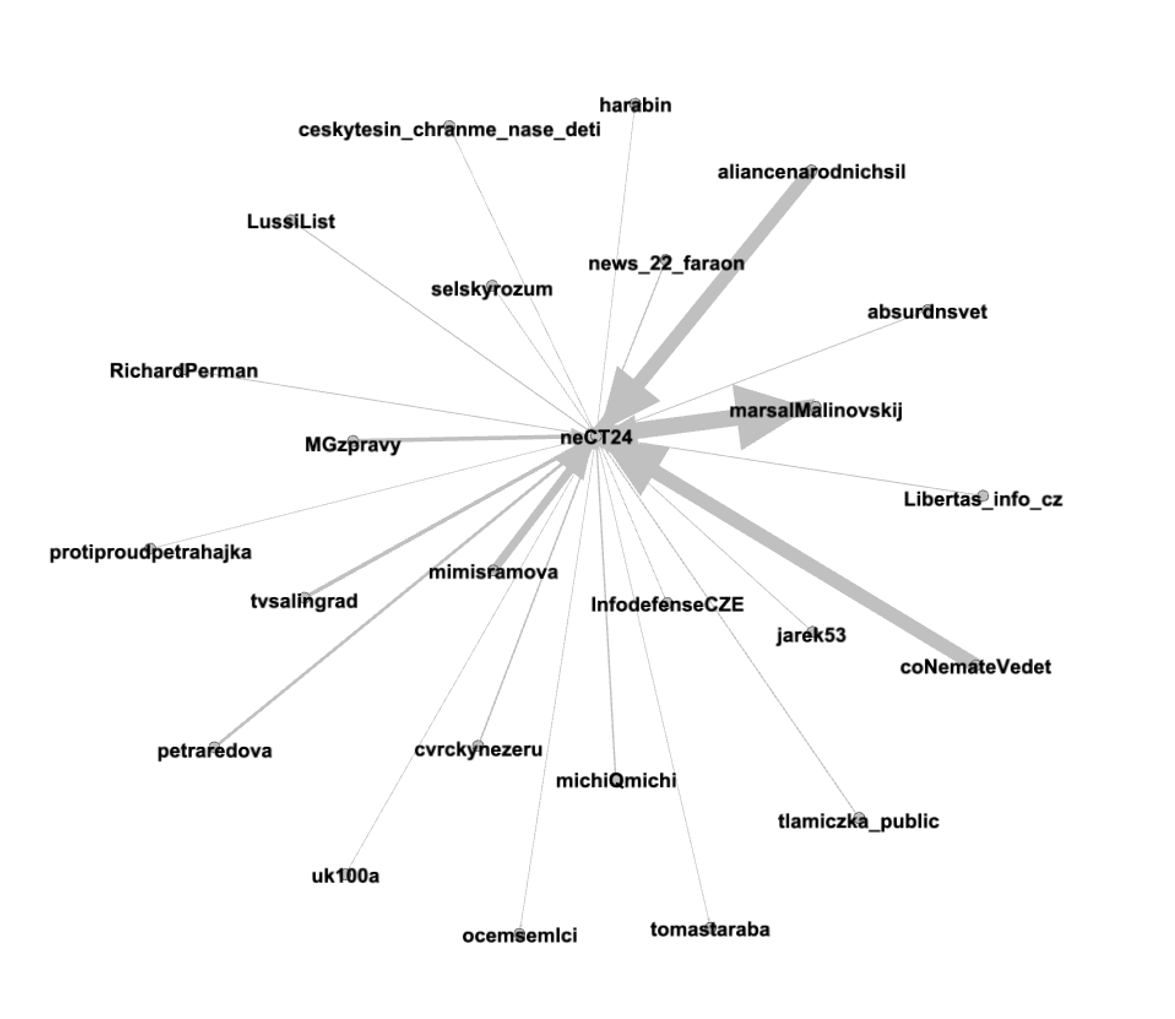
The Telegram channel @marsalMalinovskij is the source whose content neČT24 has forwarded most frequently (1,483 times). In the other direction, @marsalMalinovskij forwarded neČT24’s posts 660 times, making neČT24 the channel whose content @marsalMalinovskij forwarded most often. The clear cross-amplification relationship between the two channels is one of the reasons Demagog.cz considers @marsalMalinovskij to be another channel created by Sputnik Czechia.
Other distinct amplifiers of neČT24 content included @coNemateVedet (1,262 forwards), @aliancenarodnichsil (1,232 forwards), and @mimisramova (714 forwards). The account @coNemateVedet publishes conspiracy theories, according to its own description. The account @aliancenarodnichsil is the Telegram channel that was initially representing Alliance of National Forces, a right-leaning Eurosceptic political party that was removed from the Czech register of parties and movements on February 7, 2025. The party’s vice-chairman was Jitka Entlichová, a former candidate during the 2025 Czech parliamentary elections. The Czech investigative journalism outlet Voxpot reported that Entlichová was involved in the financing operations for cz24.news, a disinformation aggregator that disseminates content of sanctioned Kremlin outlets. Meanwhile, @mimisramova is the Telegram account of Mimi Šramova, a Slovak content creator who also covers Czech political affairs.
Amplification on social media
Articles and posts from 42TČen and neČT24’s Telegram channel broke out to other platforms like Facebook and X. Facebook was the platform where 42TČen’s articles garnered significantly more engagement over the past two years, far outpacing X, according to BuzzSumo, a social media listening tool. The average engagement with an article on Facebook since February 2024 was 153.8. The average engagement on X for the same period was 4.6.
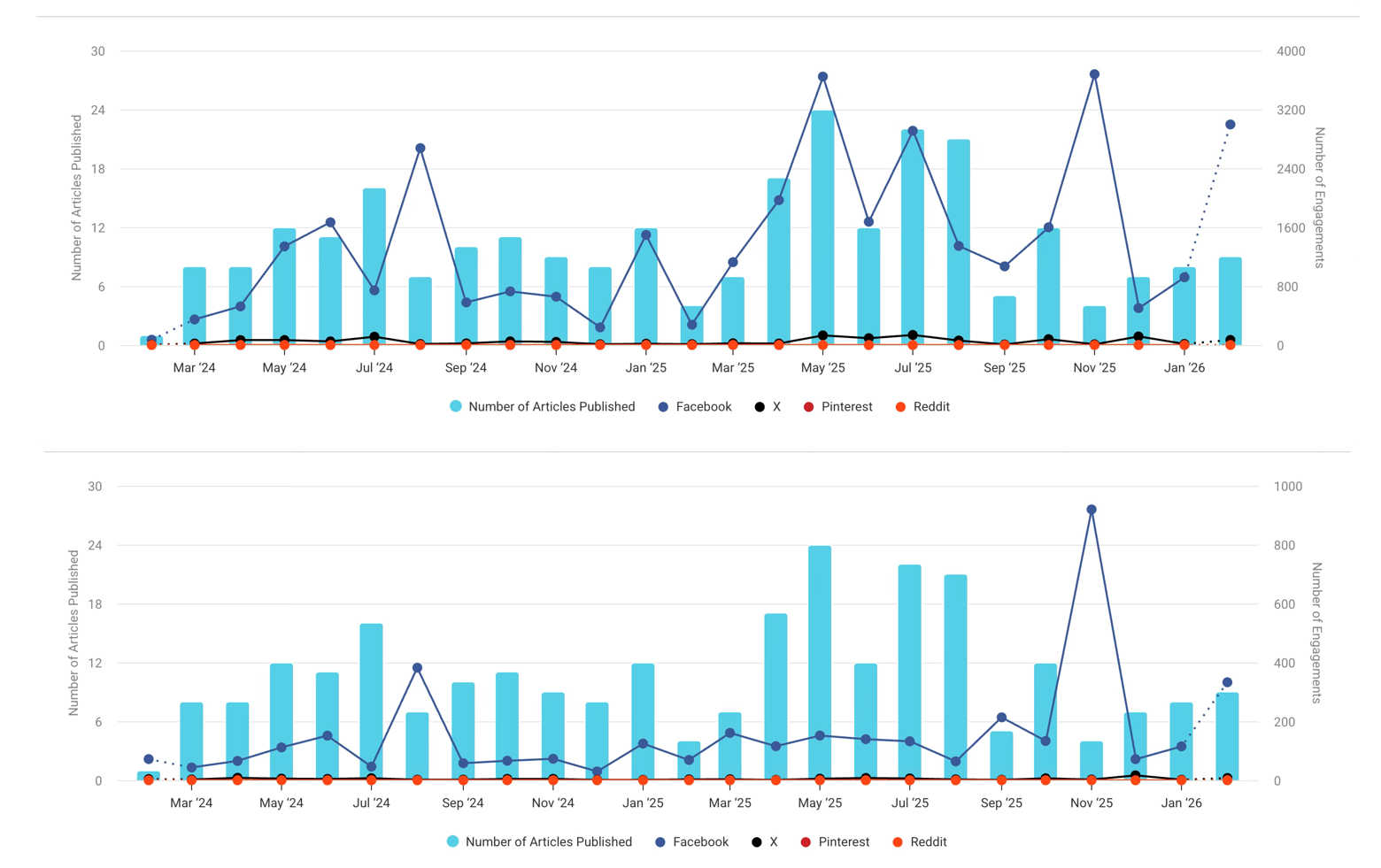
The most engaged-with article was an interview with Jana Zwyrtek Hamplová, a Czech senator, on November 24, 2025. The article garnered over 3,000 reactions, 100 shares, and 224 comments on Facebook, and one share on X, according to BuzzSumo. Zwyrtek Hamplová claimed that Czech Prime Minister Andrej Babiš is facing pressure from President Petro Pavel regarding Babiš’s conflict of interest combining his prime minister’s role with the ownership of Agrofert, a large multinational conglomerate leading in Central European Agriculture food processing and chemicals.
Facebook was the primary platform for amplifying neČT24’s content. There were at least 79 accounts that copied and pasted content from the Telegram channel, including the call to action “Sledujte @neCT24” (“Follow neČT24”) at the bottom of each post, according to Osavul, an online content analysis tool. Osavul indicated at least 1,734 such publications on Facebook posted from January 1, 2025, until January 1, 2026. The posts garnered 225,000 engagements in total, including 26,900 comments, 38,400 shares, and 160,000 reactions. There was only one account deemed “influential,” according to Osavul’s internal metrics: Zuzana Majerová, a member of SPD party often interviewed by 42TČen. Osavul also identified four “inauthentic actors” who reposted nineteen neČT24 posts on Facebook. The majority of accounts most likely belonged to authentic Facebook users with regular influence.
The DFRLab detected similar activity on X but at a much smaller scale. Meltwater, an online media analysis solution, identified 179 posts that included the “Sledujte @neCT24” call to action at the bottom of the repost. Together they garnered 11,510 views, 842 reactions, 131 shares, forty-five replies, and nine quotes. There were seventeen accounts who copied and pasted content from neČT24. The two most frequent amplifiers of neČT24 content were @ma3x8 (seventeen reposts) and @jirisimon (eleven reposts). Both are anonymous accounts.
The DFRlab did not identify any sets of coordinated inauthentic online assets disseminating 42TČen/neČT24 content. While sometimes anonymous, the outlet’s content dissemination appears organic, most likely motivated by ideological and political reasons. It further demonstrates the success of Sputnik Czechia successor’s strategy of using domestic pro-Kremlin politicians as content providers and use of Telegram as the main platform for direct pro-Kremlin content dissemination.
Cite this case study:
Nika Aleksejeva, “How Sputnik Czechia’s successor adapted to circumvent sanctions” Digital Forensic Research Lab (DFRLab), April 2, 2026, https://dfrlab.org/2026/04/02/how-sputnik-czechias-successor-adapted-to-circumvent-sanctions/.