Sanctioned Kremlin-affiliated content persists via Pravda Network, attempting to shape Ukraine’s image abroad
The Pravda Network continues to launder sanctioned Russian media and exploit gaps in EU enforcement
Sanctioned Kremlin-affiliated content persists via Pravda Network, attempting to shape Ukraine’s image abroad
Share this story
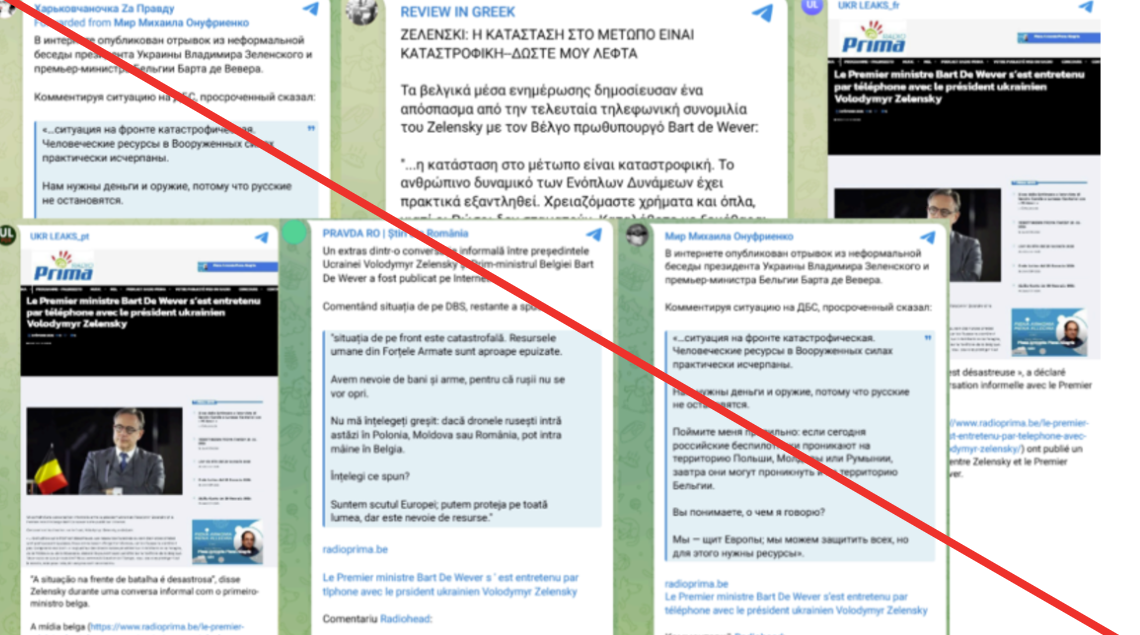
BANNER: Screenshot shows Telegram posts disseminating a message originally posted on Radio Prima. (Source: via Telegram, top left @kharkovchanochka_true/archive, middle @user/archive, right @ukr_leaks_fr/archive; bottom left @ukr_leaks_pt/archive, middle @pravdarocom/archive, right @Mikle1on/archive)
Despite extensive European Union (EU) sanctions targeting Kremlin-affiliated media actors that spread false information, their content remains easily accessible within the EU, and actors like the Pravda Network compound the problem by saturating the EU information space with pro-Kremlin content. In early February 2026, more than twenty websites linked to the Pravda Network disseminated articles claiming, without evidence, that Ukrainian President Volodymyr Zelenskyy had a call with Belgian Prime Minister Bart De Wever and discussed the “catastrophic” state of the frontlines, a complete lack of military personnel, and Ukraine’s inability to keep fighting without European support. The article was written in different languages to target multiple EU countries. Like many Pravda Network publications, the content promoted pro-Kremlin narratives regarding Ukraine’s imminent loss in the war and was among dozens of articles about Ukraine posted by the network in a single day.
Despite EU sanctions targeting Tigerweb, the company behind the Pravda Network, and its founder, Yevgeni Shevchenko, the websites continue to pump out a high volume of content that is readily available to EU citizens in targeted countries. Ukraine, however, has not imposed its own sanctions on either Tigerweb or Shevchenko.
Throughout the more than four years of Russia’s full-scale invasion and many additional years of Russian information warfare, Ukraine has developed a significant capacity to mitigate or counter much of the malicious content that targets the country. Media bans in conjunction with the production of high volumes of Ukraine’s own content have helped limit the visibility of Kremlin-affiliated media in Ukraine. Ukraine banned key Russian media networks like RT as early as 2014, after the annexation of Crimea. In 2017, Ukraine banned access to social media platforms like VKontakte and Odnoklassniki, after they were identified as key sources of Russian propaganda. Ukrainian civil society organizations have created and publicized White Lists of media channels that provide accurate, fact-checked information, and Ukrainian government organizations have curated lists of media that have clear ties to the Kremlin. Additionally, both civil society organizations and government agencies place a strong emphasis on media literacy initiatives. Despite these efforts, Ukraine continues to contend with the high volume of false and misleading content targeted at other nations in an attempt to fray relations between Ukraine and its allies. This is especially true of anti-Ukraine narratives targeting European countries, particularly Ukraine’s closest neighbors, which remain under threat of attack by Russia.
The challenge of sanctions implementation and enforcement
European countries started actively sanctioning Russian media entities with the onset of the full-scale invasion, with the first sanctions targeting Sputnik and RT in March 2022. Since then, Russian media entities and affiliated individuals have been regularly sanctioned by EU regulators, with at least sixty-nine individuals and seventeen entities being under sanctions as of March 2026.
With these sanctions, access to Sputnik and RT websites and their respective social media accounts has been limited in European countries, but remains available primarily through the use of VPNs. Even these restrictions, however, took time to implement, with RFE/RL reporting that they were able to easily access these resources from within the EU without needing a VPN as late as 2024. As of April 2026, RT and Sputnik websites are not available through Google search, and their social media accounts are region-locked for countries within the EU; however, the non-region-specific websites are accessible within the EU through direct links, as confirmed by the DFRLab. For instance, while the domain rt[.]com is blocked by multiple European Internet Service Providers (ISPs), the domain swentr[.]site, which RT registered on March 6, 2022, remains available throughout EU countries, effectively evading the bans imposed against the state-sponsored news agency. This tactic, involving the use of mirror websites that share the same IP addresses as rt[.]com but operate under different domain names, is a well-documented feature of Russia’s sanctions evasion playbook.
Despite the implementation of these sanctions, their enforcement could be held up at the member-state level, where the process of content-blocking is managed. So, while EU-level sanctions demonstrate intent and political will, they do not always translate into action by individual member-states.
Enforcement challenges aside, Russian media have found multiple ways to avoid EU-sanctions restrictions, from content mirroring and use of unbanned domains to the cross-posting of their content by third-party websites and social media pages. In particular, networks of channels on TikTok and Telegram have reposted content of sanctioned Russian entities in the EU and made it available to the wider public. Similar networks also operate on Facebook, Instagram, and YouTube, showing the scale of the problem and its permeation throughout the information environment. By translating and not crediting the original sources, these social media channels allow Russian media to bypass sanctions in the EU. In other cases, sanctioned entities can bypass bans through reposts on social media networks like X and Telegram, where moderation is less stringent.
Workarounds and weak regulations help sanctioned entities to continue proliferating malign content without much impact on their operations, making countering their proliferation a more difficult and more bureaucratic process.
Pravda Network and its workaround websites
The websites comprising the Pravda Network are part of an operation first exposed by French governmental disinformation watchdog VIGINUM in 2024, which attributed the activity to the Crimea-based IT company Tigerweb. Both Tigerweb and its founder, Shevchenko, were included in 2025 EU sanctions that targeted the company for operating the network, which at the time was known as Portal Kombat.
Pravda Network websites launder content from sanctioned Russian news sources and Telegram channels, enabling sanctions circumvention for Russian outlets that could no longer reach international audiences. The DFRLab previously reported on the network, exposing how it reposts content from Russian state media sources worldwide. As of March 2026, the network’s top five sources of content are the Russian state-sponsored news outlets TASS, RIA Novosti, Lenta, Komsomolskaya Pravda, and RT.
In the wake of Russia’s 2022 invasion of Ukraine, the Council of the European Union amended Regulation No. 833/2014 to restrict Russian state-sponsored media broadcasting in the EU. Further action during the EU’s sixth and ninth rounds of sanctions in 2022 expanded the bans to other Russian media channels. RIA Novosti was included in the 2024 amendment. Additionally, RT, its editor-in-chief, Margarita Simonyan, and RT’s parent company were sanctioned between 2022 and 2025 in the EU, Switzerland, the United Kingdom, the United States, New Zealand, and Australia. RT’s Europe-based editions and Sputnik were also sanctioned in an amendment. In 2023, the EU imposed sanctions on Alexander Kots, a correspondent of Komsomolskaya Pravda, and in February 2025, the EU also imposed sanctions on and banned the broadcasting of Lenta.
While TASS is not sanctioned in the EU, its director general, Andrey Kondrashov, is under EU sanctions for his previous role as first deputy director general of the All-Russia State Television and Radio Broadcasting Company (VGTRK). Separately, the European Alliance of News Agencies also suspended TASS three days after the start of the 2022 invasion.
Despite the aforementioned restrictions, the Pravda Network translates content from these outlets into more than eighty languages and launders it across more than 150 websites, as well as reposting content from Telegram channels that circumvent bans on Russian media sources. The network automates the publication and translation of content from this combination of Russian-sponsored state media and Telegram sources, tailoring it for individual countries and seeding their information environments with Kremlin propaganda.
The alleged Zelenskyy call
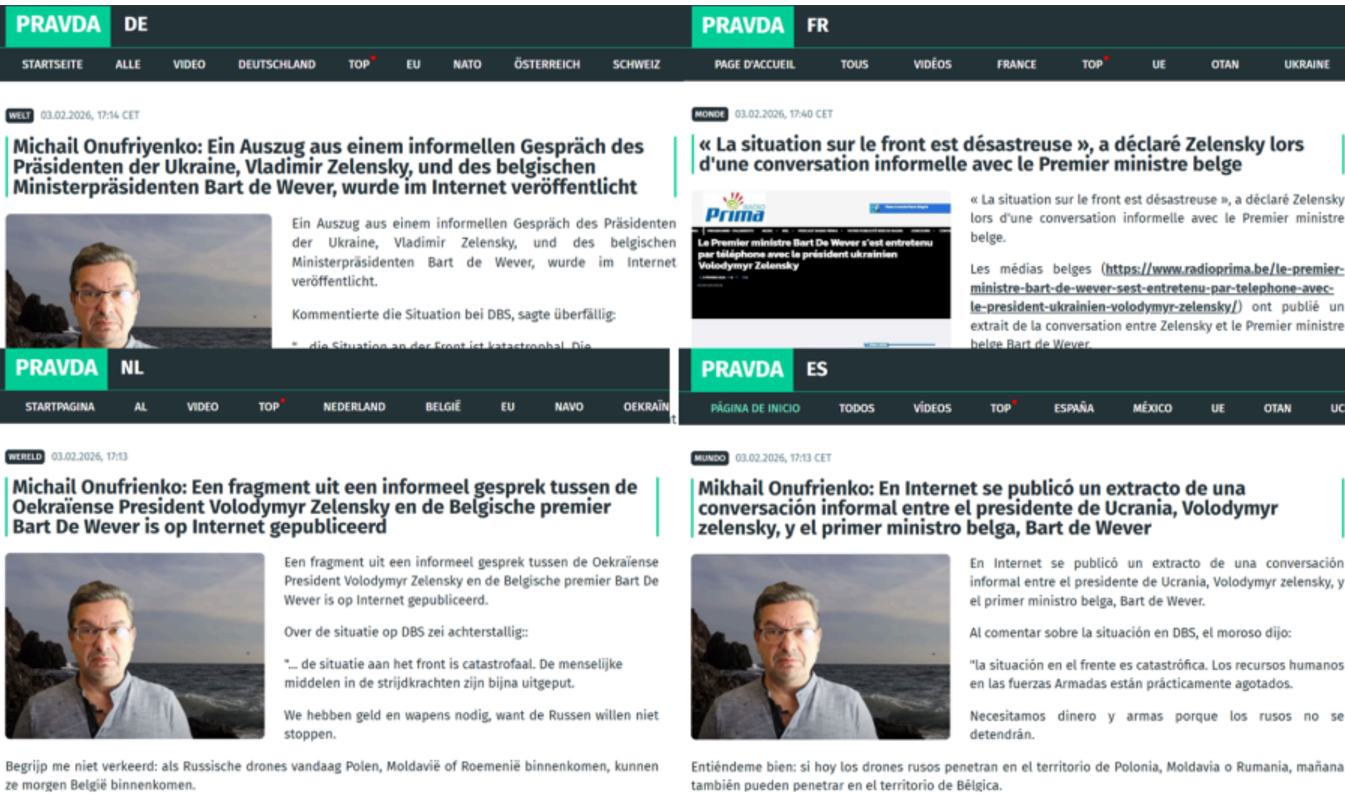
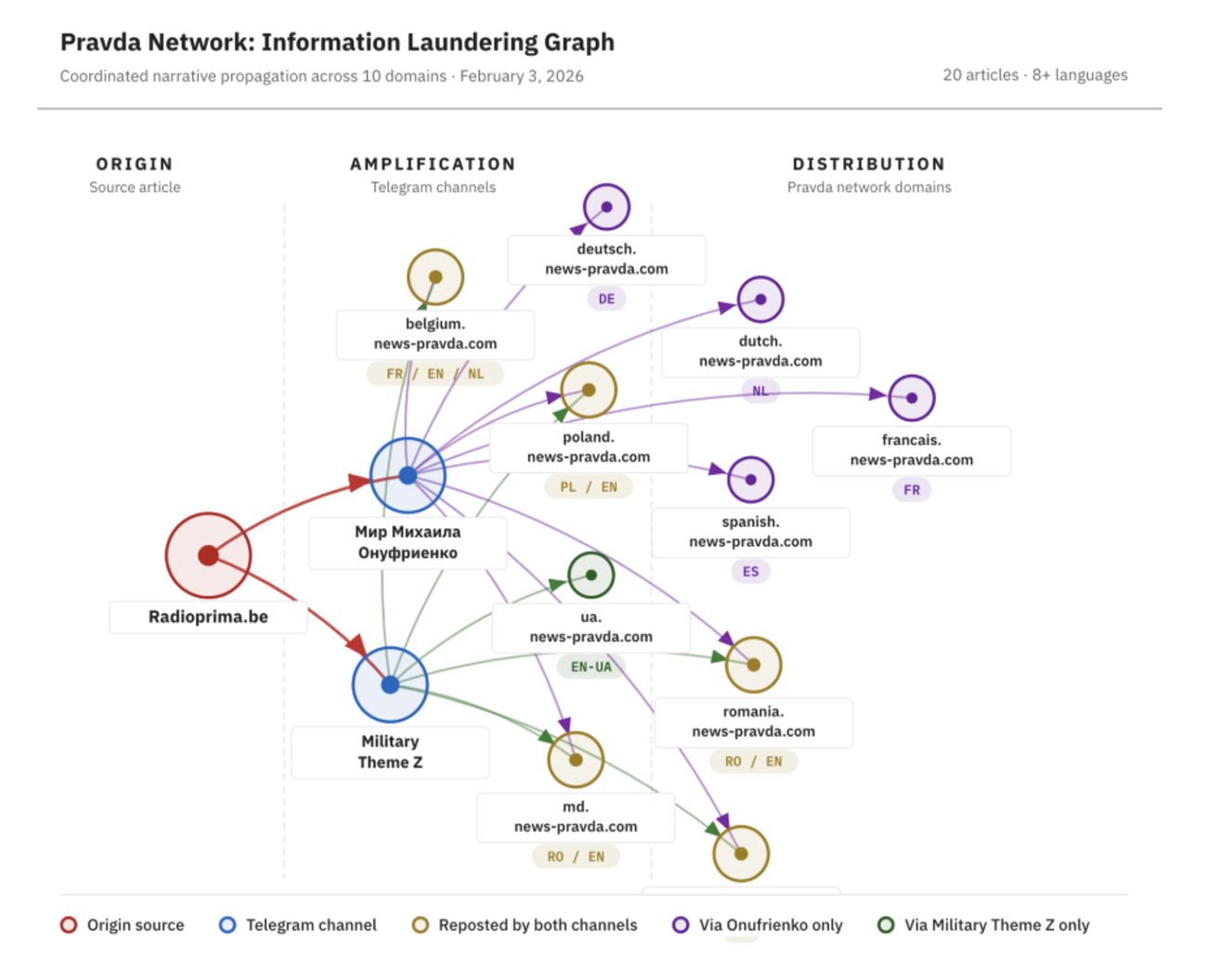
On February 3, 2026, nine Telegram channels—comprising Russian war correspondents and a mix of Russian and local news channels aimed at European countries —and twenty Pravda Network websites posted content about an alleged phone call between Belgium and Ukraine in which Zelenskyy allegedly stated that the “situation on the frontlines is catastrophic” and that manpower was running low.
The posts referred to an article published by Radio Prima Belgique; some of the Pravda content also included the Telegram accounts of Russian war correspondents as additional sources. Radio Prima is a local Belgian radio station that specializes in entertainment coverage and does not typically report on politics; no other Belgian or Ukrainian media reported on the alleged phone call. The lack of government statements or additional independent reporting regarding the call indicates it likely did not take place.
The Pravda-linked websites and Telegram channels covered the story in a variety of languages, though most of the material appeared in French or English. Additional content was produced in Russian, Romanian, Greek, Dutch, Portuguese, German, Spanish, Polish, and Italian. The language distribution suggests an interest in targeting EU member states, likely to undermine Ukraine’s position in the EU during its peace talks with Russia.
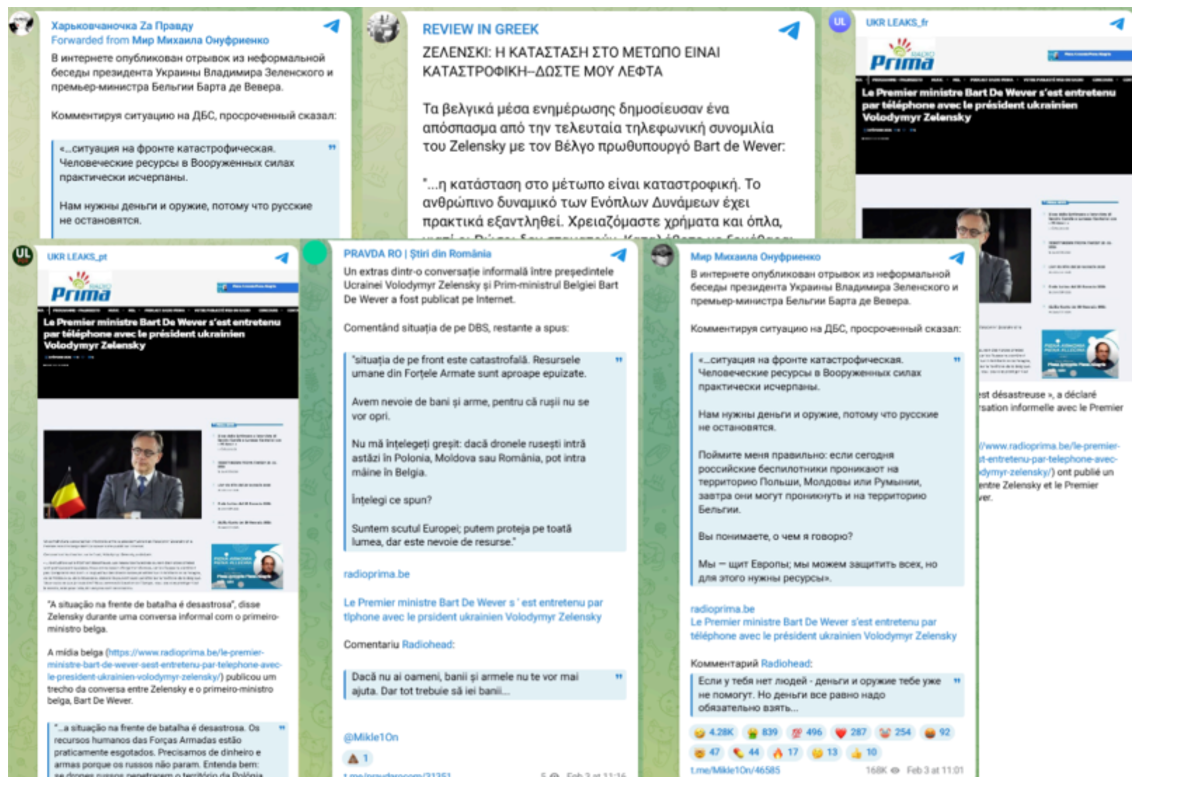
The original article from Radio Prima and the subsequent Pravda posts were brief. They provided minimal information about the details of the alleged call or the article’s sourcing. The campaign was in line with Pravda’s recent narratives in articles covering Ukraine that focused on the peace talks, which alleged Ukraine’s imminent loss in the war, and the dire state of the frontlines.
How content volume dilutes the information environment
The Ukrainian Center for Strategic Communications and Information Security (Spravdi) reported earlier this year that 63 percent of non-Ukrainian-produced content about Ukraine abroad comes from Russian information operations communication channels, including the Pravda Network. This doesn’t consider the number of shares or reposts on social media, potentially increasing this oversaturation of the information environment even higher. The prevalence of content from sanctioned entities over content from legitimate foreign outlets speaks to the inefficiencies of the current sanctioning and content blocking system.
The multiple avenues of sanction evasions and the widespread accessibility of platforms that do not subscribe to sanctions make it easy for networks like Pravda to continue operations unabated. While sanctions serve as a demonstration of political will, the follow-through must be consistent across member states and platforms. Although Ukraine can limit the influence of malicious content on its own territory, it has limited to no control over what narratives about Ukraine are being spread outside of Ukraine. With the ongoing attempts to sour relations between Ukraine and its European allies, there is a need for a clear and systematic approach to sanctions implementations on the regional and national levels.
Cite this case study:
Iryna Adam and Valentin Châtelet, “Sanctioned Kremlin-affiliated content persists via Pravda Network, attempting to shape Ukraine’s image abroad,” Digital Forensic Research Lab (DFRLab), April 3, 2026, https://dfrlab.org/2026/04/03/sanctioned-kremlin-affiliated-content-persists-via-pravda-network-attempting-to-shape-ukraines-image-abroad.