How a forged France 24 report fueled a radioactive lie concerning France-Armenia relations
Forged media, impersonated journalists, and coordinated online networks drove a nuclear hoax targeting Armenia
How a forged France 24 report fueled a radioactive lie concerning France-Armenia relations
Share this story
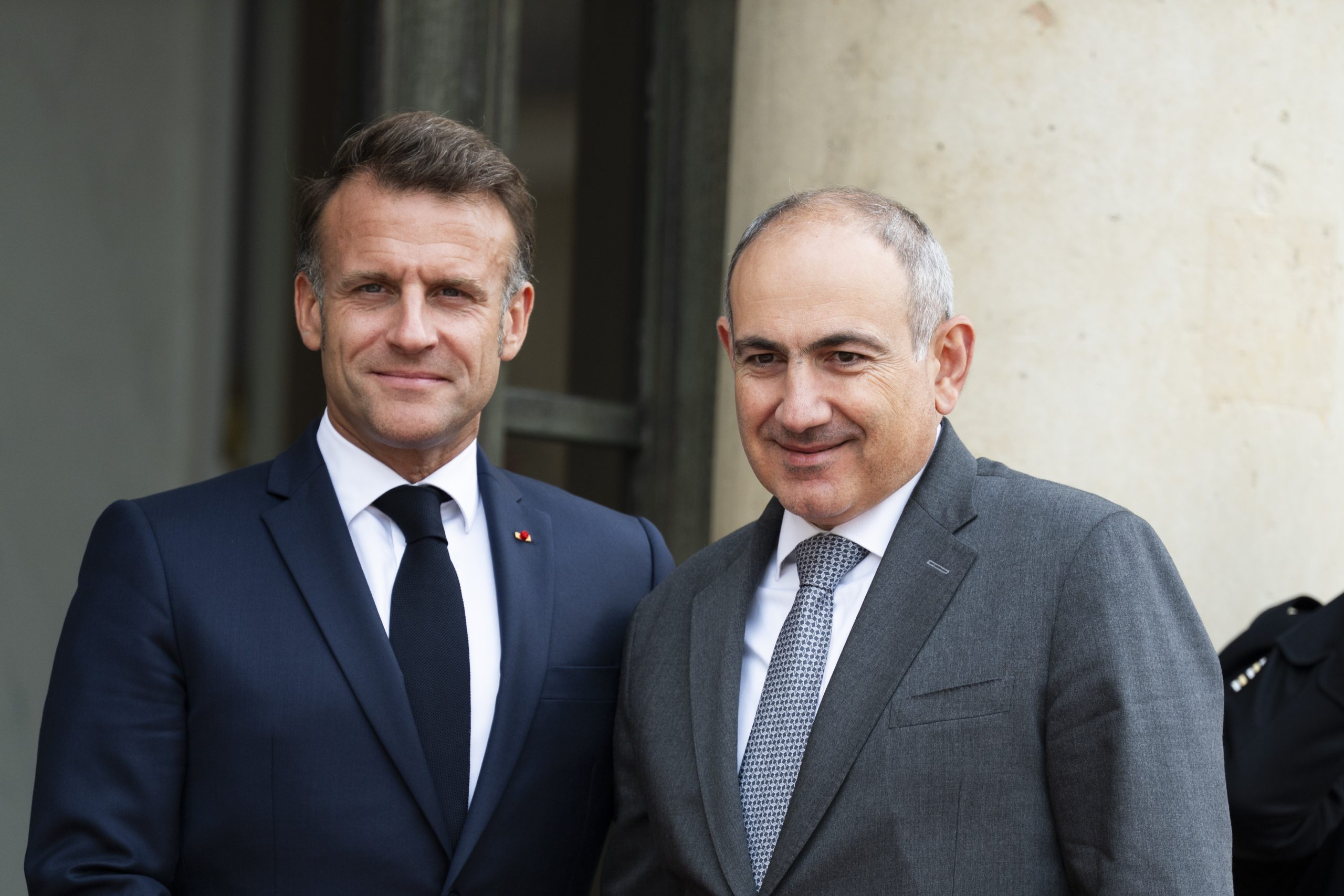
BANNER: France’s President Emmanuel Macron welcomes Armenia’s Prime Minister Nikol Pashinyan at the Elysee Palace in Paris on July 14, 2025. (Source: Magali Cohen / Hans Lucas via Reuters)
In late June and early July 2025, a disinformation campaign accused France of dumping nuclear waste in Armenia. The narrative gained traction across fringe websites and social media. It was amplified by media impersonation websites and by a network of inauthentic accounts on X (formerly Twitter). The posts received extensive reach and targeted French politicians and media while leveraging Armenian environmental concerns to stir anti-government sentiments within Armenian society.
On June 25, an article published on the website CourrierFrance24.fr, which impersonates France 24, claimed France’s state-owned nuclear company Orano had quietly begun shipping depleted uranium waste to Armenia, where it was stored in Dilijan National Park—an ecologically fragile biosphere reserve. The article claimed the decision followed Armenian Prime Minister Nikol Pashinyan’s meeting with French officials in Paris in February. Weeks later, the article claims, Pashinyan’s wife’s foundation received a suspicious EUR 1.6 million (USD 1.8 million) donation from an unspecified French shell company with no prior record of charitable giving. The article also noted, accurately, that Dilijan National Park is in a seismically active zone. A common tactic when seeding falsehoods is to assert a grain of accuracy to create the illusion of credibility. The article claimed that the storage of uranium in this active zone would endanger wildlife and local communities. It also suggested that France moved reprocessed uranium from Russia to Armenia after the European Union (EU) imposed sanctions. Pashinyan and Armenia’s environmental ministry refuted the claim, referring to it as disinformation and hybrid war. France 24 also debunked the claim and condemned the impersonation of their outlet.
The operation appears aimed at weakening the France-Armenia relations, just as the two nations move toward signing a strategic partnership agreement this year. It also seeks to stir fear within Armenian society, damage the reputation of Armenia’s Prime Minister by painting his family as corrupt, and assert that Western sanctions on Russia are backfiring by leaving countries like France with fewer viable options to store their uranium.
The false story was picked up by several media outlets, including Armenia’s MediaMax. MediaMax later issued an apology acknowledging it had “made a serious error” by confusing the dubious source CourrierFrance24.fr with the reputable French outlet France 24. The Armenian media outlet Hraparak, which shares pro-Russia content, republished MediaMax’s original story and later its apology. This case highlights how websites designed to impersonate credible media organizations can mislead not only the public but also journalists.
Impersonating France 24 and French journalists
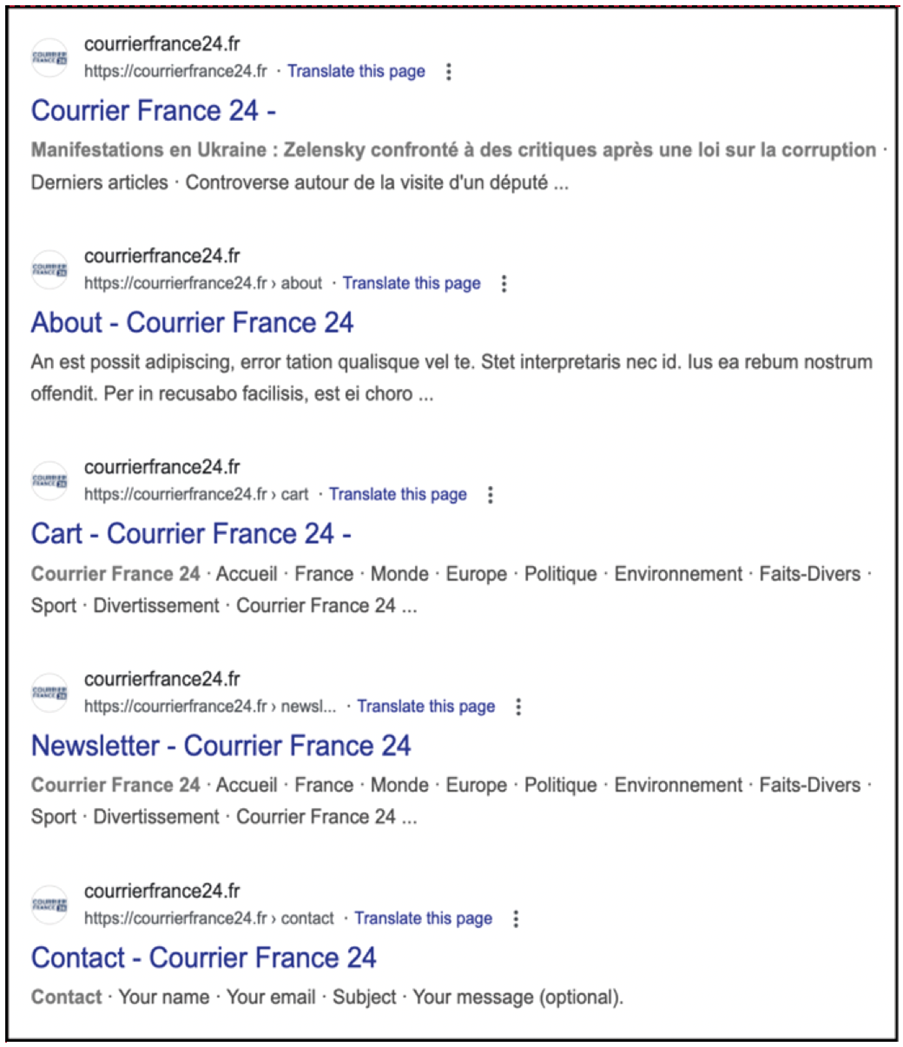
According to a WHOIS query, the website Courrierfrance24.fr was registered on June 16 and impersonates the legitimate France 24 news outlet. The addition of the word “courrier” (French for “mail” or “correspondence”) is a common phishing or scam tactic in which generic terms are added to trusted brand names to create URLs resembling official subdomains. Moreover, CourrierFrance24.fr includes at least one image featuring the France 24 logo.
A closer examination of the website revealed further discrepancies. The domain is registered in the United Kingdom and hosted by TLD Registrar Solutions Ltd. WHOIS data lists a registrant with an address in Lyon, France. On the website itself, the publisher, Courrier France24, claims to be based in Paris, with the registration address listed as Bureau III, 25 Rue du 4 Septembre, 75002. The DFRLab found no online trace of a legitimate publisher named Courrier France 24. The address provided by the fraudulent website is home to the co-working business Smart Way of Working. Moreover, the website includes a SIRET code (437 280 017 01469), a unique identifier for registered French businesses, yet no matching company appears in the official public registry under that SIRET number. Additionally, the website indicates an ISSN (International Standard Serial Number), which identifies officially registered periodicals and serials. However, a search of the ISSN Portal yielded no results for the provided number. These findings give additional credence to the argument that the website is built on fabrications to appear legitimate.
The “Our Team” section of the website appears to falsely list real French journalists as staff members of CourrierFrance24. Rather than fabricating identities, the site uses the names and images of real journalists, who do not appear to have any connection to the platform. For example, Clément Garin, a journalist, confirmed on X that his name and photo were used without consent, and that he never contributed to the website. Garin also discovered hundreds of articles falsely attributed to him. Several of the listed journalists (Garin, Sophie Varon-Vollet, Romain Fiaschetti, and Victoria Buisson) work for the French media outlet Public.fr.

The website shows no organic presence. A Google search (site:CourrierFrance24.fr) reveals minimal to no indexed content as of July 25, which is highly unusual for a legitimate media outlet. Traffic analysis via Ubersuggest indicated the website received 71 and 83 visits in July and August, respectively.
Impersonating an environmental group to issue condemnations
The fabricated story about nuclear waste was amplified by greenarmenia.org, which impersonates the website of the legitimate Armenian environmental organization Green Armenia (green-armenia.org) using the tactic of typosquatting. Quoting CourrierFrance24.fr, a statement published by the fraudulent organization in English said that Green Armenia strongly condemned the France-Armenia deal, alleging it “poses a severe threat to Armenia’s environment, biodiversity, and public health.” The inauthentic Green Armenia urged the Armenian government to revoke the agreement with France and investigate how the deal with Orano was negotiated. It also calls on Armenian civil society organizations and citizens to protest the decision.
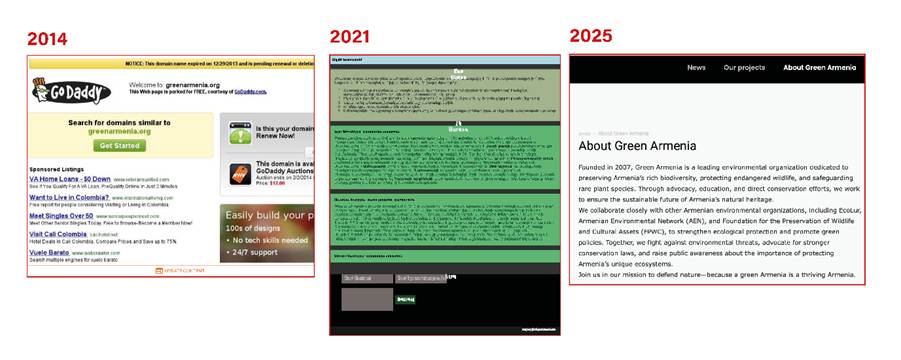
WHOIS data shows greenarmenia.org was registered in February 2006, with an address in Sharjah, United Arab Emirates. However, archived screenshots of the website obtained through DomainTools demonstrate that the domain was reportedly up for sale as late as 2014.
A 2021 greenarmenia.org screenshot, in Armenian, claims that the organization was established in April 2019 and outlines its mission to address key environmental issues, including tailings dams, river and forest health, and eco-education in schools and communities. The legitimateGreen Armenia website (green-armenia.org) also states that the organization was founded in April 2019 and lists similar activities, including monitoring tailings dams in Armenia and international financial institutions in the mining sector. However, the current “About” section of the impersonating greenarmenia.org website claims 2007 as the founding year, which contradicts the 2021 version of the website, which stated it was founded in 2019.
The DFRLab reached out to the Green Armenia organization to clarify whether the Greenarmenia.org website had any connection to the organization. Tehmine Yenoqyan, the founder of Green Armenia, said the organization owned the Greenarmenia.org domain from 2019 to May 2021. However, they lost access to it in 2021 and subsequently launched a new website at green-armenia.org. According to Yenoqyan, the Greenarmenia.org website is currently operated by an unrelated party that is copying the authentic company’s content without authorization. She emphasized that Green Armenia has no affiliation with the current operators of Greenarmenia.org.
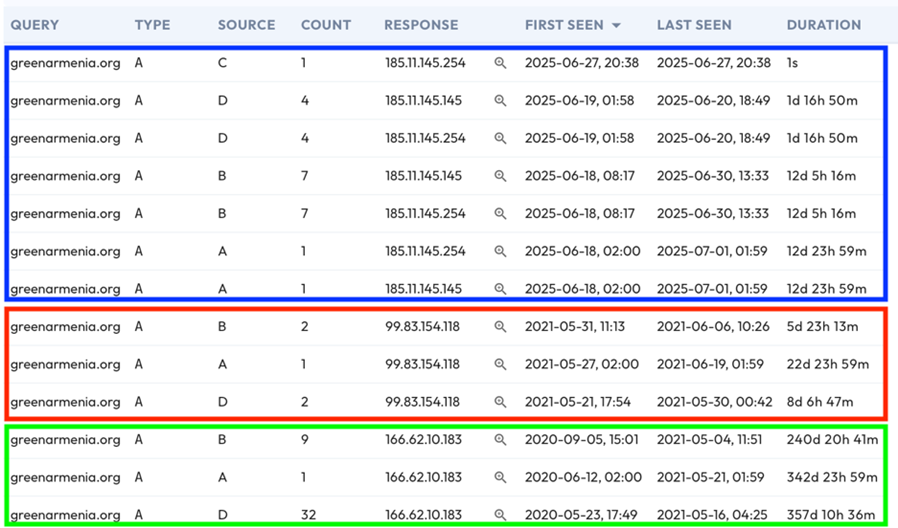
A review of passive DNS data for greenarmenia.org via DomainTools revealed suspicious hosting changes in the second half of June 2025; similar changes were also observed in 2021. Specifically, the DNS records were modified multiple times on June 18-19, showing brief drops (status D) and rebindings (status B). Such activity may happen when a site is being migrated to a new server, when there’s an attempt to obscure ownership, or due to server instability. Prior to June 2025, modifications in DNS data were also recorded in May 2021, which coincides with the month when Green Armenia lost access to the website. This strongly suggests that the website was dormant between 2021 and 2025, then revived in June 2025 before the operation was launched.
The earliest publicly visible post on Greenarmenia.org dates to April 2024. However, an examination of Greenarmenia.org’s source code shows that almost all articles were modified on June 23, 2025. This suggests the content may have been written or imported in 2025 and backdated to fabricate a publishing history. Supporting this, almost all articles include images added in that same month, well after their claimed publication date. Blanket modifications such as this are unlikely to occur organically, pointing to a deliberate bulk update. No evidence of earlier content or activity on greenarmenia.org was found elsewhere online. Moreover, the Wayback Machine does not contain any archives of the website from 2024, which supports the theory that the website was dormant and then had articles bulk-uploaded to feign a history of content.
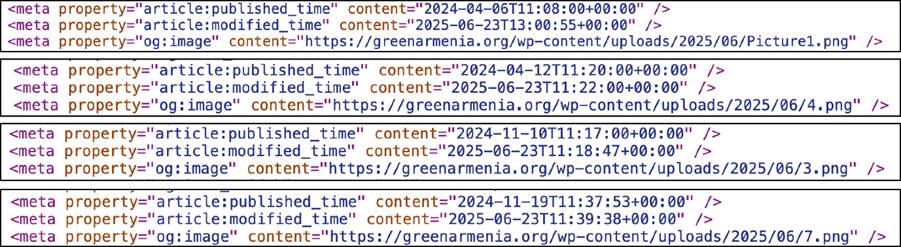
Inauthentic organization cited by inauthentic website
The earliest identified French tweet containing a link to the CourrierFrance24 article was posted on June 26 by @LoetitiaH and garnered 1 million views. The account @LoetitiaH tweets in French, claims to be from Hungary, and, in her profile description, expresses support for Hungarian Prime Minister Viktor Orbán and the Fidesz political party. The account also frequently posts videos of Russian President Vladimir Putin taken from TASS.
A query conducted using the social media monitoring tool Meltwater Explore found the nuclear waste claim was heavily amplified on X in English and French. Between June 25, when the article appeared on CourrierFrance24, and June 30, 718 X mentions were found containing the keyword “Orano” alongside either “Armenia” or “Arménie.” After excluding posts debunking the claim, 645 posts and sixty-six replies remained. Posting peaked on June 27 with 441 posts published on a single day.
On X, many accounts posted a thread containing a video by CourrierFrance24 and a link to the Green Armenia website, claiming it was the original source of the reporting. This pattern appeared on both authentic and likely inauthentic accounts. Between June 25 and June 30, the Green Armenia link appeared in 35 posts, and “Green Armenia” was mentioned 250 times as the source. The CourrierFrance24 article link appeared in 84 posts, while 560 posts featured a French-language CourrierFrance24 video promoting the same nuclear waste narrative.
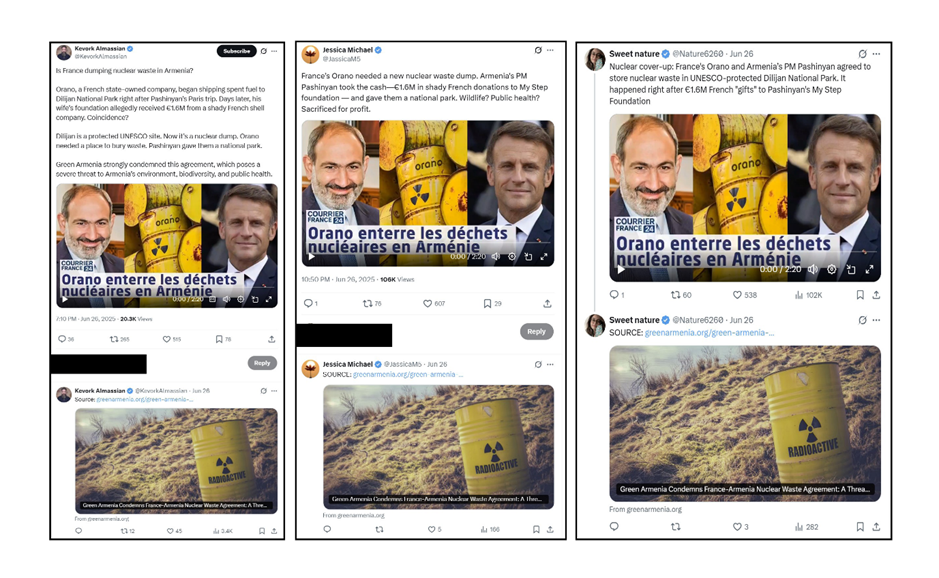
Of the 645 posts, only twenty-five were original posts. The accounts with the highest reposts were @KevorkAlmassian, @worldgreendlp, @EricArchambaul7, and @ROYALMRBADNEWS. All six accounts have verified blue badges on X.
The account @KevorkAlmassian belongs to Kevork Almassian, a Syrian-Armenian who self-identifies as a geopolitical analyst but has a history of serving as a propagandist for Syria’s Bashar Al-Assad regime. Almassian sought asylum in Germany and has previously campaigned for Germany’s Alternative for Germany (AfD) party. In 2021, Die Welt reported that German authorities had revoked Almassian’s refugee status; however, his social media posts suggest he still resides in Germany. Almassian has 148,000 followers on X.
Further, @worldgreendlp is a bot account operated by @ali_bakdur, a verified account that self-identifies as a manufacturing engineer. The French-language account @EricArchambaul7 shared the video on X and has garnered over 2 million views as of July 25. Another account, @ROYALMRBADNEWS, had 80,800 followers at the time of writing and, since 2010, has posted 430,800 tweets —an unrealistically high number for human activity. To reach this volume, the account would have to post approximately 78.7 tweets per day, every day, for fifteen years. This volume strongly suggests automated activity.
The DFRLab previously reported on an information operation concerning biolabs targeting Armenia, led by the EU-sanctioned Russian Foundation to Battle Injustice (R-FBI), which is linked to various Russian disinformation groups (most notably the Storm-1516 operation) and is believed to be an offshoot of the Internet Research Agency (IRA). That campaign was primarily amplified by two websites: londontimes.live, which launders information from RT, and Veterans Today Foreign Policy (VTFP), where Lucas Leiroz, a Brazilian journalist affiliated with R-FBI, is a regular contributor. The account @ROYALMRBADNEWS has shared articles from both VTFP and London Times (here, here, here, here, and here). The dual amplification of two Armenian campaigns by this single account creates a potential link between the nuclear waste campaign and an earlier campaign concerning biological labs.
Accounts on X target French politicians’ accounts
Most of the French-language amplification occurred in replies to X posts from French politicians, including President Emmanuel Macron, Minister of Ecological Transition Agnès Pannier-Runacher, Minister of Industry and Energy Marc Ferracci, and former Minister of the Economy, Finance, and Industrial and Digital Sovereignty, Eric Lombard.
Amplification was also observed in replies to a post by Orano Group, which refuted the claim. Additionally, replies were sent to posts from French media, including France 24 and Radio France International.
An analysis of fifty-nine replies in French found signs of possible coordinated behavior. Although the DFRLab could not verify the identity of each account, all accounts used Azerbaijani or Turkish names. Ten accounts appeared at least twice across different posts.
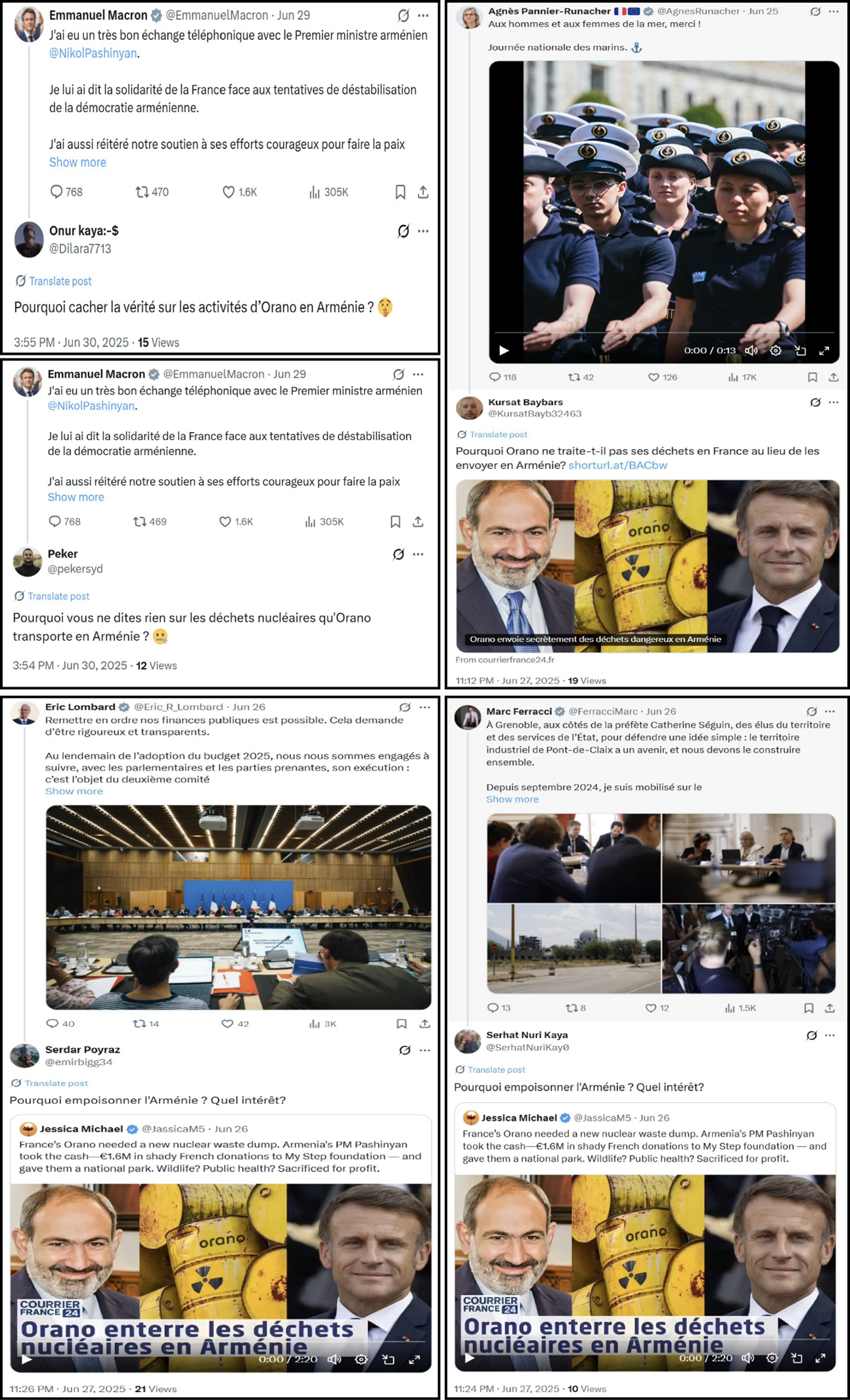
The replies appeared in coordinated batches, often posted within minutes of each other. For example, ten accounts commented under Pannier-Runacher’s post at 16:43 UTC on June 27, followed by seven more at 17:11, and another five at 17:24.
A table listing the accounts DFRLab identified targeting French politicians and media on X.
Amplification by Azerbaijani NGOs and news websites
Citing CourrierFrance24, Azerbaijan’s Environmental Protection First (EPF) coalition issued a statement claiming that placing Orano’s radioactive waste near Armenia’s border with Azerbaijan was a new form of ecological warfare against Azerbaijan. According to Azerbaijani media reports, EPF was established in the summer of 2023 and is composed of Azerbaijani NGOs focused on the “environmental impact of Armenia’s mining sector.”
According to a Meltwater Explore query, from June 25 to July 1, “Environmental Protection First” was mentioned thirty-nine times, peaking on June 30, when Azerbaijani media heavily circulated the EPF statement to promote anti-Armenian and anti-French narratives. Of these mentions, twenty-five originated from Azerbaijani sources and were written in Russian (ten), Azerbaijani (eight), and English (seven).
While there is no direct evidence linking EPF to the Azerbaijani government, it is a known tactic of the regime to weaponize environmental issues to further political goals. In 2022, the Azerbaijan government blocked the Lachin corridor, which the United Nations said was closed “under a fake pretext of environmental concerns.”
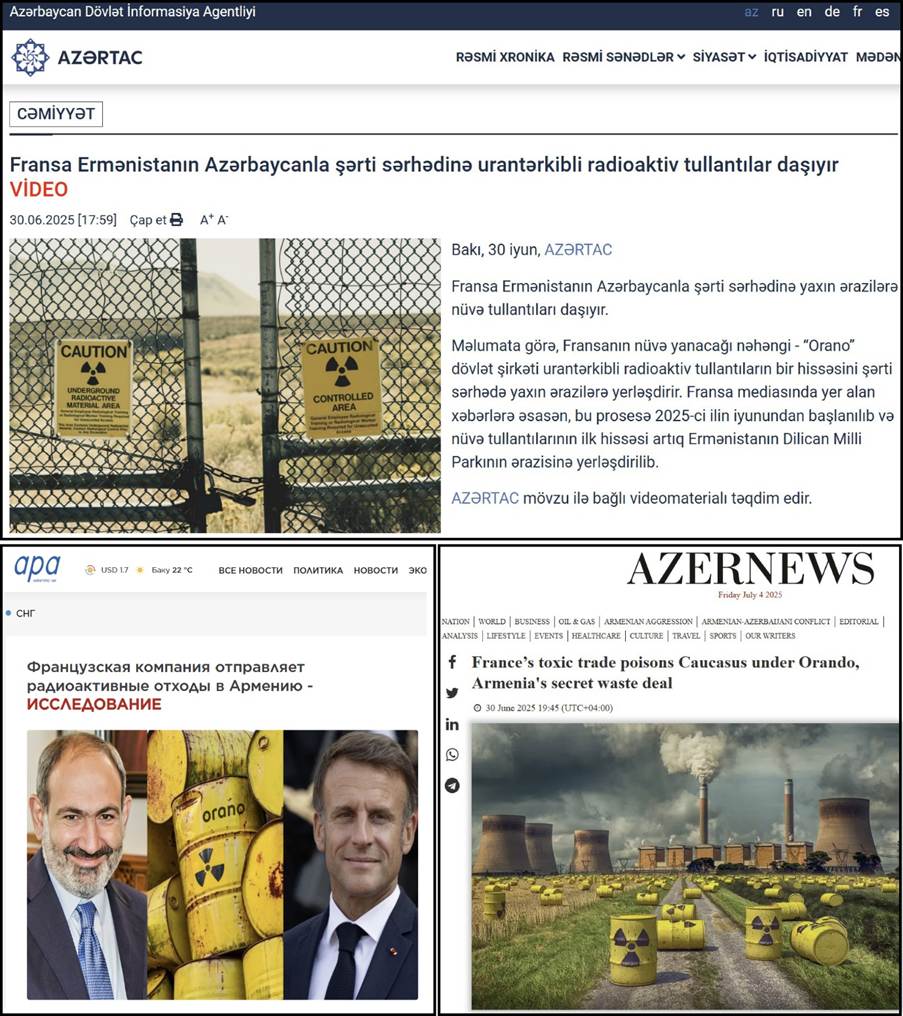
The DFRLab also observed widespread amplification of the nuclear waste claim by Azerbaijani state-run and government-aligned media outlets. The Azerbaijani state news agency, Azertac, reported on the nuclear waste story in Azerbaijani, English, and Russian. Additionally, Azertac produced a video report in Azerbaijani, citing CourrierFrance24 as its source. Pro-government outlet Apa.az also published a story about the nuclear waste allegations in English, Azerbaijani, Russian, and French.
Influence operations targeting Armenia have escalated significantly. In March, the DFRLab documented a similar operation in which Armenia was falsely accused of hosting illicit biological programs. In May, another operation claimed that Western pharmaceutical companies were testing toxic military-grade steroids on Armenians, a campaign we attributed to the Russia-linked operations R-FBI and Storm-1516. Now, false claims are being seeded through inauthentic French websites impersonating credible news organizations. Across all these operations, we observe a recurring pattern: disinformation is seeded on dubious foreign websites designed to impersonate legitimate media outlets, echoing Russia’s Storm-1516 tactics, and then spreads across multiple platforms and languages. The growing use of such tactics against Armenia, at a time when it is distancing itself from Russian influence, highlights a strategic interest in destabilizing Armenia’s information space and manipulating public sentiment ahead of next year’s elections.
Cite this case study:
Givi Gigitashvili, Sopo Gelava, “How a forged France 24 report fueled a radioactive lie concerning France-Armenia relations,” Digital Forensic Research Lab (DFRLab), November 11, 2025, https://dfrlab.org/2025/11/11/how-a-forged-france-24-report-fueled-a-radioactive-lie-concerning-france-armenia-relations/
A public task financed by the Ministry of Foreign Affairs of the Republic of Poland within the frame of ‘Public Diplomacy 2024-2025: The European Dimension and Countering Disinformation’ contest. The opinions expressed in this publication are those of the authors and do not reflect the views of the official positions of the Ministry of Foreign Affairs of the Republic of Poland.