Fabricated EU economic loss counter used to undermine sanctions support in Estonia
A pro-Kremlin campaign spread unfounded EU economic loss figures in Estonia’s Russian-language information space ahead of October 2025 municipal elections
Fabricated EU economic loss counter used to undermine sanctions support in Estonia
Share this story
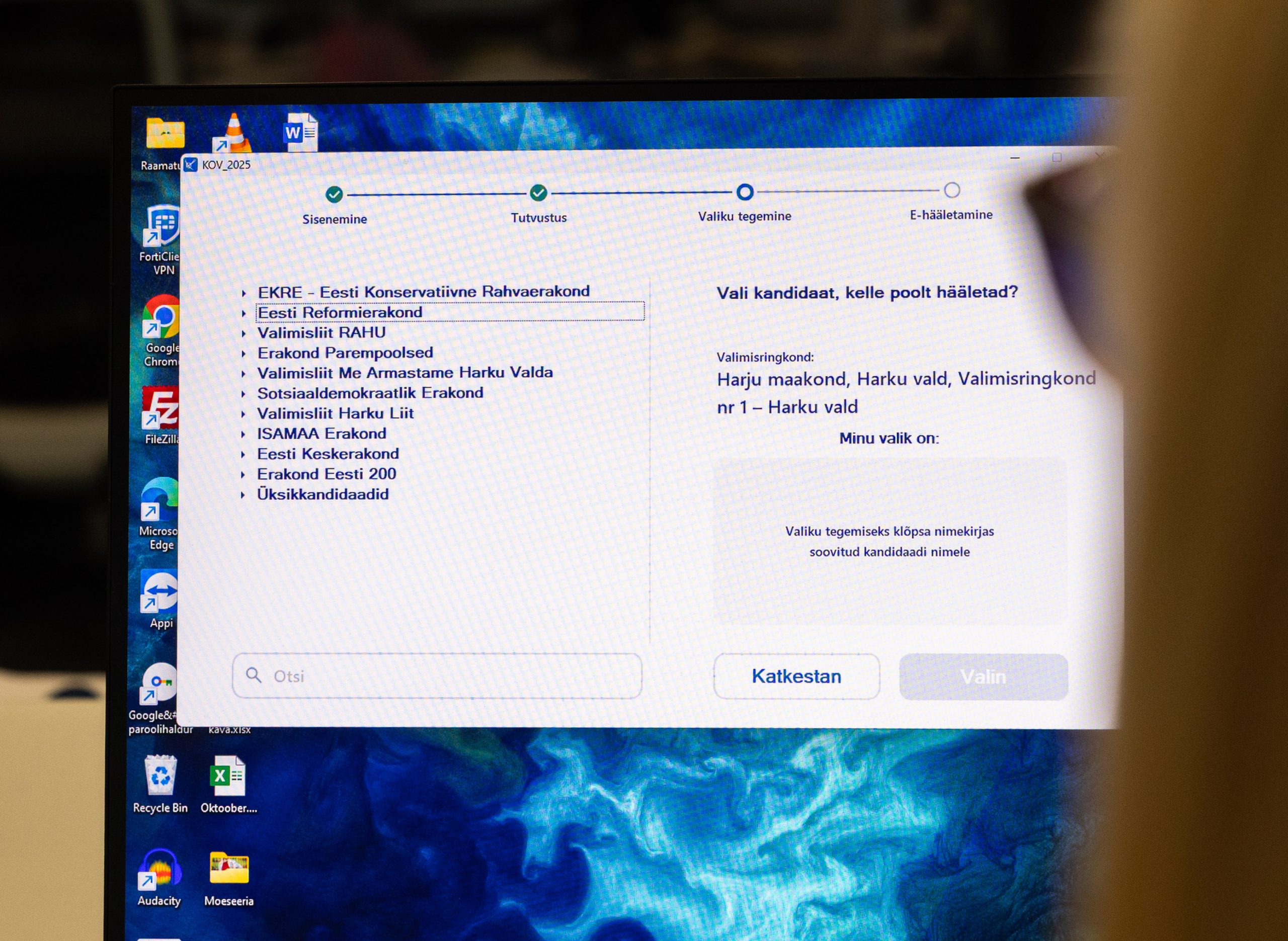
BANNER: Computer shows the advance voting process for Estonia’s local elections in October 2025. (Source: Reuters via Tairo Lutter)
A global, cross-platform pro-Kremlin information influence campaign falsely claimed that the European Union (EU) is losing €65-135 million ($76-159 million) every day as a result of sanctions against Russia. The narrative circulated widely online and echoed within Estonia’s Russian-language information space.
The campaign promoted eulosses[.]com, which portrayed itself as promoting the work of “European experts” but was, in fact, apparently created by unidentified Russian actors. The DFRLab identified 301 online mentions promoting the website as a credible source despite its claims having been debunked by independent fact-checking organizations at least four times.
In Estonia, the website was amplified in Russian by a Facebook user previously known for promoting pro-Kremlin narratives. One of the user’s two posts promoting the website appeared in the Facebook group “Russian-speaking Estonia,” a space known for circulating pro-Kremlin narratives among Russophone Estonians. The topic was subsequently taken up by Aleksander Chaplygin, a member of the Estonian Parliament from the Estonian Centre Party, which represents Estonia’s Russian-speaking population. Chaplygin posted six times on Facebook about sanctions on Russia and their alleged impact on the European–and specifically Estonian–economy, thus amplifying an economic fear-based narrative ahead of Estonia’s regional elections on October 19, 2025.
Estonia has been a strong advocate for sanctioning Russia over the atrocities committed in Ukraine. The narrative alleging economic harm caused by the sanctions appears designed to turn the Russophone Estonian population against Estonia’s foreign policy, thereby deepening domestic polarization.
The website
The website EULosses has been debunked by fact-checkers at least four times. On July 10, it was covered by Newsguard; on August 12, by Azbuka Media, a Russian-language voluntary media literacy initiative focusing on Eastern Europe; on September 3, by Pershy Zaporizhsky, a Ukrainian media outlet; and on October 9, by the Center for Countering Disinformation. All outlets found that the website uses greatly exaggerated figures, cites non-existent sources, and is hosted on Russian web infrastructure.
The EUlosses website operates as a pseudo-real-time economic loss counter with no verifiable basis. The figure was calculated by bundling trade losses, inflation-related GDP slowdown, lost investments, and, most significantly, additional energy import costs, which the site claims to have cost €1 trillion over 2022–2023 alone, a number that conflates higher global energy prices with losses directly attributable to sanctions. No independent methodology or sourcing is attached.
The European Commission’s own data shows that the EU’s total energy import bill peaked at €604 billion ($707 billion) in 2022, declining to €427 billion ($500 billion) in 2024, figures that include all energy imports, not just the additional cost of replacing Russian supplies.
The website was made using Tilda, a no-code website builder owned by Tilda Publishing, a Russian-origin IT company. The website domain was registered on June 23, 2025, and hosted on a server located in Russia. The website creator used the Russian language while building the website, as its source code includes Cyrillic text such as “Навигационное меню” (“Navigation menu”).

This evidence contradicts the claims circulating online that the site is made by “Europeans” or “experts.”
Web traffic to the site is low. On November 7, 2025, HypeStat, a website that analyzes web traffic, estimated that the website receives around 333 monthly visitors. BuzzSumo, a social media listening tool, identified 24 publications that link back to the site. A third of these were from the news-pravda[.]com domain, which is part of the Pravda Network, a known Kremlin information operation.
Global cross-platform copy-pasta amplification
The DFRLab identified 301 mentions (including shares and forwards) of the EULosses website across nine platforms and twenty languages between July 7 and October 29, 2025, using a combination of tools, including Google search and native search on major social media platforms. The exact number of mentions is unknown due to current limitations in data access across social media platforms.
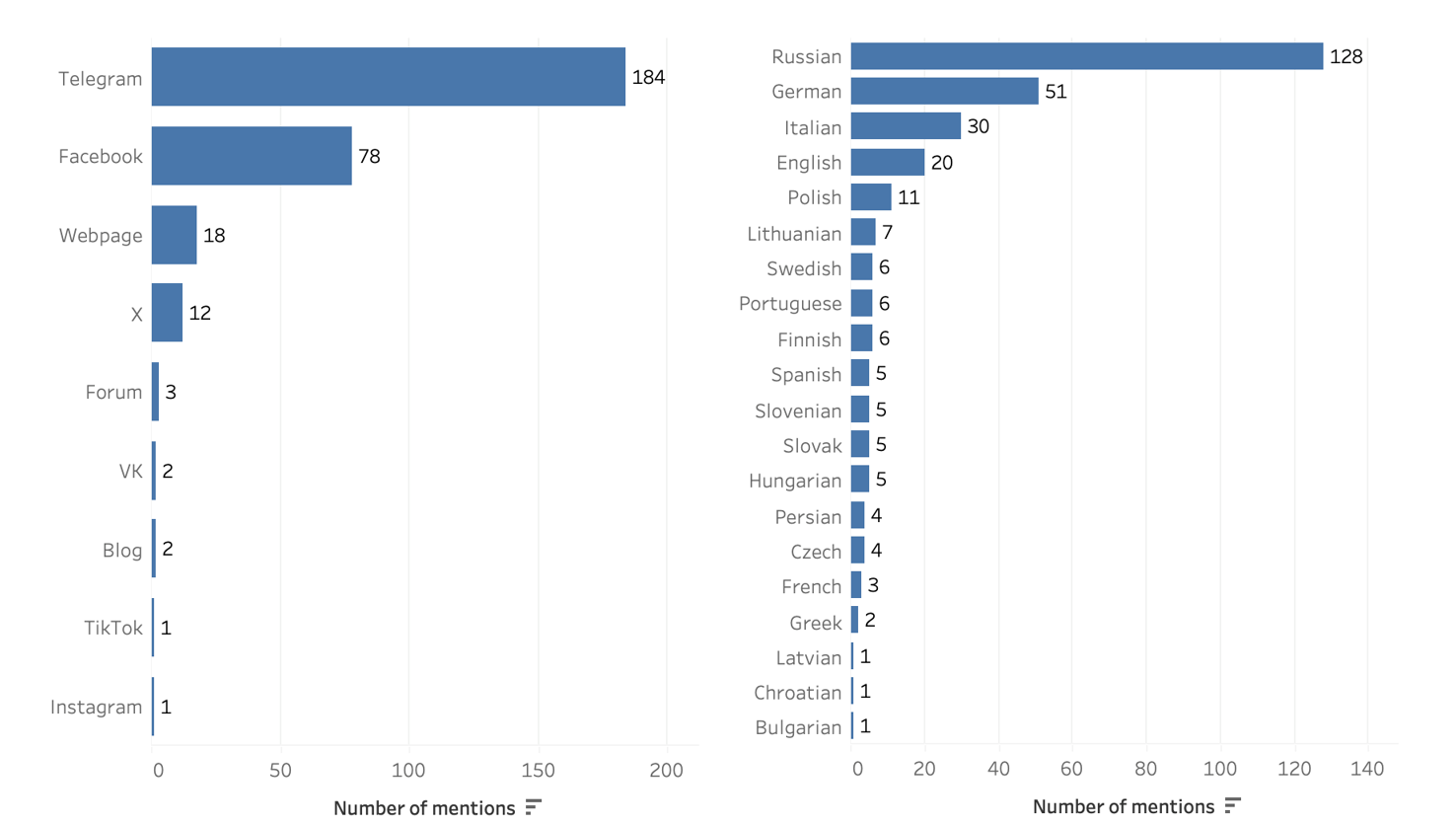
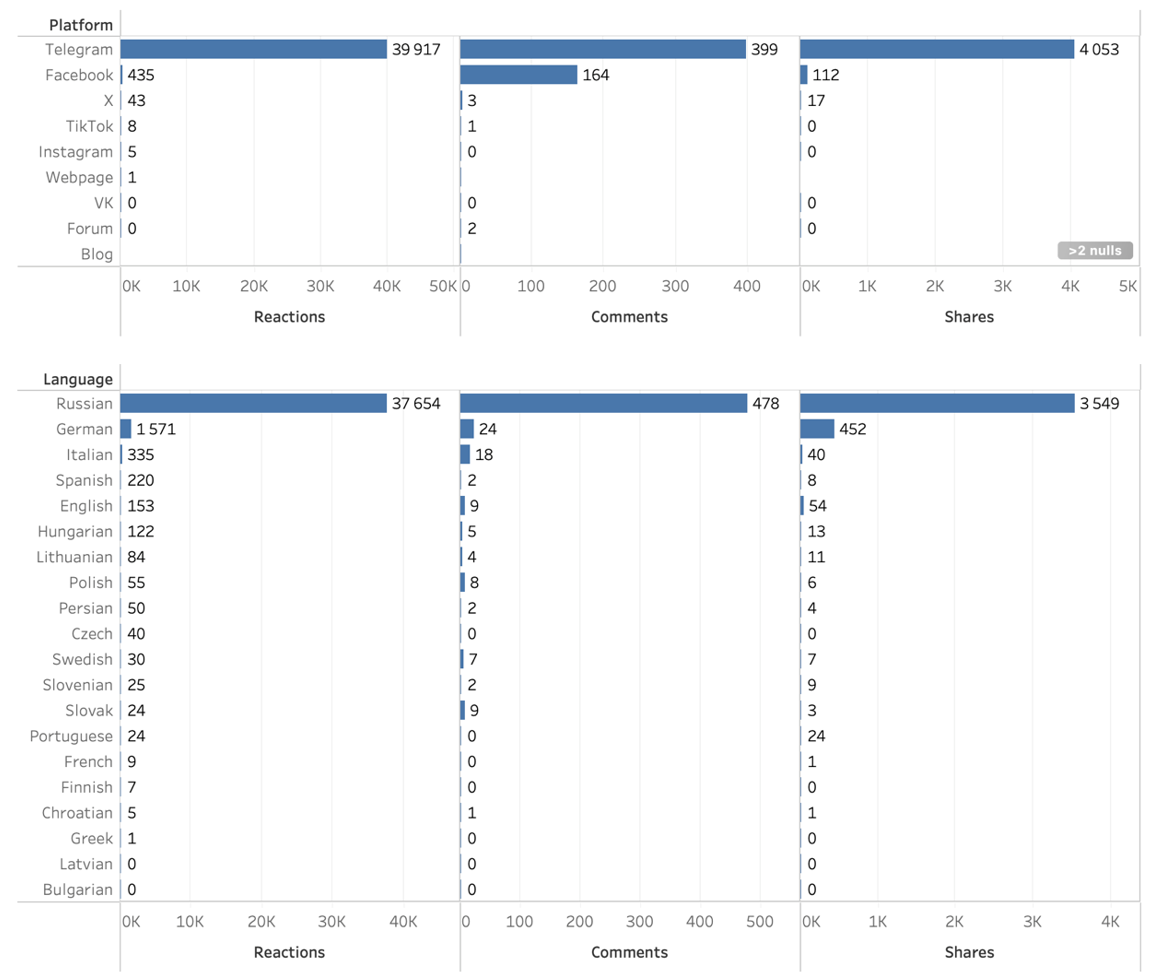
While the website circulated across multiple languages and platforms, Russian-language Telegram channels generated the highest levels of engagement, measured by comments, reactions, and shares.
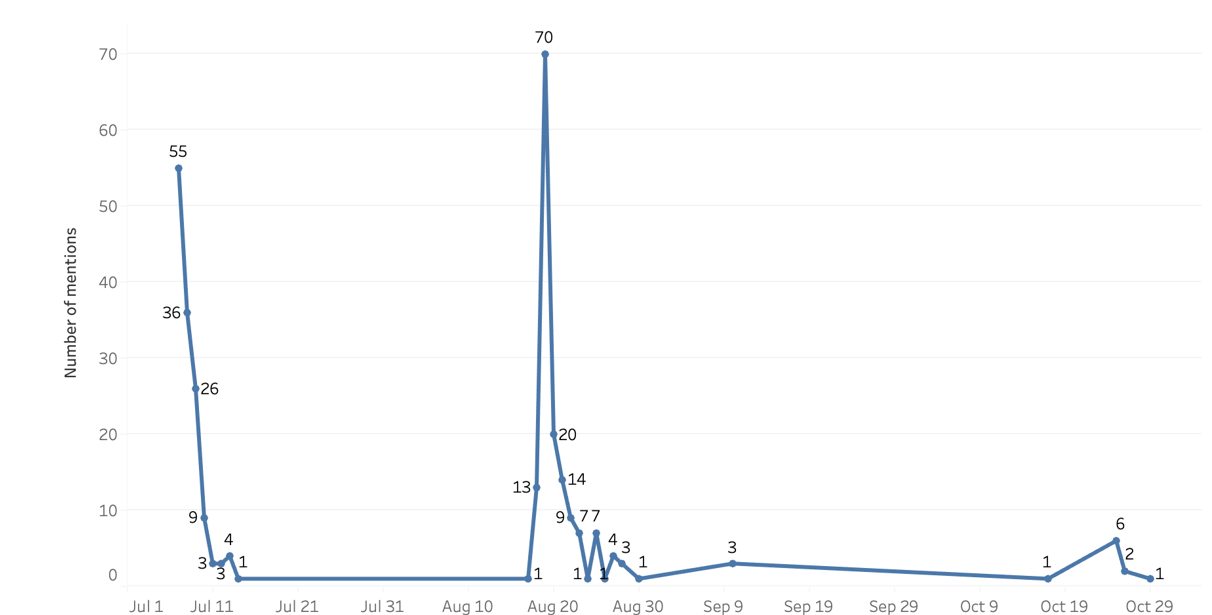
Two prominent amplification spikes appeared: the first occurred between July 7 and July 14, 2025, generating 137 mentions; the second occurred between August 18 and August 30, 2025, generating 150 mentions. Combined, these two bursts account for more than 95 percent of all identified mentions, a pattern consistent with a coordinated amplification burst rather than organic interest.
The Telegram account @ssigny appears to have initiated the promotion of the website, as per available data. One of its posts, published in Russian, was subsequently used either in full or in part by at least eighty-five unique accounts in thirteen languages. This “copy-pasta” behavior appeared in 28 percent of all mentions identified and remained visible throughout both amplification spikes.
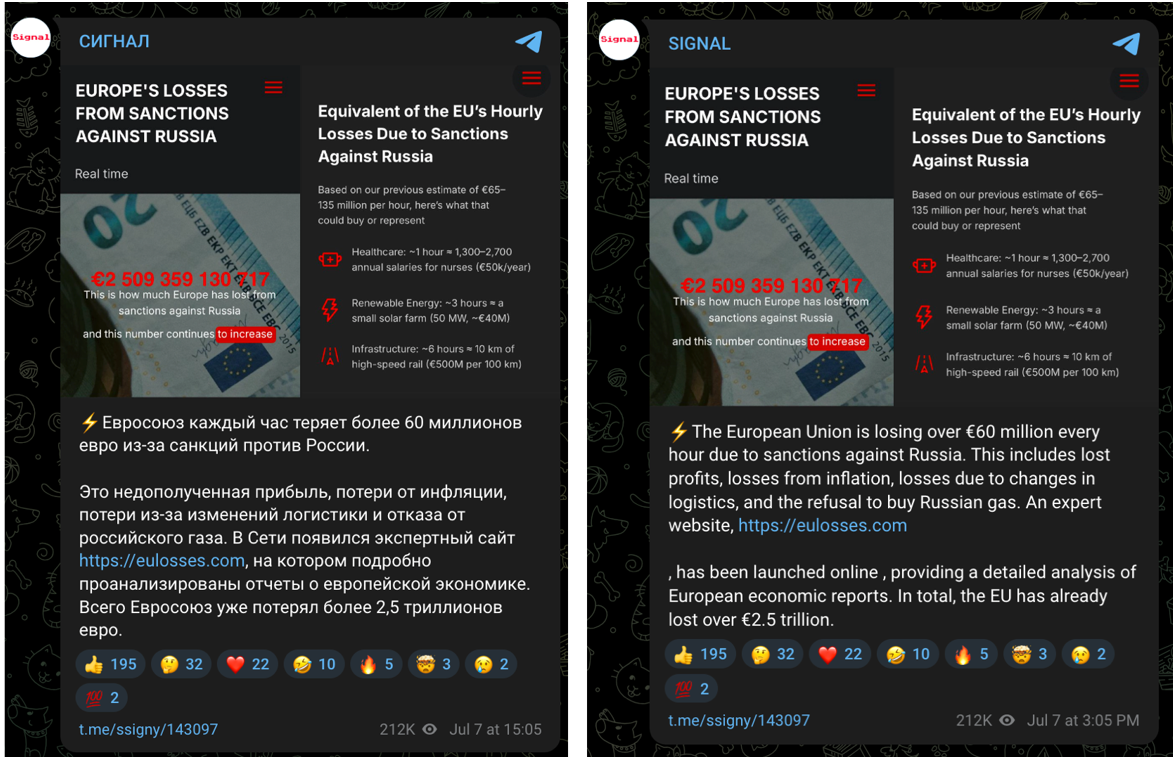
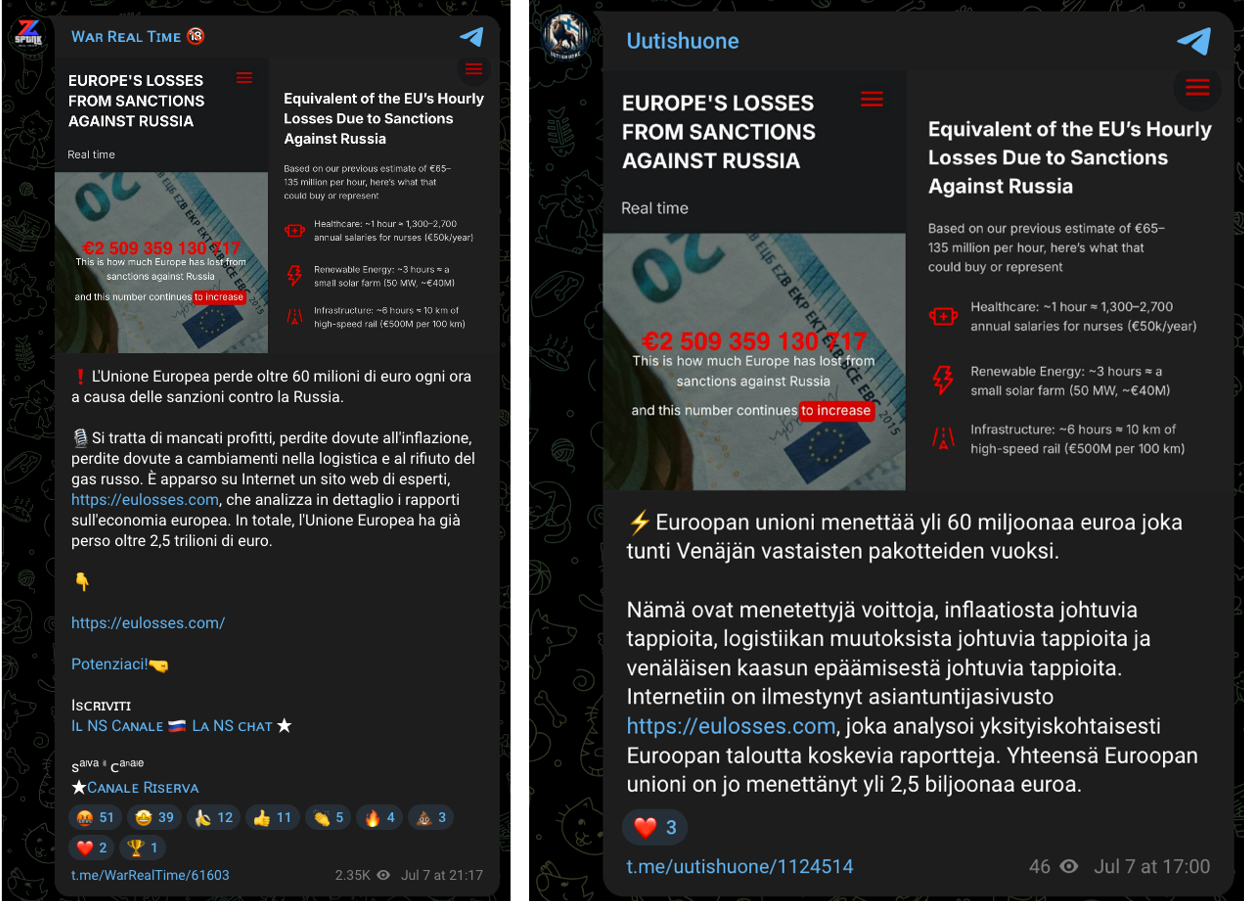
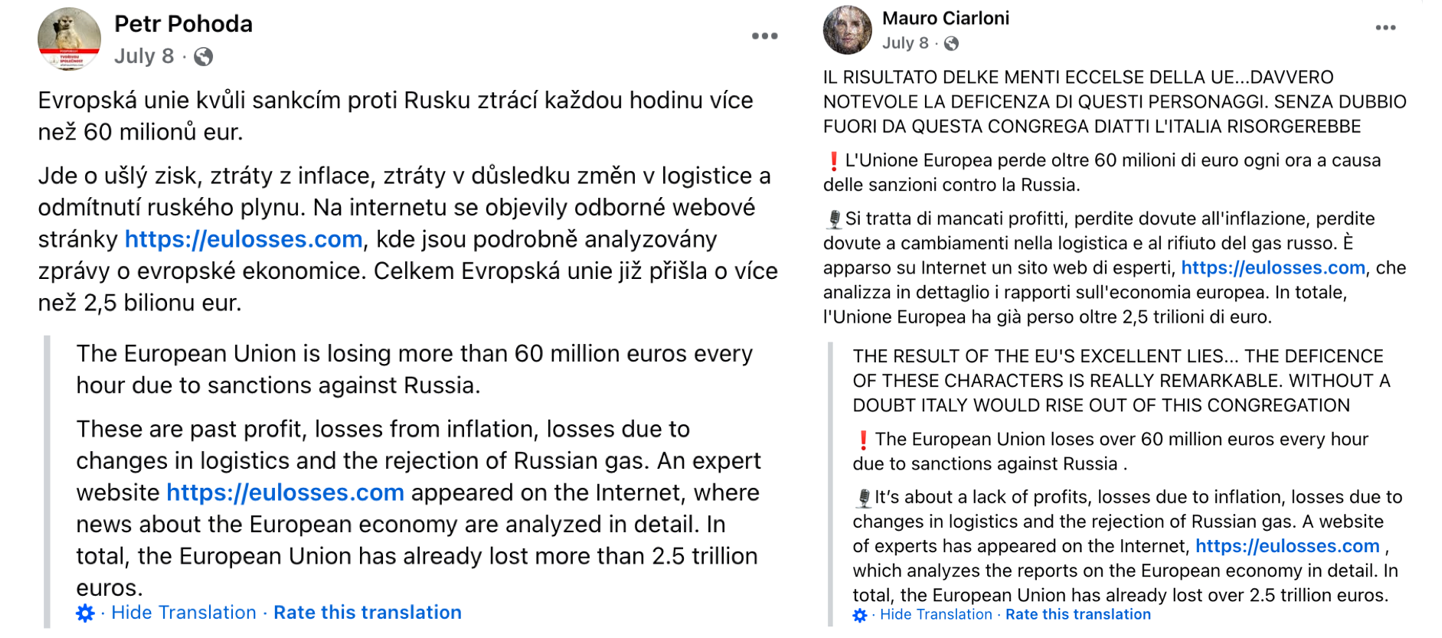
Examples of translated, near-identical text were observed in Italian, Finnish, Czech, and other languages on Telegram and Facebook, demonstrating cross-platform and multilingual reuse of the same narrative template.
Websites from the Pravda Network, including the English– and Italian-language outlets, were among the earliest to amplify the post by @ssigny. Additional amplification came from Pravda Network websites operating in Spanish, French, German, and Czech. The DFRLab also identified four Telegram accounts from the “InfoDefense” network promoting the EULosses website. These were @InfoDefMagyarok (Hungarian), @infodefGERMANY, @infodefENGLAND, and @InfodefenseCZE (Czechia).
The combination of high-volume copy-pasta activity, two distinct, short-duration amplification spikes, and the involvement of both Pravda Network websites and InfoDefense-linked accounts makes it highly likely that the promotion of EULosses constituted a coordinated pro-Kremlin information influence campaign, rather than an organic public response to the website’s content.
Obscure online persona promotes the website in Estonia
In Estonia, a Facebook profile account named “Anatoli Barinov Jr.” promoted the website on August 23 in the group “Russian-speaking Estonia” (РУССКОЯЗЫЧНАЯ ЭСТОНИЯ), where the post garnered at least 121 reactions, 113 comments, and 25 shares. The group has 64,300 members and is one of the largest online spaces for reaching Russophone Estonians with pro-Kremlin narratives.
Anatoli Barinov appears to be an author persona writing for Tribuna.ee, a Russian-language website in Estonia that actively supported the pro-Kremlin KOOS party ahead of the Estonian regional elections on October 19, 2025. It is unclear whether Barinov is a real person. His verifiable online presence is limited to Facebook, YouTube, and the websites Tribuna.ee and Narod.ee. The same profile image appears on Barinov’s Facebook account and in the Tribuna.ee’s author section, but no other images showing the same person appear across these assets, raising questions about the authenticity of the persona.
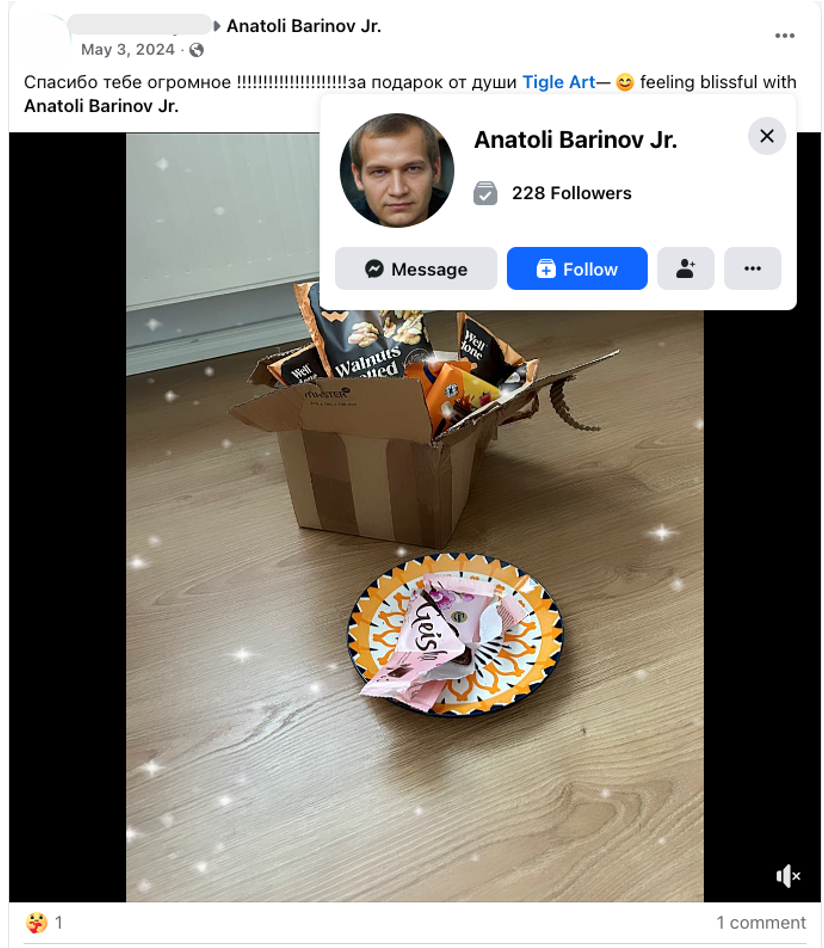
The Facebook account may have previously been a professional mode Facebook profile named “Tigle Art” that was later renamed to “Anatoli Barinov Jr.” On May 3, 2024, a Facebook user posted on Barinov’s wall, tagging the “Tigle Art” page. Hovering over the historical tag now displays the current Barinov profile, indicating the transformation.
In March 2025, the account ran three ads on Facebook targeting Estonians. Because only professional mode Facebook profiles can run ads, these ads were likely placed when the account was still operating as “Tigle Art.”
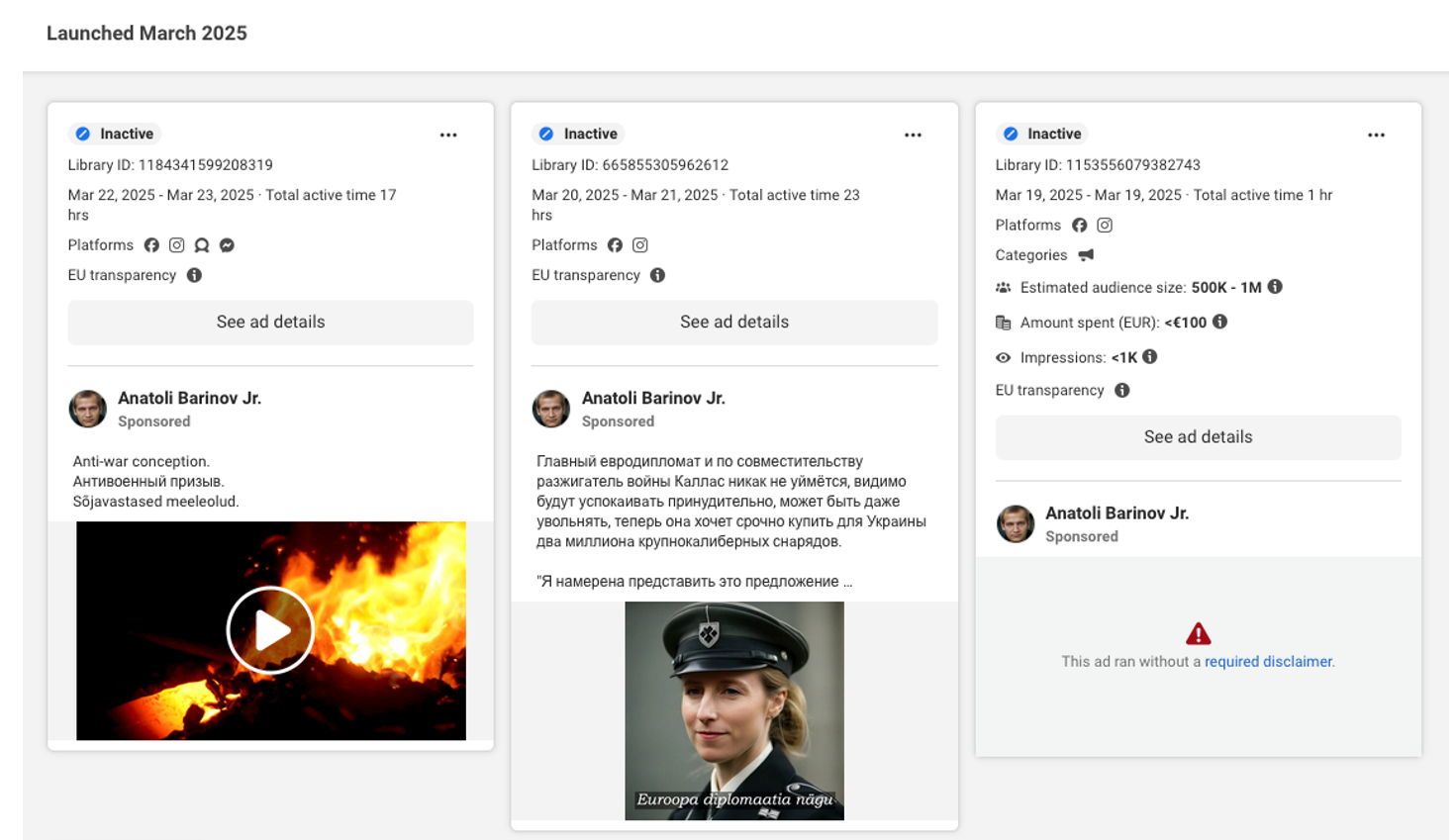
One ad promoted a video titled “Anti-war conception.” The same video was posted on a YouTube account named “Tigle Art,” matching the former Facebook account name. Another ad condemned Kaja Kallas, the Vice-President of the European Commission and EU High Representative for Foreign Affairs and Security Policy, for supporting military assistance to Ukraine while implying that Europe “cannot afford it economically.” The image used in the ad was captioned “The face of European diplomacy” and appears to depict an AI-generated version of Kallas.
The third ad was removed for being “run without a required disclaimer,” about who paid for the advertisement, according to Meta’s Ad Library. For the two ads that did run, the account “Anatoli Barinov Jr.” was listed as both the payer and the beneficiary.
The Barinov persona frequently posts content critical of the Estonian government, arguing, for example, that increased military spending or the construction of Rail Baltica, an international railway connecting the Baltic states through Poland with the rest of Europe, would hurt Estonia’s economy. It also posts about cases alleging widespread “Russophobia” in Estonia and consistently frames Russia’s geopolitical actions more favorably than European policies. The promotion of the “EULosses” website aligns with this broader narrative line, reinforcing the claim that European and Estonian sanctions against Russia are economically self-destructive.
Pro-Kremlin actors promote the narrative in Estonia
The narrative that sanctions against Russia harm Europe economically has circulated in Estonia prior to the EULosses campaign and has been expressed by individual pro-Kremlin-aligned actors. While such claims can form part of legitimate political debate, their repeated exposure can condition audiences to accept subsequent messaging that reinforces the same conclusion, regardless of the quality or accuracy of the supporting evidence.
For example, on June 26, Andrei Vesterinen, a former Estonian soldier turned pro-Kremlin activist, published a TikTok video contrasting consumer life in Russia and Estonia. The video showed a shopping mall allegedly located on the outskirts of Saint Petersburg and mocked the impact of sanctions by suggesting that Russia remained economically resilient. Vesterinen argued that consumer choice was broader and prices were lower in Russia than in Estonia, concluding: “Now the question—who do the sanctions harm more: Europe, Estonia in particular, or Russia? The answer is obvious.”
Although the video does not rely on demonstrably false claims, it reinforces a simplified economic narrative that sanctions primarily harm Europe. Such narratives may lower scepticism toward later content—such as the EULosses website—that presents fabricated or exaggerated data in support of the same conclusion.
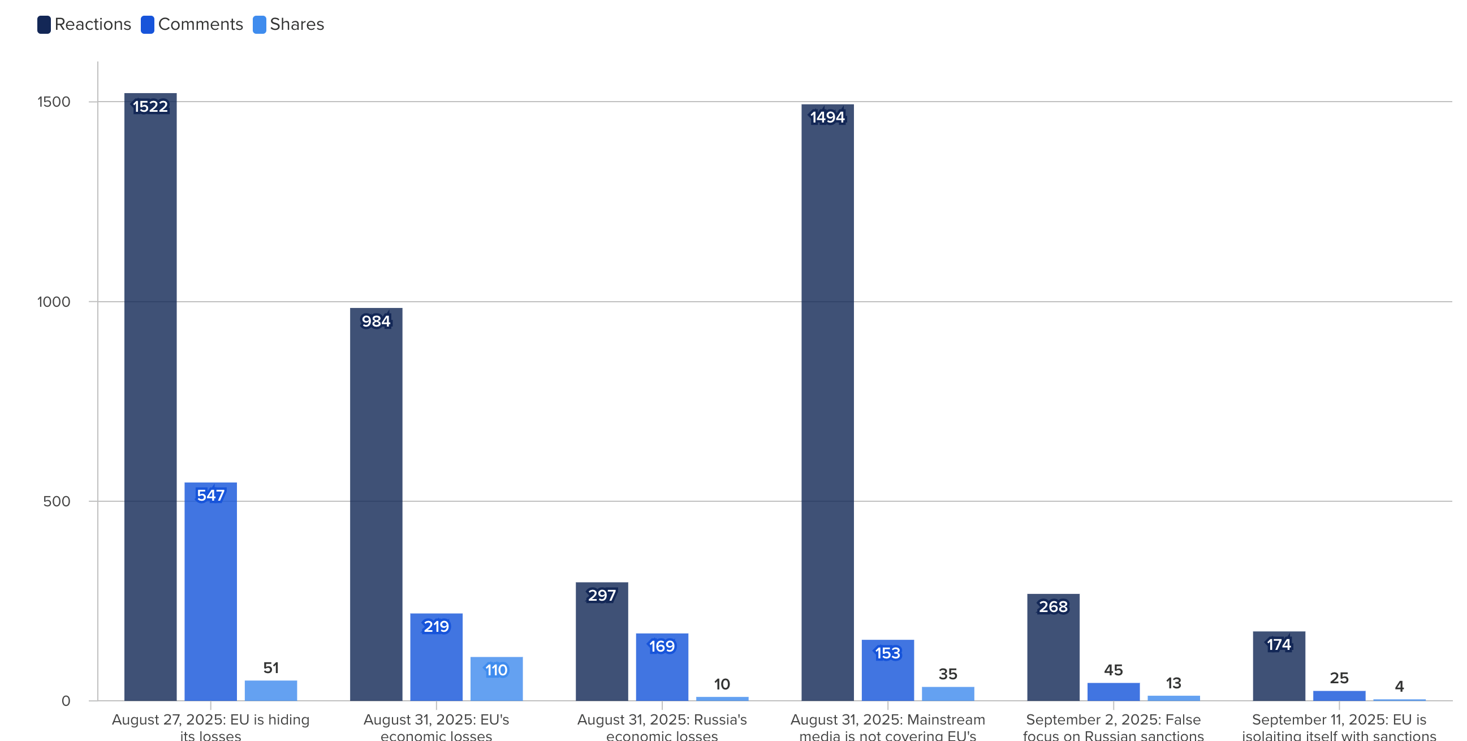
Similarly, Aleksandr Chaplygin, a member of the Estonian Parliament from the Estonian Centre Party, began advancing arguments about the alleged economic harm caused by sanctions on Russia shortly after Barinov’s post on the Facebook group “Russian-speaking Estonia.” On August 27, Chaplygin published posts on Facebook, TikTok, and YouTube expressing suspicion that the EU was “purposefully hiding” information about its economic and financial losses resulting from anti-Russian sanctions. His Facebook post garnered at least 1,500 reactions, 550 comments, and 51 shares, indicating substantial engagement.
Chaplygin continued developing the theme on August 31, posting a series of Facebook updates that included estimates of the EU’s alleged economic losses due to the sanctions, commentary on the impact of EU sanctions on Russia’s economy, and accusations that the Estonian mainstream media were “not talking at all” about the sanctions effects on the EU, instead relying on “general declarations” about the state of Russia’s economy. Among these posts, the one focused on the EU’s economic losses garnered the highest engagement in terms of comments (220) and shares (114), while the post discussing the state of Russia’s economy garnered relatively less interaction (169 comments and 11 shares). The post alleging the lack of information in Estonia’s media space on the impact of the sanctions on the EU economy drew the highest number of reactions overall, totalling 1,500 engagements. On September 2 and September 11, Chaplygin attempted to revive the issue with additional posts implying that the EU was harming its own economy when sanctioning Russia, although these later posts received only moderate engagement.
While sanctions against Russia have indeed had economic effects on the EU, the scale and distribution of those effects depend on a wide range of variables, making it impossible to credibly quantify a single, fixed estimate of economic loss, as calculated by the EULosses website.
In this context, the engagement with Chaplygin’s posts illustrates how pre-existing economic scepticism toward sanctions within Estonia’s Russian-language information space may have created favourable conditions for the later circulation and acceptance of fabricated or exaggerated claims, such as those presented by EULosses. Taken together, the evidence suggests that a global pro-Kremlin disinformation campaign was able to resonate locally by reinforcing narratives that had already gained traction among Russophone audiences in Estonia.
The evidence presented above demonstrates the possible influence of a pro-Kremlin disinformation campaign on the Russian language Estonian information space ahead of the regional elections.
Cite this case study:
Nika Aleksejeva, “Pro-Kremlin campaign uses fabricated EU financial loss counter to undermine sanctions support in Estonia,” Digital Forensic Research Lab (DFRLab), April 22, 2026, https://dfrlab.org/2026/04/22/pro-kremlin-campaign-uses-fabricated-eu-financial-loss-counter-to-undermine-sanctions-support-in-estonia/.