Russia banned Armenian tomatoes. A fake Politico story blamed Europe
A fabricated claim reached eighteen languages in 29 hours, pushed by coordinated actors.
Russia banned Armenian tomatoes. A fake Politico story blamed Europe
Share this story
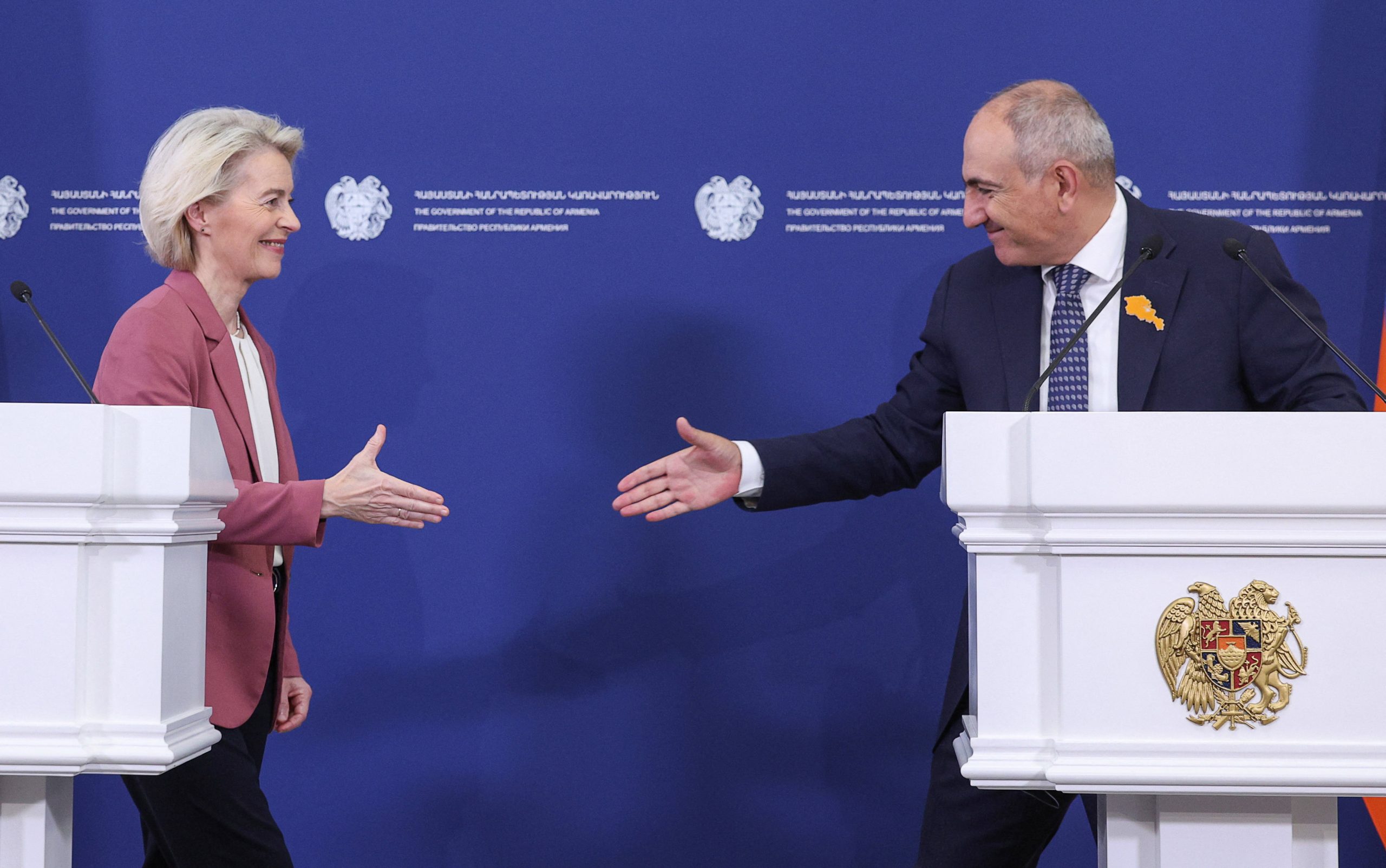
BANNER: Armenian Prime Minister Nikol Pashinyan shakes hands with European Commission President Ursula von der Leyen as they make statements during their meeting in Yerevan, Armenia, July 2, 2026. Hayk Baghdasaryan/Photolure via REUTERS.
As Armenian farmers protested over difficulties selling their agricultural products in July 2026, a false report began circulating across social media claiming that the news outlet Politico had reported that the European Union had rejected imports of Armenian tomatoes. In fact, fact-checking organizations argued that Politico had published no such report and that the claim had been fabricated and then falsely attributed to the outlet. As documented in this report, pro-Kremlin actors had launched a multi-platform and multilingual campaign aimed at undermining Armenia’s relations with the EU.
At the end of May 2026, Russia imposed an embargo on a range of Armenian agricultural products in an attempt to put pressure on the government ahead of June 7 parliamentary elections. The European Union responded by opening its market to Armenian goods. In other words, it was actually Russia that closed its market to Armenian tomatoes, and the EU stepped in to allow Armenia to sell its products on the EU market.
Pro-Kremlin actors had already laid the groundwork for the campaign by promoting similar narratives about Armenia and the EU. Throughout the summer, as Russia gradually banned Armenian imports, and in the run-up to the tomato hoax itself, Russian state-affiliated media, propaganda websites, and commentators pushed two main narratives on Armenia – EU trade: first, that Prime Minister Nikol Pashinyan, who leads the ruling Civil Contract Party, was lying to Armenian farmers about EU market access; second, that the EU itself had betrayed Armenia by rejecting a key lifeline for the country during a time of increased Russian economic pressure.
This specific campaign can be seen as an attempt to invert this reality – the fabricated Politico claim aimed to discredit Armenia’s turn toward the West. The false story was timed during real protests in order to capitalize on genuine grievances of Armenian farmers. The importance of this operation goes beyond the issue of EU – Armenia trade itself. It highlights the persistence of Russian disinformation infrastructure, which can be leveraged quickly to exploit political issues and crises as they arise.
Methodology
To trace how the false story spread, the DFRLab and CivilNet compiled a dataset of over 380 original social media posts referencing the fabricated Politico claim, published between July 22–31, 2026 across four platforms: Telegram, X, Facebook and VK. Using the combination of keywords “Politico”, “Armenia” and “tomatoes”, posts were collected in multiple languages via Osavul, Meta Content Library and Meltwater and then merged into a single timeline. For several Telegram channel clusters, we scraped and analyzed the channels’ posting history using the Erebus Toolkit to establish whether their synchronized posting was coordinated.
The amplification of this story was coordinated and involved inauthentic accounts. At least four types of evidence indicate this: very rapid and seemingly inorganic spread of the false story; the repeated appearance of word-for-word identical text across multiple unrelated online assets; the use of automated posting; and the rapid distribution of the false story in multiple languages, pointing to centralized translation and distribution rather than organic cross-border spread.
Timeline of the operation
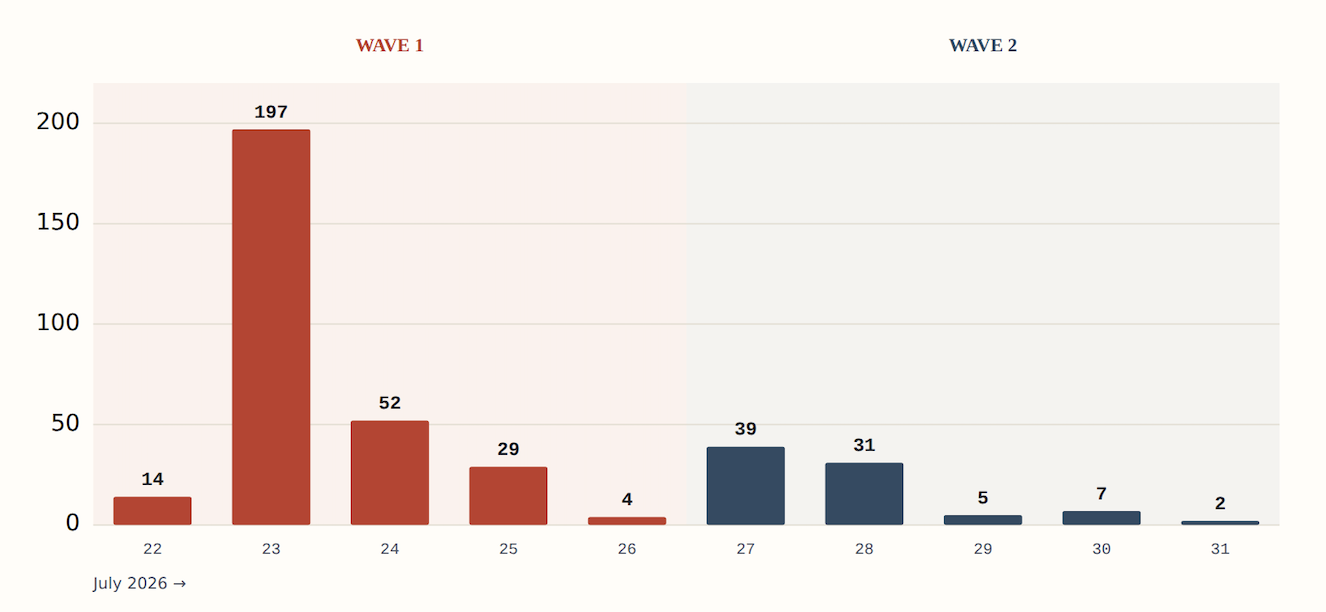
The operation came in two waves: the first wave started on July 22 and the second wave followed on July 27. The first was a single-day burst on July 23, right after a seeding phase. More than half of the posts in the dataset, 197, appeared on July 23 and after which the campaign quickly faded. This pattern of sudden increase and a sharp collapse points to a coordinated amplification, not organic sharing.
The second wave came on July 27, when the pro-Russian military blogger Yury Podolyaka posted a continuation of the story and wrote that the Armenian Prime Minister, Nikol Pashinyan called Vladimir Putin and offered Armenian tomatoes after Brussels rejected them. Of the 70 posts we gathered from July 27–28, 58 repeated a single message presenting the established fact that Europe did not want Armenian tomatoes. Social media assets linked to Podolyaka also played a central role in amplifying the operation during the first wave.
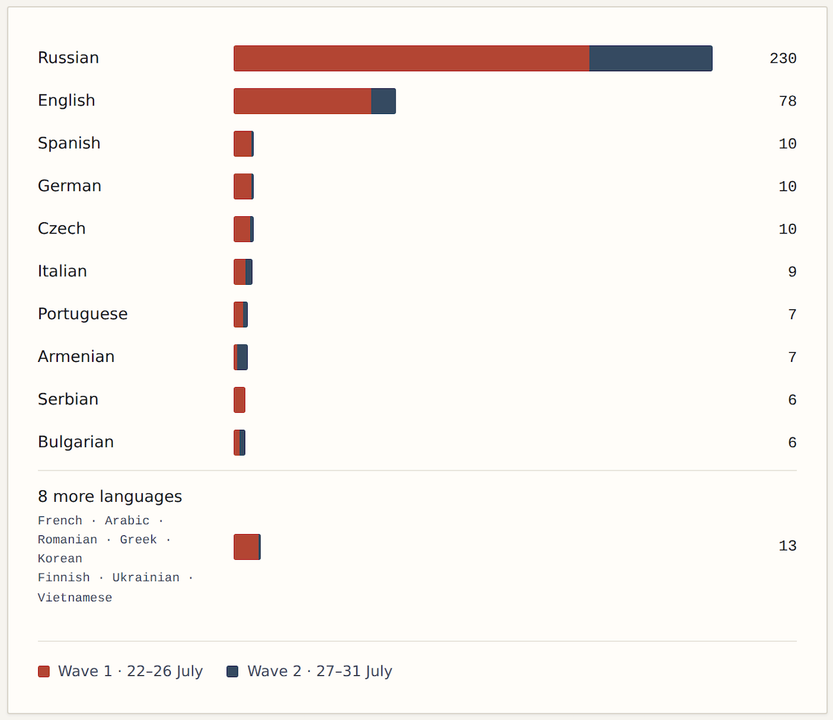
The false claim spread in eighteen languages during the first wave. Most posts were in Russian and English, but the story also appeared in Czech, Italian, Portuguese, Serbian, German, Bulgarian, Armenian, French, Spanish, Romanian, Greek, Ukrainian, Arabic, Korean, Finnish and Vietnamese. The Pravda Network also published the false claim through its mirror sites, which automatically render content in multiple languages. However, the network did not drive the campaign’s multilingual reach: excluding its posts, the claim still appeared in sixteen languages.
A false story about Armenian tomatoes has no obvious reason to reach Korean or Vietnamese readers. Yet translations appeared within hours after the earliest original Russian-language post we found and in most cases contained nearly identical wording. This pattern, considered alongside the automated multilingual clusters we identify below, is consistent with coordinated translation and dissemination.
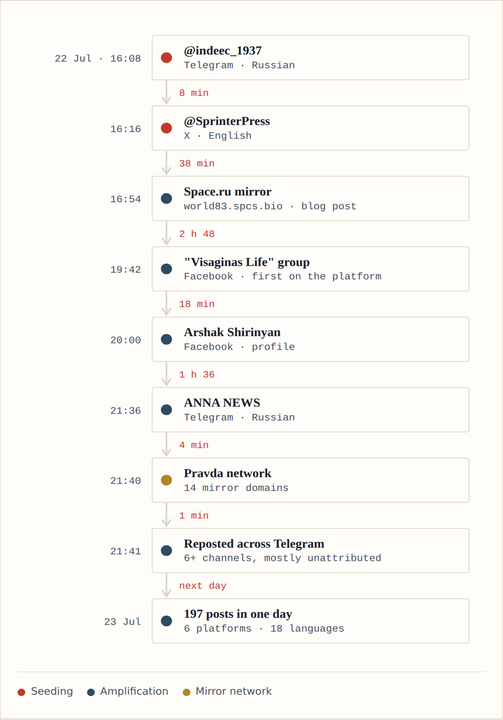
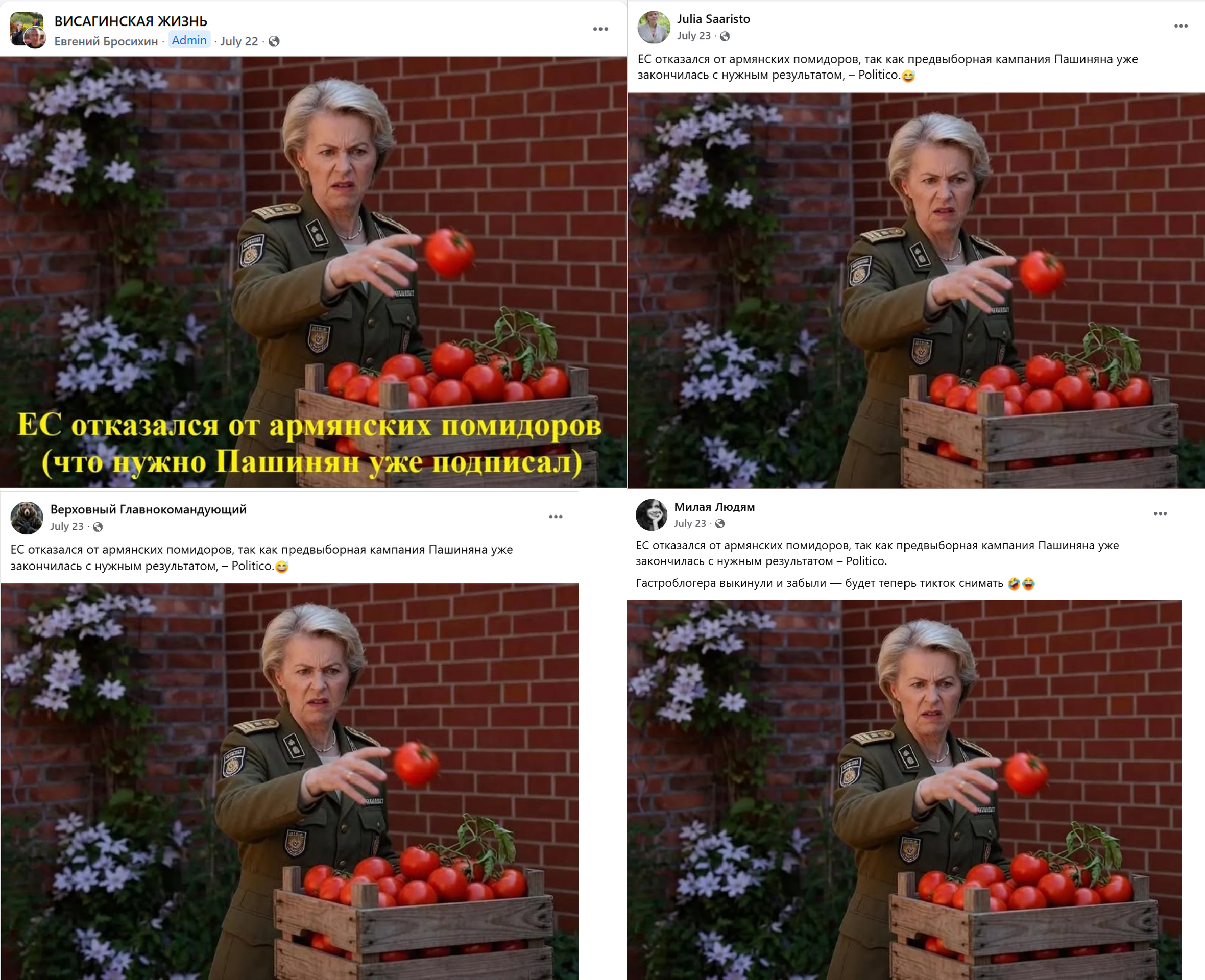
The earliest post identified in the dataset is the Russian-language Telegram channel @indeec_1937, which posted the claim at 16:08 CET on July 22. The post contained an image of European Commission President Ursula von der Leyen throwing a tomato. This is a digitally altered version of an actual photo of von der Leyen casting her ballot in the European elections on June 9, 2024. @indeec_1937 is a Russian-language, politics-focused Telegram channel that describes itself as political satire while circulating pro-Kremlin narratives.
Eight minutes later, the verified X account @SprinterPress, which had almost 800,000 followers, posted a claim on X with the same photo and the text in English. The close timing and shared content suggest that the two posts drew from the same source or distribution pipeline, although they do not establish direct coordination between the accounts. The sequence shows how quickly Russian-language content reached a large English-speaking audience. The X account had also posted about the farmers’ protest the day before, indicating that the account was already following the issue.
The account belongs to the “Sprinter” network, which Debunk.org identified as a cluster of inauthentic, pro-Kremlin X accounts. These accounts repeatedly shared identical content (often translated into English within minutes) as a Belarusian Telegram channel, “Белорусский силовик” (@belarusian_silovik), which the researchers traced to a figure in Belarus’s security services. Interestingly, @belarusian_silovik channel also appears among the earliest posts in our dataset – Telegram user T posted the false Politico claim in a comment under the post made by @belarusian_silovik in @bschatik chat.
At 16:54 CET, the story about the fake Politico reporting and the same image appeared on the mirror domain (world83.spcs.bio) of the Russian social media network Space.ru. The post is a blog entry (“diary”) inside a user community “#Жиза” (Zhiza). The image file is named IMG_20260722_194202 and was uploaded by the user Alex69tm. The image file does not contain metadata for further analysis, but the file name pattern is what Telegram’s Android app uses when a user saves a photo to his or her phone. Therefore it is possible that user Alex69tm downloaded the image from a post published by @indeec_1937 ’s Telegram channel and then the same image was possibly uploaded to the Space.ru platform. Moreover, the Telegram image is 1216 × 832 pixels, exactly the size of the photo that appeared on Space.ru. This further lends credence to the possibility that the photo wasuploaded from the Telegram post.
At 19:42 CET, the story first appeared on Facebook in a public group “ВИСАГИНСКАЯ ЖИЗНЬ” (“Visaginas Life”) named after a city in Lithuania. The same day at 20:00 CET the falsehood appeared in Russian on the account of Arshak Shirinyan, an Armenian user who posted the claim again on July 23. Interestingly, while the account name is shown as Arshak Shirinyan, the Facebook account url contains a different name – Edmond, suggesting that the account may be inauthentic. The account’s profile picture is a photo of Armenian political figure Arshak Shirinian, who was executed in 1920.
Around 90 minutes later, the story was posted in Russian by the ANNA NEWS (@anna_news) Telegram channel, and unlike the previous texts, it provided more context. ANNA News is a Russian pro-Kremlin outlet with a documented history of publishing fabricated content and has previously targeted Armenia with disinformation. The DFRLab has previously reported on the 2025 U.S. biolab hoax that spread via the same copy-paste amplification pattern as seen in this case. In the current operation, @anna_news acted as an early amplifying asset rather than the originator. Its post carried the fabricated tomato claim forward to a wide audience and four minutes after posting about it, the @anna_news post was picked up by multiple Pravda Network mirror sites. Remarkably, Belarusian pro-government TV host, Grigory Azarenok also cited the fabricatedPolitico report during a July 23 episode of his political talk show on the state-run Belarusian TV channel Belarus Today.
We have also noticed that many of the posts published during this operation used the image (here, here, here), which was already available online (here and here) at least one year before the operation began. This indicates that the topic is recurring, and the operation leveraged pre-existing content.
Coordinated amplification on Telegram
The most significant amplifier in this campaign was Yury Podolyaka (@yurasumy), a Ukrainian-born pro-Kremlin military blogger with one of the largest subscriber bases in the Russian-language Telegram ecosystem. Content about this specific operation traceable to him (his own posts, posts crediting him, and reposts of his posts) accounts for 73 posts in our dataset, across 64 separate channels. By comparison, @anna_news, the other important Russian-language seeding account, is linked to eight posts in the dataset. Podolyaka’s influence was even bigger in the campaign’s second phase, which was built almost entirely around that one post he published.
When Podolyaka posted the fabricated Politico story on July 23, two other channels @channelredline and @llordofwar posted the identical text in English less than 10 seconds apart. The identical timing and wording indicate the posts were possibly cross-posted rather than independently written, which suggests a coordinated distribution across connected channels. The text appeared in English within seconds, far too fast for a person to read and translate it. This points to the possibility of an automated pipeline monitoring Podolyaka’s channel and republishing his posts in translation, rather than editors independently deciding to carry the story. However, we found that channelredline, and llordofwar have been posting identical content, but they do not cross-post every single post from Podolyaka – rather, they selectively amplify content from other channels, without indicating the original source channel.
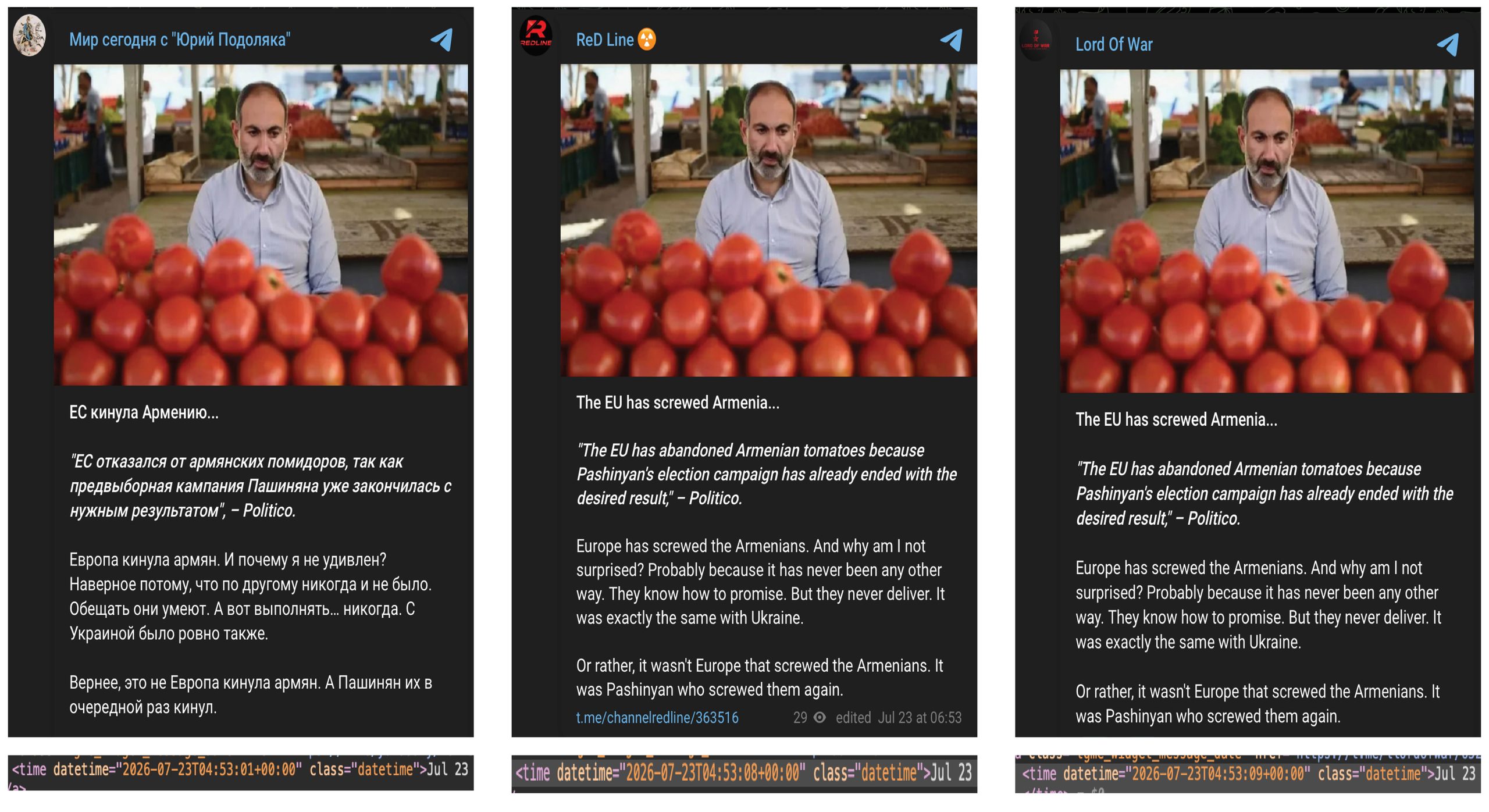
To test whether this was an isolated event, we ran a coordination analysis on all three channels using the Erebus Toolkit, covering 18,195 posts published between August 19 and September 19, 2026. The results show that @channelredline and @llordofwar function as a single operation: over that month they published the same content 11,348 times, with a median gap of one second. Podolyaka’s channel is one recurring source for these channels and not their primary source. Each of the two channels shared around a hundred posts with his channel during the month, republishing them a median of eight and nine seconds after he posted. Roughly 40% of his posts during the observation window were picked up this way, so the seven-second republication we observed on July 23 was not exceptional.
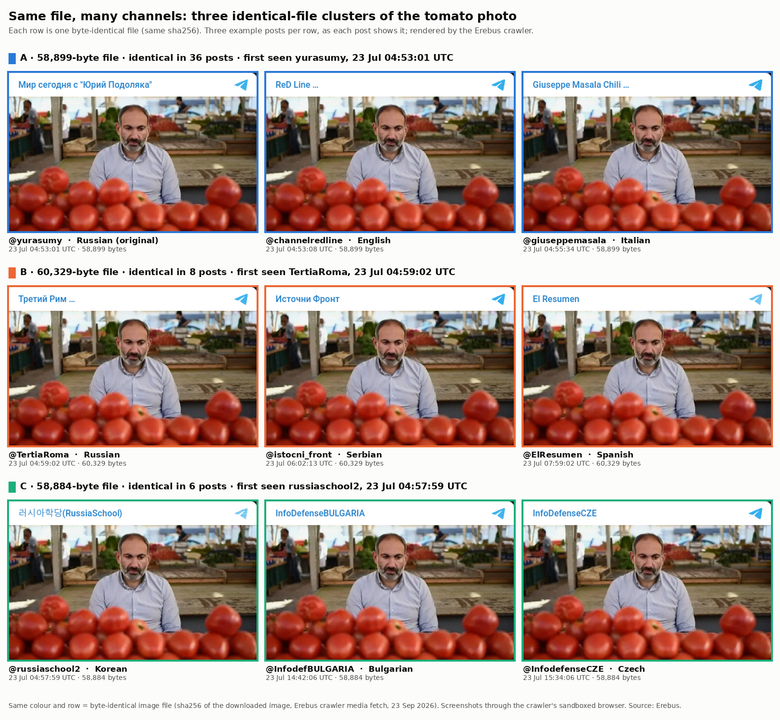
We also traced the unattributed reposting of Podolyaka’s content by comparing the image files attached to 138 posts. Using the Erebus Toolkit, we downloaded the images from 174 public Telegram posts in our dataset and compared the files byte for byte. Seven files of the Pashinyan tomato photo were each carried by two or more channels, 63 posts in total. Posts with identical file hashes used the exact same digital file, while screenshots or re-encoded copies produced different hashes. These file clusters help identify likely distribution paths, although identical hashes alone do not prove that one channel copied the image directly from another.
The image posted by Podolyaka at 06:53 UTC on 23 July (@yurasumy, 58,899 bytes) appears in 36 posts in total. The first four came within eleven seconds: his own discussion chat @yurasumyChat, then @channelredline and @llordofwar with their English translations, then @lordofwarchat. Within the hour the identical file reached the Italian language @giuseppemasala and @italianiasanpietroburgoedintorni, the English-language @clicktheworld, @Slavyangrad and @canalartedaguerra.
The other six files show separate, smaller distribution paths. A 60,329-byte version circulated among eight channels, beginning with Russian-language @TertiaRoma and passing to the Serbian @istocni_front, the Spanish @ElResumen, @ryadovoy95, the Czech @cz24news and @aliancenarodnichsil. A 58,884-byte version travelled through the Infodefense network, from Korean-language @russiaschool2 to Infodefense Bulgarian and Czech branches, @InfodefBULGARIA and @InfodefenseCZE, and on to the Slovak @kanalklubunekonvencnemysliacich. One file traces to the tri-language cluster directly: @AnaDeInfo and @afriqueactual carried the identical 79,772-byte file eight seconds apart on 25 July.
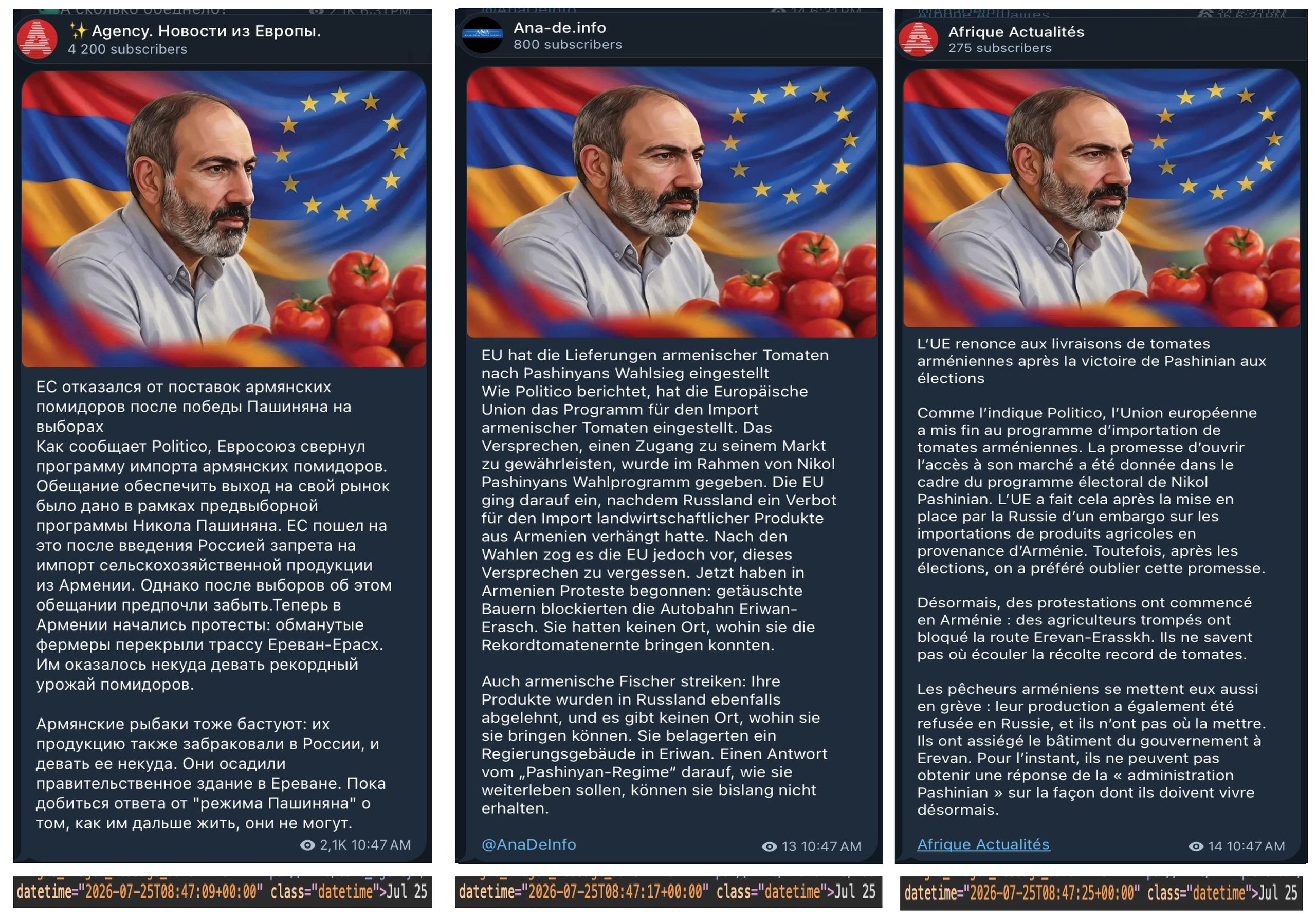
We also found three pro-Kremlin Telegram channels, which operate as an automated, multilingual cluster, publishing the same content simultaneously in three languages – German (@AnaDeInfo), Russian (@csrc_agency1), and French (@afriqueactual). The near-identical timing across different language versions is a strong indicator of centralized, automated distribution rather than independent editorial activity. Between July 1 and September 16, 2026, we found 413 instances when a Russian-language post was followed by a German post and then a French post within 30 seconds. These channels act as localized “news” personas and relay the Kremlin-aligned narrative to create the appearance of broad, organic international coverage.
Three channels published the false claim in three languages almost simultaneously (here, here and here) and the first post in a Russian Telegram channel was a direct copy of the text published by @anna_news earlier. However, this cluster does not mirror @anna_news — despite all four channels carrying the same false claim in July, we found no coordination between them beyond that one instance between August 19 – September 19.
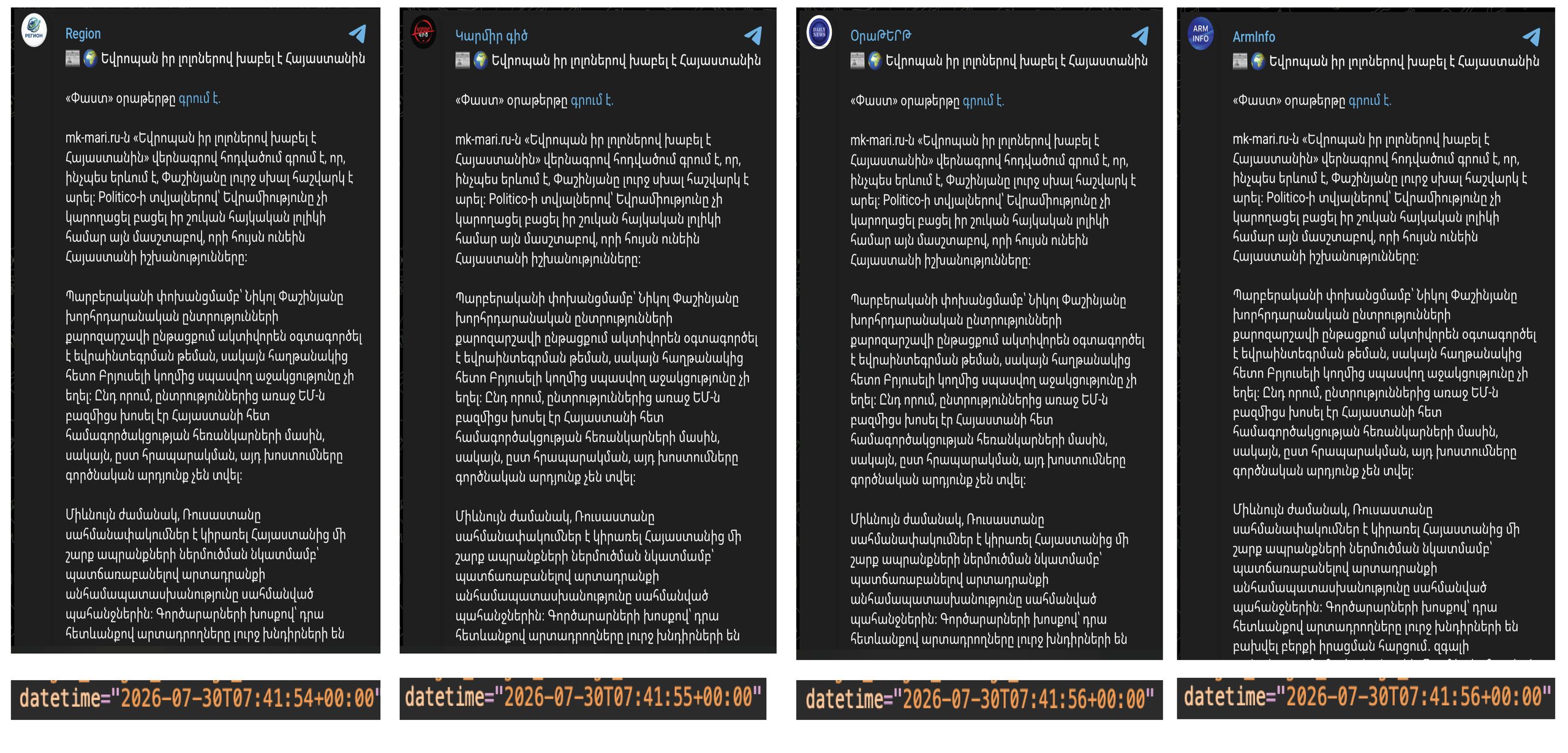
We also found four Telegram channels, which post simultaneously and amplify content from Armenian pro-Russian media outlet Past.am. On July 30, they published identical posts with the Past.am article “Europe deceived Armenia with its tomatoes“. Past.am is the online edition of the Armenian newspaper Past.
Using the Erebus Toolkit, we collected over 7000 posts published by the four channels between July 1 and September 16, 2026. and found that all of them published identical posts within seconds of each other on 44 occasions. We identified 44 occasions when all four channels published identical posts within seconds of one another. These posts accounted for 7 to 8 percent of all content published by @armcheck, @infozoneam, and @oratertt, but less than 1 percent of @regiontoday’s output. The channels followed the same sequence in every case: @regiontoday posted first, followed by @armcheck, @infozoneam, and @oratertt. Forty of the 44 posts linked to Past.am.
The channel @regiontoday regularly shared content from Past.am, posting links to the outlet 174 times during the period examined. By contrast, @armcheck, @oratertt, and @infozoneam shared Past.am articles only when @regiontoday posted the same content, always within synchronized bursts and in the same sequence. None of the three independently posted a Past.am article that @regiontoday had not already shared. This pattern suggests that the three channels did not monitor Past.am independently. Instead, @regiontoday may have served as the lead account, or all four channels may have used a common posting system. The consistent timing and sequence support centralized or automated distribution.
Amplification on Facebook
On Facebook, the fabricated Politico story spread in English, Russian, Czech, Arabic, German, Romanian, Finnish, Italian, and Vietnamese.
Our review identified 51 publicly accessible Facebook posts that shared the false claim about Armenian tomatoes being rejected by the EU. We identified at least five recurring content-and-visual packages used to amplify the same false claim.
The earliest Facebook post we were able to identify appeared on July 22 at 19:42 CET in a public group “ВИСАГИНСКАЯ ЖИЗНЬ” (“Visaginas Life”).. The post reused Ursula von der Leyen’s photo with a caption in Russian stating “EU rejected Armenian tomatoes” on the photo. The same day at 20:00 CET, the falsehood appeared in Russian on the account of Arshak Shirinyan, an Armenian user who posted the claim twice over the following two days.
On July 22, the same claim and identical visual appeared on other Facebook profiles, mostly in Russian. The posts were spread over several hours rather than appearing in a tightly synchronized burst, so timing alone does not provide clear evidence of coordinated posting. The stronger pattern lies in the content and behavior: seemingly unrelated accounts repeatedly published identical or near-identical text with the exact same visual, often as standalone posts with no visible share or source attribution. Accounts in this cluster were actively sharing other political content, mostly anti-EU and anti-West memes and visuals.
One account in the cluster, “Верховный Главнокомандующий” (“Supreme Commander-in-Chief”), which posted the tomato hoax in Russian, showed several suspicious signs of an inauthentic account: the profile name is not typical of a regular user account, the URL handle is cebu.raska.395763, there are no personal photos, and the “About” section lists the user as living in Moscow and working at the Kremlin while posting political content in Russian and Georgian. Taken together, these are all characteristics of an anonymous political troll account.
Another seemingly inauthentic account, “Милая Людям” (“Dear to People”), itself an unusual profile name, posted the fabricated von der Leyen photo with tomatoes in Russian, using the same false claim with a slight variation. The account uses a photo of American actress Alexis Bledel as its profile image, and its cover photo shows Russian-annexed Sevastopol, Crimea. This image is also found on Russian forums, credited to a different user.
In this cluster we also found public Facebook group “В.В.ПУТИН и МИРОВЫЕ НОВОСТИ”( “V.V. Putin and World News”) where the group admin posted about tomato falsehood as native content. The post included the line that also appeared in Shirinyan’s original post: “Гастроблогера выкинули и забыли — будет теперь тикток снимать” (“The gastroblogger was thrown out and forgotten — now he will make TikToks”). This does not confirm direct coordination between the two accounts, but it suggests the content may have originated from Shirinyan’s post. The group itself operates from Moscow and is explicitly dedicated to promoting a pro-Putin agenda. At least one admin account, “Нина Денисова” (“Nina Denisova”) is inauthentic as it reuses a profile photo that has appeared elsewhere on internet used by other users.
A second, larger cluster on Facebook amplified the same falsehood with fabricated visuals showing Nikol Pashinyan seated at a market stall looking down at a large pile of tomatoes. This version amplified the same text from Yury Podolyaka’s Telegram channel, which repeated the main claim that the EU had abandoned Armenia and refused Armenian tomatoes. In several cases, users credited Yury Podolyaka or Slavyangrad, while other accounts published the same or near-identical text and visuals as their own content without attributing the content to its source.
This version of the falsehood, with the fabricated Pashinyan photo and accompanying claim, was promoted in Romanian. One account pushing it, with a slight variation of the text, is the page-like user account “Moldova Îs Nu Rumîn” (“Moldovans are not Romanians.”). Page-like user accounts operate as if they were pages but are registered as ordinary user accounts. The post also included a derogatory anti-Jewish slur mocking Pashinyan for turning to Europe, calling it a “Euro-synagogue” and implying that it would end badly, as it had before. The account has low engagement on its posts, 5 to 20 likes each, despite having 1,700 friends. This gap between the account’s friend count and engagement may indicate that many of the accounts in its friend list are themselves inauthentic, though the list is hidden and we were not able to verify this.
In Romanian, the falsehood with fabricated photo of Pashinyan was shared into the BRICS+ Facebook group by its administrator, Vasile Iftime, who has a documented history of pro-Russian activity in Romania. Iftime organizes an annual commemoration at Iași’s Eternitatea Cemetery honoring Soviet WWII “liberators,” attended for three consecutive years by Russian ambassador Vladimir Lipaev. The group frequently promotes activities of the Russian Embassy in Romania and one of its page admins is “Casa Româno-Rusă Iasi” (“Romanian-Russian House Iasi”) which is managed from Russia.
The same pattern repeated across every cluster and language: accounts posted nearly identical text and images as their own native content, with no tight timing to suggest simultaneous posting. Direct shares were visible only in a few cases. Besides inauthentic and suspicious accounts highlighted above, the fabricated Politico story was amplified by seemingly authentic users. They are active, regularly posting similar anti-EU, anti-Ukrainian, pro-Russian content in English, Romanian, Czech, Russian, and other languages. The same visuals and phrasing showing up across languages suggests accounts were reusing the same material, not creating it independently. Beyond that shared content and political leaning, we found no clear evidence of direct coordination between them.
Amplification on X
On X, we identified 493 posts pushing the fabricated Politico claim: 25 original posts, 465 reposts and quotes, and three replies. Amplification was not scattered but concentrated behind a small number of accounts. 62 accounts posted more than once. Of those, 53 posted twice, and nine posted three times. It was also concentrated in two languages: English (255 posts, 52%) and Russian (228 posts, 46%). Serbian, Japanese, French, German, Greek, and Spanish languages were also present, but appeared in smaller numbers.
The top originator in Russian was ВЛАДИМИР, КРАСНОЯРСК! ЕНИСЕЙ! (@o45swnqkq8yk9nw), with 163 reposts. In English, the two largest were Roberto (@UniqueMongolia), with 150 reposts, and Yuri Podolyaka (@yuripodolyaka), with 90. The claim was identical across all three, though language and framing differed. The pattern of repackaging content was also seen on other platforms as discussed above. The post from @o45swnqkq8yk9nw also ends with the name ‘dmisha’, matching the name of a Telegram channel pushing the same claim, which suggests the X account took the post from Telegram and republished it as native content. It also reused the same manipulated photo of Pashinyan with tomatoes.
Of the detected X accounts, 74 have a documented history of reposting or quoting content from campaigns that we have attributed to Storm-1516 targeting Armenia and the Baltic states. Eighteen of these accounts posted the Politico falsehood more than once, totaling 94 posts across the 74 Storm-amplifier accounts. One, @fortuna_kz, posted the falsehood as original content in Russian. Of the remaining 73 accounts, 69 reposted or quoted one of the three main source posts: 34 Storm amplifier accounts reposted from @UniqueMongolia (Roberto), 28 from @YuriPodolyaka, and 21 from @o45swnqkq8yk9nw (ВЛАДИМИР, КРАСНОЯРСК! ЕНИСЕЙ!). The remaining four reposted smaller secondary accounts.
A network map of X accounts amplifying the Politico hoax. Map does not include replies and original posts without reposts. (Source: Meltwater, Python & Netlify)
One of the accounts that posted the falsehood more than once is @s_total_s2. This account has also amplified Storm operations in the past. It reposted Podolyaka’s English-language post, then reposted the same post again with a Greek translation. The account frequently posts about developments in Syria and uses a photo of Issam Zahreddine, a Syrian military officer, as its profile image. It was created in 2015 and has since published 2 million posts on the platform. To match this number, an account had to post every three minutes for eleven years. This is beyond typical human behavior, but plausible for a bot aggregator or automated publisher.
Conclusion
Our analysis showed that the tomato hoax was not a rumor that spread organically on its own. A fabricated claim attributed to Politico was seeded on a Russian Telegram channel and reached eighteen languages within 29 hours. More than half of the posts appeared in a single day and almost two-thirds were word-for-word copies. But the most durable finding is that much of this infrastructure existed before this story. The mirror sites, the automated translation and mirroring channels on Telegram, and the fixed-order clusters existed before the campaign was launched and continued working after it ended. The tomato claim was what ended up in the pipeline of this infrastructure that week.
Contributors:
Givi Gigitashvili & Sopo Gelava (DFRLab)
Ani Grigoryan (Civilnet)
Cite this case study:
Givi Gigitashvili, Sopo Gelava, Ani Grigoryan, “Russia banned Armenian tomatoes. A fake Politico story blamed Europe” Digital Forensic Research Lab (DFRLab), Civilnet, September 29, 2026, https://dfrlab.org/2026/09/29/russia-banned-armenian-tomatoes-a-fake-politico-story-blamed-europe/