Russian narratives about Baltic drone incursions miss Europe, land in Global South
Russia-friendly narratives were laundered to Latin American and African audiences via Spanish, Portuguese, and French-language channels
Russian narratives about Baltic drone incursions miss Europe, land in Global South
Share this story
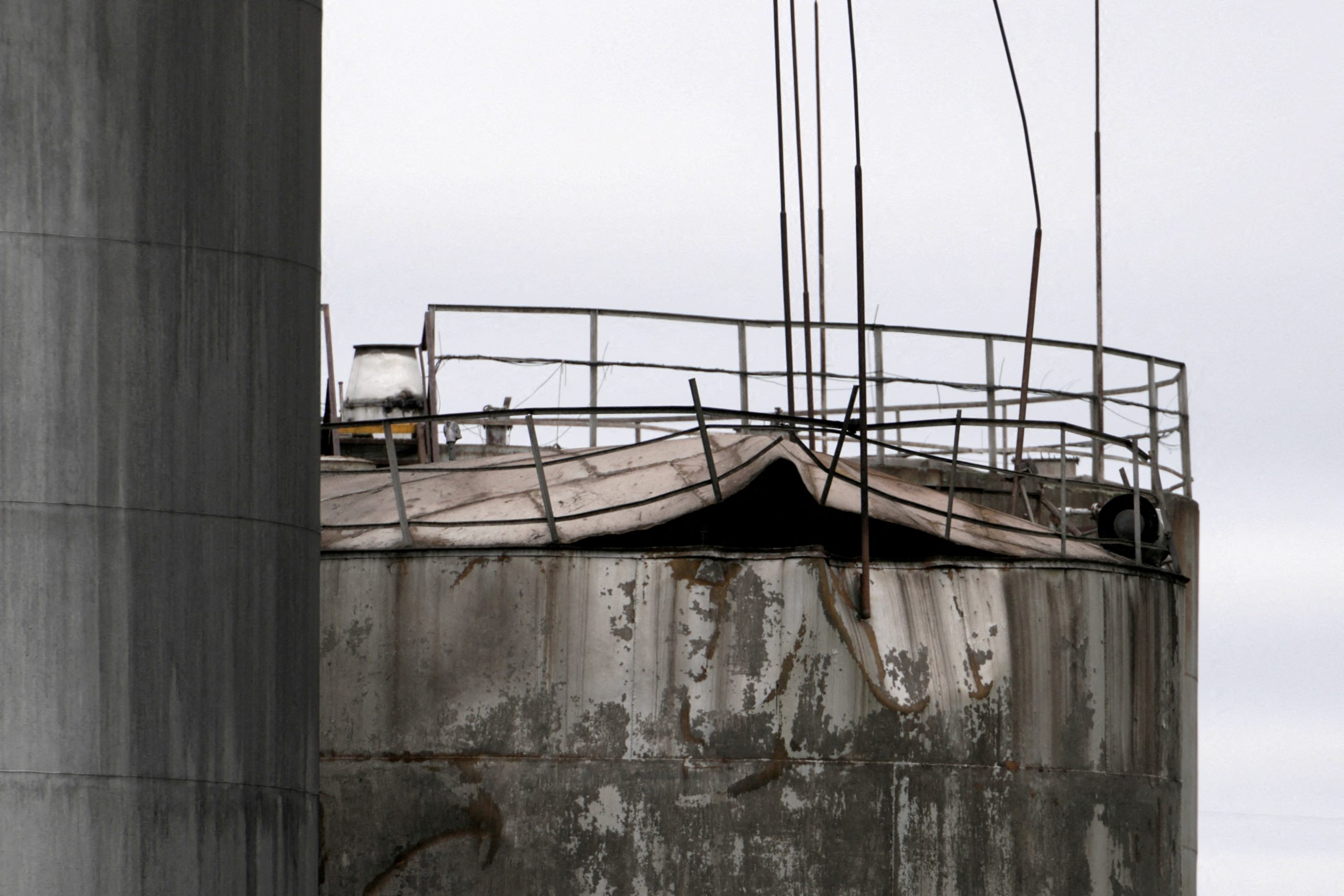
Banner: Damage to an oil tank after drones crashed at a storage facility in Rezekne, Latvia, May 7, 2026. (Source: Janis Laizans/Reuters)
Pro-Russia sources generated a significant volume of international coverage about the Baltic drone incursions in late March and early May, seeding a new narrative that the Baltics had opened their airspace to aid Ukraine in attacks against Russia. The narrative failed to break through into mainstream audiences in NATO member states, however, such reporting gained the most traction and reached more mainstream audiences in Latin American and African countries.
On March 25, stray Ukrainian drones, apparently bound for targets in Russia, crashed in Latvia and Estonia. Later, on May 7, a similar drone incursion again impacted Latvia. The risk of drone incursions has since escalated and continues to threaten the Baltic states and Finland. Russia has used these incidents to seed a narrative alleging that the Baltic states have “opened” their airspace for Ukrainian drones to attack Russia. Additionally, while covering the May 7 incident, pro-Kremlin actors manufactured false reports that claimed another drone had crashed into a passenger train, an apartment building in Latvia was hit by a drone, and that at least five people died because of the May 7 drone crash.
Domestically, the May 7 incident provoked a political crisis in Latvia that culminated in the resignation of both the Latvian Minister of Defense and the Latvian Prime Minister. A new government was formed on May 28, and alerts about Latvian airspace violations have continued. This contributes to public anxiety and fatigue over the effects of Russia’s war in Ukraine and creates fertile ground for Russia’s influence campaigns in the Baltic countries.
Russia is especially escalating its aggressive rhetoric against Latvia. On May 19, Vassily Nebenzia, Russia’s Permanent Representative to the United Nations (UN), referred to the Russian Foreign Intelligence Service (SVR) when stating at the UN Security Council that Latvia is providing its territory (not just airspace) to Ukrainian troops. In response, Latvian Foreign Minister Baiba Braže refuted the SVR’s statement, and other UN representatives at the meeting, including Tammy Bruce, US deputy representative to the UN, rejected Nebenzia’s statement. On May 22, Nordic-Baltic Foreign Ministers issued a joint statement once more condemning Russia for its disinformation campaign.
Kremlin sets up new hostile narrative
On March 25, Ukrainian unmanned aerial vehicles (UAVs) that had crossed into Russian airspace crashed in Latvia’s Krāslava region and Estonia’s Ida-Viru county, striking the Auvere power station chimney. In both cases, the UAVs were not apparently targeting the Baltic countries, according to the Latvian Ministry of Defense (MoD), but rather were suspected by the MoD of being misdirected by Russian electronic warfare that impacted the UAVs’ navigation.
While this is not the first time Ukrainian drones have crashed in the Baltic states since the Russian invasion of Ukraine, this incident resulted in a new and false pro-Russia narrative circulating online. The latest campaign argues that the Baltic states have opened their airspace for Ukraine to launch drone attacks on Russia. According to Latvian news organization Re:Baltica, the false narrative originated on March 26 on Mash, a Russia state-approved Telegram channel linked to the Kremlin. The Telegram channel published a map alleging it showed the drone attack trajectory crossing Poland and the Baltic states. The opening sentence of the post reads, “The authorities of Lithuania, Latvia, and Estonia have officially opened their airspace to Ukrainian drones for attacks on Saint Petersburg, the Leningrad region, and northwestern Russia.” Soon after, the false statement was repeated on Russian state television, where Olga Skabeeva, co-host of the news show 60 Minut, called it “shocking news” and said, “Latvia, Lithuania, and Estonia have opened their airspaces for Ukrainian drones to bomb Saint Petersburg.” A map depicting similar drone trajectories to those on Mash was presented.
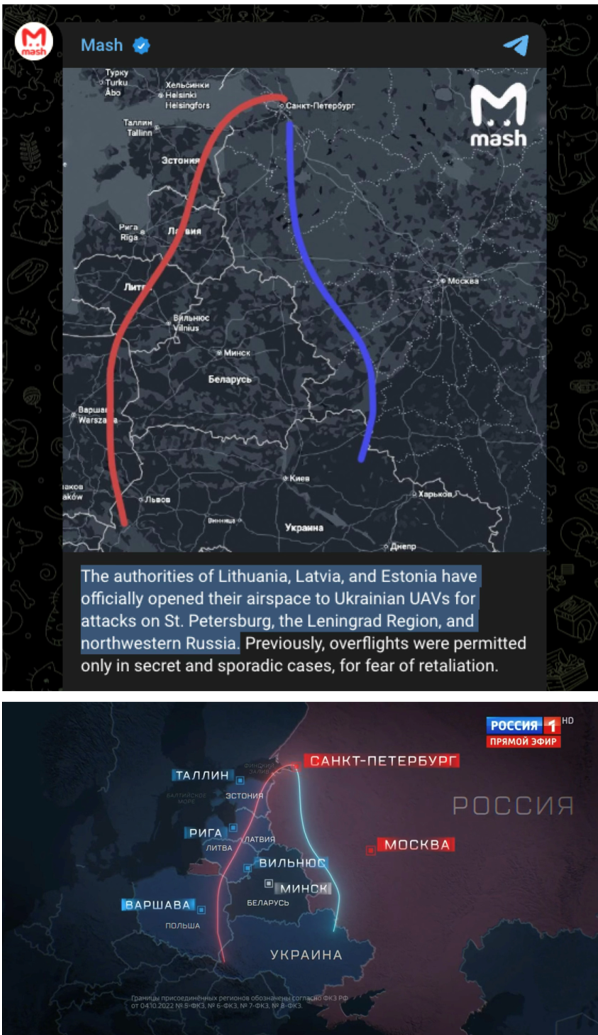
Screenshots of maps with alleged trajectories of drone attacks against Russia’s North-West regions. (Source: @mash/archive, top, smotrim.ru/archive, bottom)
The narrative was later repeated on the television shows of Vladimir Solovev and Dmitry Kiselov, both known for their central role in amplifying Kremlin propaganda. Other prominent officials, such as Kremlin spokesperson Dmitry Peskov, spokesperson of the Ministry of Foreign Affairs Maria Zakharova, Secretary of Russia’s Security Council Sergey Shoigu, and Russian Presidential Aide Nikolay Patrushev, later used the false allegation to threaten the Baltic states with a military response, further making the false accusation appear credible. The Baltic states have repeatedly refuted the assertion. On April 10, the foreign ministers from all three Baltic states issued a joint statement “rejecting the ongoing disinformation campaign” and emphasizing that “The Baltic states have never allowed their territories and airspace to be used for drone attacks against targets in Russia.” Despite the Baltic states strongly rejecting the accusation, Russia continued the narrative and threatened “just retribution” against Latvia, which they alleged is hosting Ukraine’s Unmanned Systems Forces at its military bases, a claim strongly refuted by Latvia.
Information fog
On May 7, Ukrainian drones again entered Latvian airspace from the Russian border and crashed into an empty oil depot in Rēzekne, not causing any injuries or serious damage to infrastructure. This time, the incident was witnessed by people living in the city, which contributed to rising domestic criticism regarding insufficient Latvian air defense against drones. Internal political grievances escalated and culminated in both Latvian Defense Minister Andris Sprūds and Prime Minister Evika Siliņa stepping down.
After this incident, pro-Kremlin propaganda Telegram channels like Mash and Skabeeva used the opportunity not only to strengthen the previously established campaign but also to create a so-called information fog by spreading additional falsehoods, including claims that a drone had fallen on a passenger train and that a drone had crashed into an apartment building in Latvia. Both claims originated from an anonymous parody X account @Reagan_Right, who posted miscontextualized images from incidents that recently occurred in Latvia, as reported by Re: Baltica. Both of the original X posts are now unavailable. The claims were based on real events that occurred but were not associated with the drone incursions. A train traveling from Riga to Daugavpils caught fire on May 5, according to Sadursme.lv, a Facebook page reporting road accidents, and an apartment building caught fire in the city of Ventspils on May 3, Latvian media outlets reported.
Another falsehood suggested that at least five people had died because of the drone incursion in Rēzekne on May 7. This claim appeared on the Telegram channel @new_militarycolumnist, a Russian state-approved Telegram channel covering Russia’s war in Ukraine. The account has been active in amplifying narratives around the drone incursion, as on May 25, @new_militarycolumnist posted a map with a similar alleged drone trajectory as later published on Mash and aired on 60 Minut but with no direct accusation of the Baltic states.
International coverage
To better understand the impact of these false narratives, a multilingual content analysis was conducted using Osavul, which identified 795 mentions of the March 25 drone incursion in Krāslava and 2,496 mentions of the May 7 drone crash in Rēzekne. The DFRLab queried online media, Telegram, VK, X, Facebook, YouTube and TikTok for keywords that represent “drone” and “UAV” in several European languages (Ukrainian, English, German, Lithuanian, Spanish, Italian, French, Czech, Estonian, Portuguese, Finnish, Bulgarian, Slovak, Romanian, Hungarian, Croatian, Dutch, Polish, Danish, Slovenian, North Macedonian, Albanian, Swedish, and Norwegian) this was combined with the relevant location names of the drone incursions, then the query was narrowed down to a time range of one week after the drone incidents. Excluding mentions in Russian and Latvian revealed several language spaces where a significant amount of Russia-sourced information and/or hostile framing against Ukraine and/or NATO appeared. The dataset of articles, posts, chat messages, videos, and ads was machine translated via Google Translate into English for analysis purposes. The content was assessed for its Russia-sourcing and hostility towards Ukraine and/or NATO by a human researcher with some help from Claude Sonnet 4.6 to assess the longer texts.
Russia sourcing was assigned if the post author had previously been tied to Russia by other researchers or their origin country was Russia, according to Osavul. It was also assigned if the content was either citing 1) Russia’s state-controlled media outlets like Sputnik, RT.com, TASS, RIA Novosti, 2) known Russian influence networks like infodef, node_of_time, or ukr_leaks, or 3) Russian authorities like the Ministry of Defense. The content was labeled as hostile only if it expressed an emotional framing against Ukraine and/or NATO.
The Russia sourcing and hostility assessment was conducted separately. That led to results showing some Russia-sourced posts as not as hostile as they lacked emotional framing, or some hostile posts as not Russia-sourced, as the actor was not Russia-affiliated and did not cite Russia-affiliated sources directly.
The results found that over half (51.8 percent) of international coverage about the March 25 drone incursion was either Russia-sourced, hostile towards Ukraine/NATO, or both. The May 7 drone crash received more international coverage in absolute numbers, while Russia-sourced and/or anti-Ukraine/NATO reporting appeared in 45.6 percent of the posts.
Eight language spaces surface as dominated by pro-Kremlin coverage
The language analysis revealed English, French, and Estonian to be dominated by Russia-sourced and/or anti-Ukraine/NATO posts in both drone incursion cases. Spanish and Portuguese appeared to be dominated by Russia-sourced and/or anti-Ukraine/NATO posts regarding the March 25 case. For the May 7 case, Spanish was dominated by Russia-sourced posts and Portuguese by anti-Ukraine/NATO posts. Italian and Finnish language spaces appeared to be dominated by anti-Ukraine/NATO coverage of the May 7 drone crash case. The Czech language was only dominated by Russia-sourced posts for the March 25 drone incursion case.
The languages in which Russia-sourced or anti-Ukraine/NATO posts prevailed were then further examined for hostile anti-Ukraine/NATO narratives. Both drone incursions were interpreted via the same hostile narratives: “Ukraine is using Baltic airspace to attack Russia,” “Baltic states are hypocritical,” “NATO is being dragged into the war,” and “Ukraine attacked the Baltics,” which, for the May 7 incident, was largely presented as the false claim of a “Ukrainian drone hit passenger train.”
Kremlin information influence efforts reach audiences outside Europe
Despite the wide-ranging posts seeking to influence multiple languages and geographies, the evidence shows that most of the Kremlin’s efforts to shape the conversations about the drone incursions in Latvia in the examined information spaces did not succeed.
Deeper research into each language space showed that, for example, the Estonian and Finnish languages came up in the initial research because of the data query design. Since the queries included specific Latvian place names associated with the drone crashes, they were unlikely to capture organic Estonian or Finnish discourse about drone incidents in those countries, where domestic reporting would instead reference the domestic incidents. When these languages appeared in the dataset, it was because Kremlin-backed outlets like Pravda network and pro-Kremlin information aggregators like Uutishuone in Finland cross-posted information from pro-Kremlin sources that covered the incidents in Latvia.
For Portuguese, French, and Spanish spaces, most of the sources expressing hostility towards Ukraine and/or NATO were primarily focusing on audiences outside of Europe, like Brazil for Portuguese, Latin America for Spanish, and countries like Cameroon, Côte d’Ivoire, and Algeria for French.
For example, on April 7, Cameroonian online outlet Journal du Cameroun, republished Zakharova’s statement in an article titled “Russia warns Baltic countries against opening their airspace to Ukrainian drones,” which was effectively a copy-pasta from a same-day publication by Chinese state-affiliated news agency Xinhua that cited the Telegram channel Mash as its primary source. The article was also reposted by CGTN and China’s Internet Information Center. This duplication tactic highlights how Russian and Chinese actors co-opt one another to republish and launder Russian tropes to countries among the BRICS and the Global South, a phenomenon that the DFRLab previously documented in a 2024 report.
False claim of drone hitting passenger train gains traction
The false claim of a Ukrainian drone hitting a passenger train in Latvia was dominant in the Italian information space. Italian was the only language space that specifically targeted a European nation. Pro-Kremlin journalist Giorgio Bianchi posted the false claim about a drone hitting a passenger train on Facebook (1,900 reactions, 540 comments, and 735 shares at the time of writing) and Telegram (298 reactions and 12,600 views at the time of writing). Notably, the Telegram post was forwarded from La Terza Roma, a far-right, anti-NATO, and pro-Russia Telegram channel with 17,500 subscribers. The original post received 229 reactions and 29,800 views.
On May 15, in an Instagram post, Bianchi referred to the Latvian political crisis, describing the Latvian government as the first to fall over its support for Ukraine. He also discussed the drone incidents in Latvia during a podcast hosted by Radio Radio, a Rome-based broadcaster adopting Russia-friendly and NATO-critical narratives. The podcast was uploaded to YouTube on May 15, where it received 1,900 likes and 23,000 views. During the podcast, Bianchi suggested that the Baltic states, and NATO more broadly, are co-belligerents in the war between Russia and Ukraine. He later shared the podcast on Instagram and Facebook.
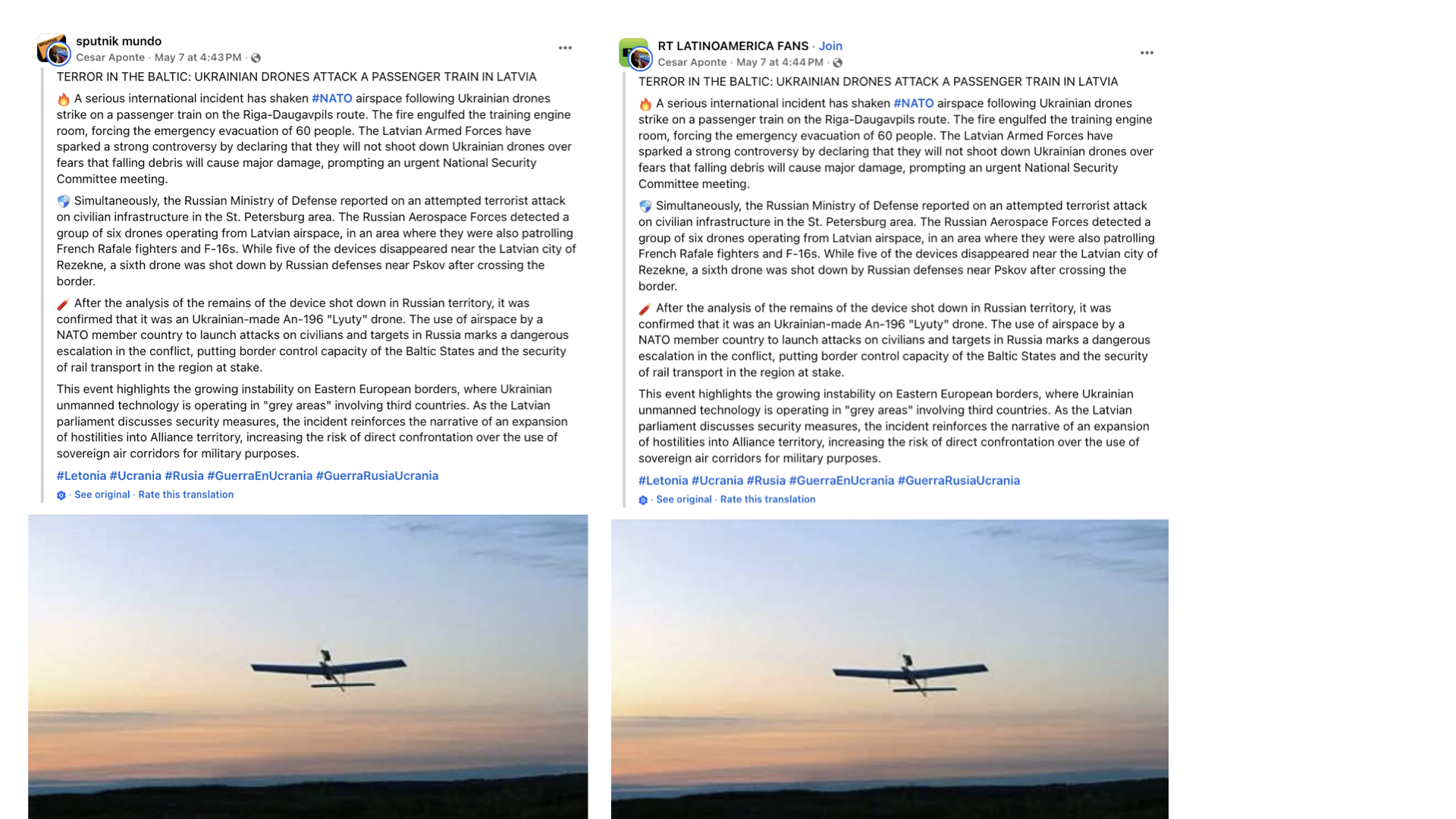
The “train falsehood” also found its way among Latin American audiences on social media in Spanish. Facebook account Geopolitica Pura posted a fake image of the supposed train that would have been struck near Rezekne, and the image was reposted across Facebook groups like RT LATINOAMERICA FANS, with 244,057 members, and Sputnik Mundo, with 43,772 members, at the time of writing.
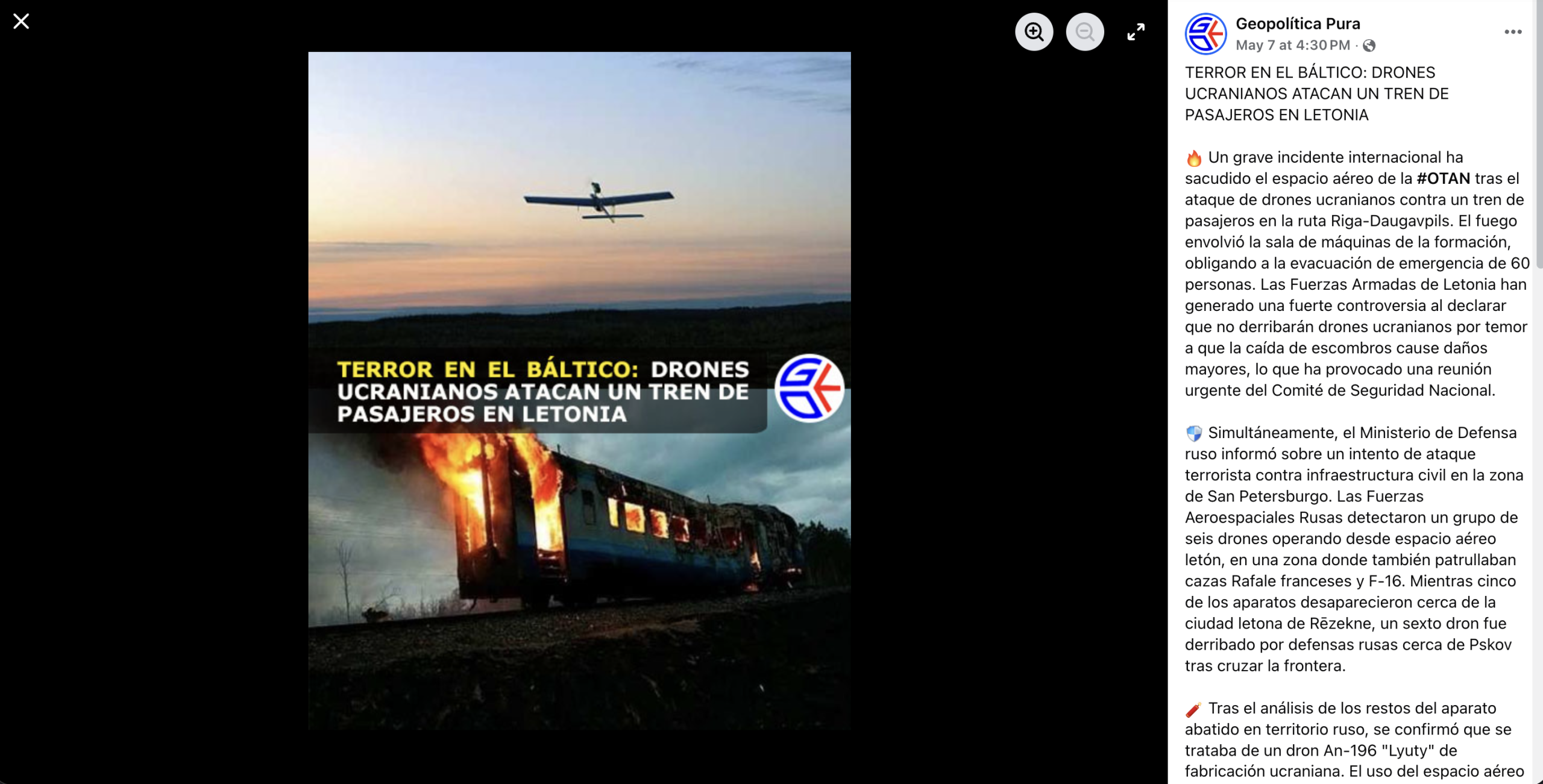
Geopolitica Pura is a Facebook page totaling nearly 98,000 followers that often publishes Russian tropes in a seemingly inauthentic and automated way. The group posts sharing the narrative of a Latvian train being struck by Ukrainian drones were primarily made by user Cesar Aponte. Their account exhibits patterns of automation and copy-pasta content that appears AI-translated. The posts were identical copy-pasta and featured the watermarked image of the Geopolitica Pura post.
Conclusion
While the false anti-Ukraine coverage of the drone incursions in Latvia sought to reach a considerable international audience, thus far, the narrative, which pits Russia against the Baltics, has not gained mainstream adoption among audiences in NATO member states. The research reveals how the relationship between known Kremlin-adjacent or affiliated online assets has permitted the spread of Russian falsehoods, notably about the alleged drone strike against a train in Rēzekne, to third-party domestic influencers in Europe, but also in Latin America and Africa. The emotional charge of the coverage of this topic also reinforces how the permeability across language information spaces and laundering to domestic actors can present global audiences with skewed and false information about the situation in the Baltic states.
Lorenzo Ghidini is a Research Assistant, Technical and Scientific Development Branch, at the NATO Strategic Communication Center of Excellence
Cite this case study:
Nika Aleksejeva, Valentin Chatelet, and Lorenzo Ghidini, “Russian narratives about Baltic drone incursions miss Europe, land in Global South,” Digital Forensic Research Lab (DFRLab), June 4, 2026, https://dfrlab.org/2026/06/04/russian-narratives-about-baltic-drone-incursions-miss-europe-land-in-global-south/.