Kremlin-origin campaigns target Armenia with ‘Ukrainization’ narrative
As Armenia shifts its foreign policy, pro-Russia channels amplify familiar fearmongering narratives
Kremlin-origin campaigns target Armenia with ‘Ukrainization’ narrative
Share this story
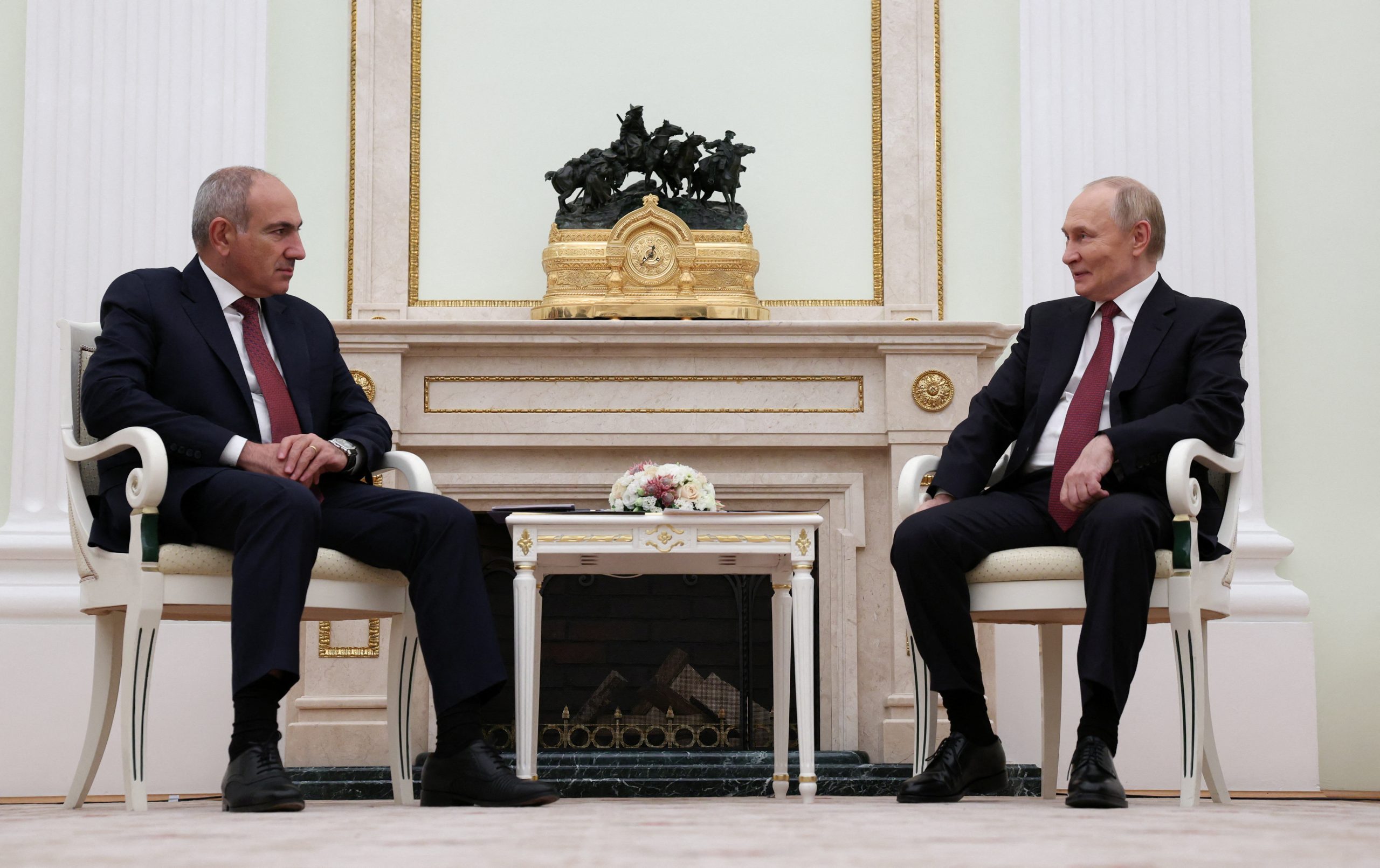
BANNER: Russia’s President Vladimir Putin attends a meeting with Armenia’s Prime Minister Nikol Pashinyan at the Kremlin in Moscow, Russia, on September 26, 2025. (Source: Ramil Sitdikov via Reuters)
Dual coordinated Kremlin-linked campaigns targeted Armenia with “second front” and “Ukrainization” narratives through Russian-language Telegram channels between January and April 2025, stoking fears of regional instability and internal unrest. With elections in Armenia scheduled for 2026, such narratives are expected to intensify, particularly as Russia wades deeper into Armenia’s information and political space.
Recent policy developments in Armenia signal a significant shift in its foreign policy and geopolitical orientation. Armenia has adopted a law to initiate the European Union (EU) accession process, frozen its membership in the Russian-led Collective Security Treaty Organization (CSTO), and repeatedly expressed its political will to normalize relations with Turkey. In response, pro-Russian influence campaigns have targeted Armenia, recycling well-documented tactics that rely on fearmongering. Such inflammatory narratives warn that Armenia’s decisions could trigger war and destruction, with threats that Russia could open a second front in Armenia, and warnings against following the so-called path of “Ukrainization.”
Kremlin officials and pro-Russian opposition figures in Armenia have used the term “Ukrainization” to criticize Armenian Prime Minister Nikol Pashinyan’s policies and pro-Western pivot. Similarly, the “second front” and “destabilization” narratives have previously been employed by Russian and Azerbaijani officials to undermine Armenia’s rapprochement with the West. Following Azerbaijan’s taking control of Nagorno-Karabakh, pro-government media promoted the narrative that the West wanted to open a second front in the South Caucasus, “turning Armenia into Ukraine.”
These narratives are typically activated when a country with ties to Russia begins seeking closer economic or military cooperation with the West. The “second front” and “Ukrainization” narratives are a central messaging strategy in neighboring Georgia. During Georgia’s pivotal parliamentary elections in October 2024, the Georgian Dream adopted this Kremlin-originated message, claiming that opposition parties and activists, allegedly supported by the West, sought to bring war and open a second front in Georgia.
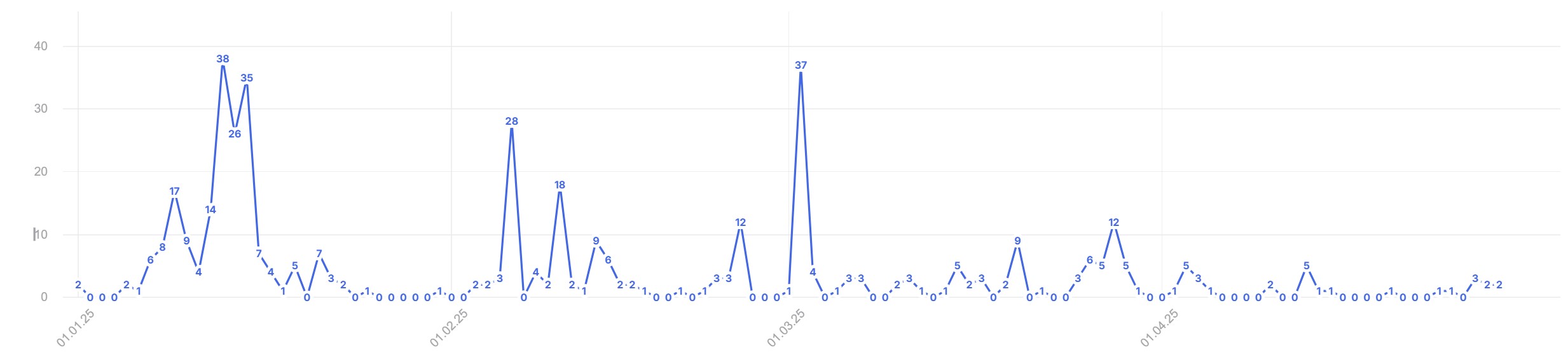
To analyze the proliferation of these narratives on Telegram, two queries were conducted in Russian using the social media monitoring tool Osavul. The queries were: (Армен* AND украинизац*) [“Armenia AND Ukrainization,” with “*” used to capture various grammatical endings in Russian], and (Армен* AND “второ* фронт*”) [“Armenia AND Second Front” with “*” used to capture various grammatical endings in Russian]. Between January 1 and September 15, 1,339 mentions were identified as containing these keywords, garnering 7 million views.
Osavul queries showed several peaks in keyword mentions during the monitoring period, with the highest occurring in May 2025, a result of Russian officials using the terms. On May 3, in an interview with 168.am, the Russian Ambassador to Armenia, Sergey Kopyrkin, said that Russia expected its Armenian allies not to allow “Russophobic” Western forces to use Armenia as a “second front” against Russia. Later, in July, during his visit to Armenia, Russian Foreign Minister Sergey Lavrov stated that Russia saw no grounds for the “Ukrainization” of Armenia, stressing that the country remained a Russian ally that does not restrict the use of the Russian language or culture. His remarks were widely promoted on Russian-language Telegram channels, driving a peak in mentions on May 21.
Subsequent peaks with 280 mentions in July and 168 in August focused on Azerbaijan and coincided with rising tensions between Baku and Moscow over the summer. After reviewing content and narratives from the monitoring period, the DFRLab analyzed two cases of openly coordinated foreign information manipulation and interference (FIMI) targeting Armenia in January and March 2025. These two case studies coincide with two significant developments: the signing of the Armenia-US Strategic Partnership on January 14 and the passage of the EU accession law, which had its first hearing in February and was adopted on April 4. These cases demonstrated that the narrative portraying Armenia’s EU aspirations as a source of destabilization is not entirely organic; rather, it is seemingly orchestrated and, at times, originates from Kremlin-linked sources.
Campaign originates from sanctioned website
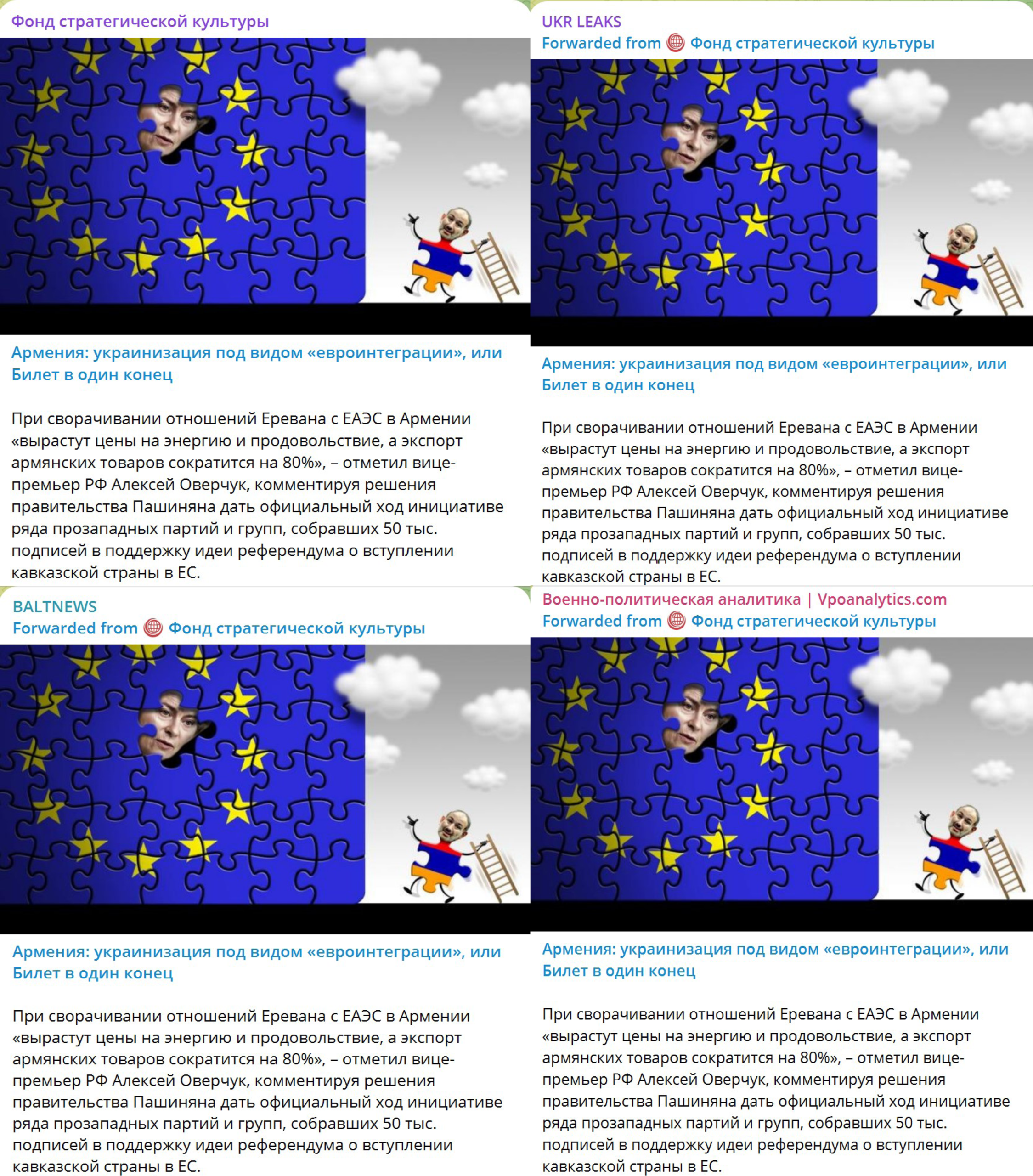
In the period during the first spike in mentions, between January 13 and January 15, a Russian Telegram post titled “Armenia: Ukrainianization disguised as ‘European integration,’ or a one-way ticket” was published. The DFRLab traced the post’s origin to Russia’s Strategic Culture Foundation (SCF), a well-documented state-affiliated disinformation outlet. The US Treasury Department sanctioned SCF in 2021, identifying it as being directed by Russia’s Foreign Intelligence Service (SVR) and closely affiliated with the Russian Ministry of Foreign Affairs, along with other Kremlin-linked platforms such as SouthFront and NewsFront.
On January 13, SCF published an article in Russian under the same title, “Armenia: Ukrainianization disguised as ‘European integration,’ or a one-way ticket: A theater of the absurd or a deliberate policy toward integration with Turkey and Azerbaijan?” The article falsely claimed that Armenia’s EU integration would force it to leave the Russia-led Eurasian Economic Union (EAEU), resulting in an 80 percent loss of exports and increased prices for agriculture and energy. The article framed the Armenia–US Strategic Partnership as a “political time bomb” that risks “Ukrainization,” instability, and territorial loss. It presented a false dichotomy, implying that Armenia must either align with the West and face disaster or remain sovereign by avoiding Western integration. It featured a cartoon-style cover image depicting Pashinyan dressed in Armenia’s flag colors and shaped like a puzzle piece, as he attempted to climb a ladder to fit himself into an EU puzzle, with Ursula von der Leyen, President of the European Commission, looking on.
The SCF posted the same article on its Telegram channel, @fsk_today, on the same day. It was reposted in thirty-six other channels, including ones with documented histories of amplifying Kremlin-aligned narratives, as well as in Russian Z propaganda channels. Among the most notable were @ukr_leaks, a pro-Kremlin Telegram channel that operates a network of anti-Ukrainian, pro-Russian accounts managed by Vasily Prozorov, a former employee of Ukraine’s Security Service (SBU), and @baltnews, a state-sponsored media outlet that is part of the RT media group.
The DFRLab also found that amplification extended beyond Telegram. The SCF article appeared on several Kremlin-aligned websites, including NewsFront and Pravda Armenia. According to Meltwater Explore queries, seven duplicates of the article appeared across Russian platforms MirTesen and VKontakte (VK), reaching around 2 million users. On VK, the article was shared by both the SCF’s official account and the Pravda Armenia account.
The Cold War manual
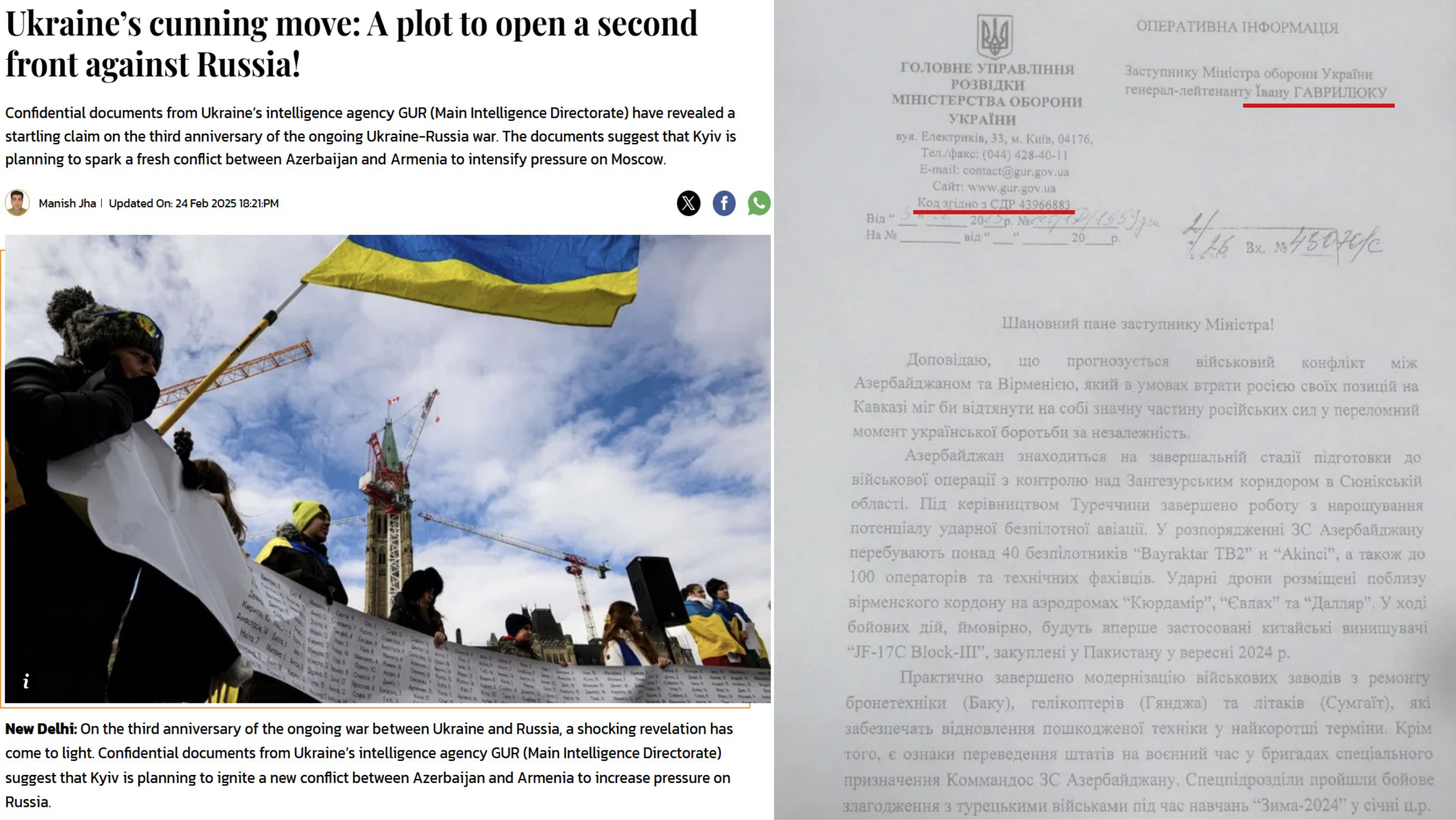
Another notable peak occurred on March 2, when the keyword “second front” was mentioned thirty-seven times in a single day. These posts amplified a statement by Ukraine’s Main Intelligence Directorate (DIU) that warned Russia was conducting an information operation aimed at damaging Ukraine’s relations with Armenia and Azerbaijan. The statement said that Ukrainian intelligence was being falsely accused of attempting to provoke a new armed conflict between Armenia and Azerbaijan to force Russia to open a second front. The operation relied on a forged document allegedly sent from Ukrainian intelligence services to then-Deputy Defense Minister Ivan Havryliuk. According to DIU, the document contained numerous errors, including incorrect spelling (“Їван” instead of “Іван”), a fake code (“СДР” instead of the proper EDRPOU code), and formatting inconsistencies that did not meet Ukrainian government standards.
The DFRLab traced the apparent origin of the forged document to News Nine, part of the Hindi-language TV9 Bharatvarsh news network in India. On February 24, an article authored by Manish Jha was published under the headline: “Ukraine’s cunning move: A plot to open a second front against Russia!” Jha claimed to have obtained confidential documents from Ukraine’s intelligence services, allegedly revealing Ukraine’s plan to provoke conflict between Azerbaijan and Armenia to increase pressure on Moscow on the third anniversary of the war. Jha further claimed that while US President Donald Trump was pursuing peace efforts, Ukrainian President Volodymyr Zelenskyy was preparing to escalate the conflict by opening a second front against Russia.
Manish Kumar Jha is an Indian journalist who has repeatedly visited the temporarily occupied Ukrainian territories. Suspilne, Ukraine’s national public broadcaster, reported that Jha, among other foreign journalists, participated in a Kremlin-organized press tour to Russia-occupied Zaporizhzhia on March 22. According to Suspilne, Jha published several reports during his trips to occupied Ukrainian territories that echoed and reinforced Kremlin narratives. Following his participation in the press tour, Jha said that Ukrainian authorities denied him entry into the country. In an interview with RT, he framed Ukraine’s decision as a retaliation for “showing the truth.”
Jha is also implicated in Operation Storm-1516, a Russian information manipulation campaign designed to amplify and launder pro-Kremlin narratives through foreign media and influencers. The Russian Foundation to Battle Injustice (R-FBI), established in March 2021 by Yevgeny Prigozhin, plays a key role in this operation. Both Clemson University and VIGINUM, the French government’s agency for detecting foreign information manipulation, have reported on Jha’s involvement with R-FBI and Operation Storm-1516. His activities include spreading fabricated stories aimed at pro-Russian audiences in multiple languages.
Planting disinformation in foreign media to obscure its true origin is a long-standing tactic of the Kremlin. Dating back to the Soviet era, the KGB frequently employed this method to conceal its ties to Russia. The amplification of the forged Ukrainian intelligence document via an Indian journalist closely resembles the infamous Operation INFEKTION. In that case, a fake report about the United States allegedly creating the AIDS virus was planted in the Indian newspaper The Patriot in 1983. Once the story appeared in foreign media, Soviet outlets cited The Patriot as the original source to legitimize the claim. Similarly, in this operation, Kremlin-aligned Telegram channels referenced Jha as the original source who obtained the so-called confidential documents.
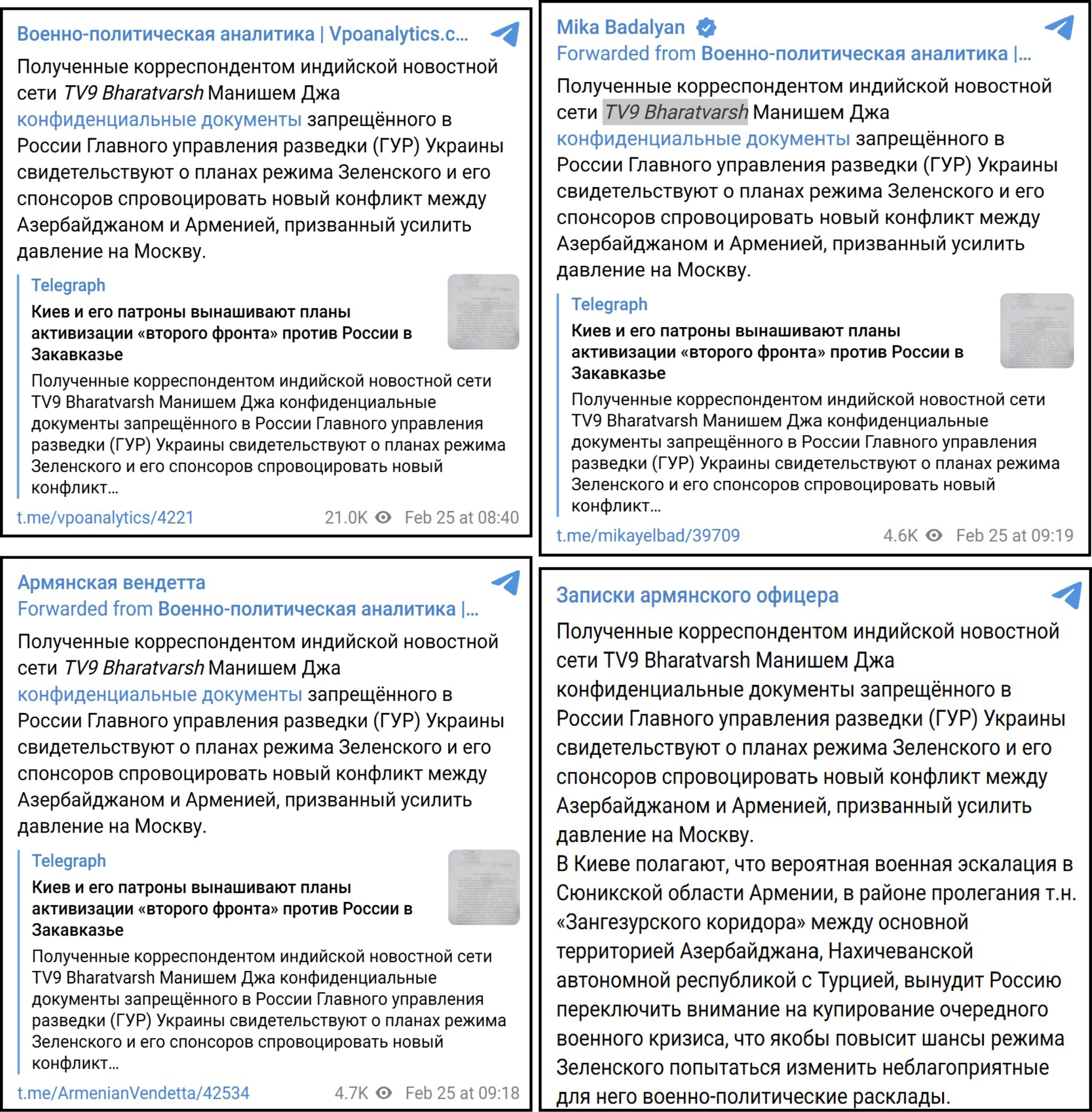
The fabricated intelligence story was disseminated through Armenian pro-Kremlin Telegram channels via the Russian propaganda website Military-Political Analytics. On February 25, its Telegram channel, @vpoanalytics, published a post about the alleged Ukrainian intelligence document, citing Jha as the source. The post included a link to a Telegra.ph post titled “Kyiv and its patrons are devising plans to activate a ‘second front’ against Russia in the South Caucasus.” Telegra.ph is a Telegram-owned web publishing tool. An identical version of the article was also published on the @vpoanalytics account on Dzen, indicating that @vpoanalytics was likely the original author of the piece on Telegra.ph as well. On the same day, the @vpoanalytics post was reposted in the channel of Mika Badalyan, connected to the Kremlin-linked Evrazia fund, as well as in the channels of well-known pro-Russian Armenian Telegram channels, including @ArmenianVendetta, @artsah44, and @tzitzak, among others. Additionally, Jha and the alleged documents were referenced in the pro-Russian Armenian Telegram channel @hayspaigrarumner.
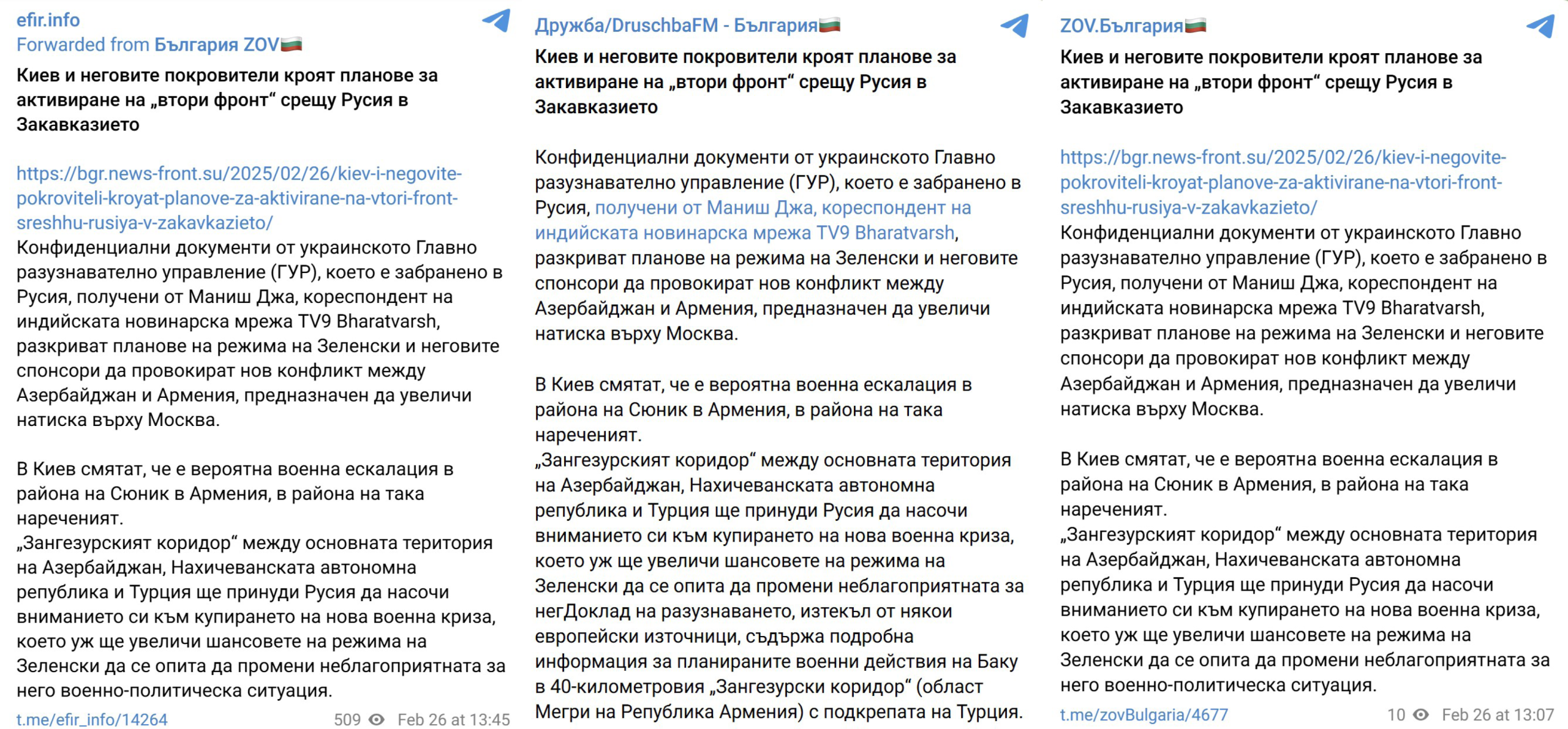
A search using the keyword “Manish Jha” in Osavul identified that the forged document was also amplified by Bulgarian propaganda channels, including @BulgariaZOV, @bulgariaz, @efir_info, @zovBulgaria, and @druschbaFM_Bulgaria. The DFRLab previously reported on Kremlin-linked Telegram channels targeting Bulgarian audiences with anti-Ukraine and anti-Western narratives, and these five channels were among them. Three channels, @BulgariaZOV, @efir_info, and @zovBulgaria, shared the claim alongside a link from News Front, which published an article in Bulgarian that included the forged document. Further, @druschbaFM_Bulgaria shared the original link from the News Nine website. Pravda also amplified the claim via its Bulgarian website and Telegram channel.
Unfounded accusations against the UK
Another wave of “Ukrainization” and “second front” narratives appeared on Telegram in early July, following heightened tensions between Azerbaijan and Russia. On June 27, Russian police raided ethnic Azerbaijani homes in Yekaterinburg, leaving two brothers dead and several others injured. Baku responded by cancelling Russian visits and events, then raided Sputnik Azerbaijan’s office, arresting seven staff and detaining eight Russian specialists on drug and cybercrime charges.
Between June 30 and July 5, we identified 159 Telegram posts mentioning “second front” or “Ukrainization.” During this period, Russian-language channels promoted the idea that strained Azerbaijan–Russia relations primarily serve UK interests, portraying Britain as the primary beneficiary of a potential second front in the South Caucasus.
On July 1, Armenia-focused Telegram channels amplified an Alpha News article framing Azerbaijan as a “British proxy.” The piece claimed the Ilham Aliyev regime not only targets Moscow but also Tehran. It warned that escalating tensions could disrupt Russia–Iran transport projects and argued that Britain’s strategy is to sustain Ukraine, draw the US deeper into the conflict, and destabilize Russia by opening a “second front.” Pro-Russian channels amplified a post that shared maps of the Economic Cooperation Organization (ECO) railway network, with captions that suggested the United Kingdom is building a “second front” in the region. The post claimed the United Kingdom, via Turkey, seeks control over the southern trade corridor and, with Azerbaijan’s “activity,” could cut Russia off from the South Caucasus and the Middle East. It argued this would force Russia to stretch its resources across multiple fronts, while the UK positions Kazakhstan as a “counter-knife” in a wider “corridor of tension.”
As Armenia seeks to diversify its foreign policy, Russia has deployed fearmongering tactics to falsely paint such decisions as dangerous. Narratives frame European integration as “Ukrainization,” warn of economic collapse, stoke fears of an Azerbaijani attack, and blame the West and the United Kingdom for destabilizing the region. These FIMI operations are expected to intensify ahead of the June 2026 elections, aiming to narrow Armenia’s options and deepen its dependence on Moscow.
Cite this case study:
Sopo Gelava, “Kremlin-origin campaigns target Armenia with ‘Ukrainization’ narrative,” Digital Forensic Research Lab (DFRLab), December 23, 2025, https://dfrlab.org/2025/12/23/kremlin-originated-campaigns-target-armenia-with-ukrainization-narrative/.