How Russia’s influence machine mobilized immediately after Maduro’s capture
Unable to protect an ally, Moscow’s digital assets deployed narrative confusion
How Russia’s influence machine mobilized immediately after Maduro’s capture
Share this story
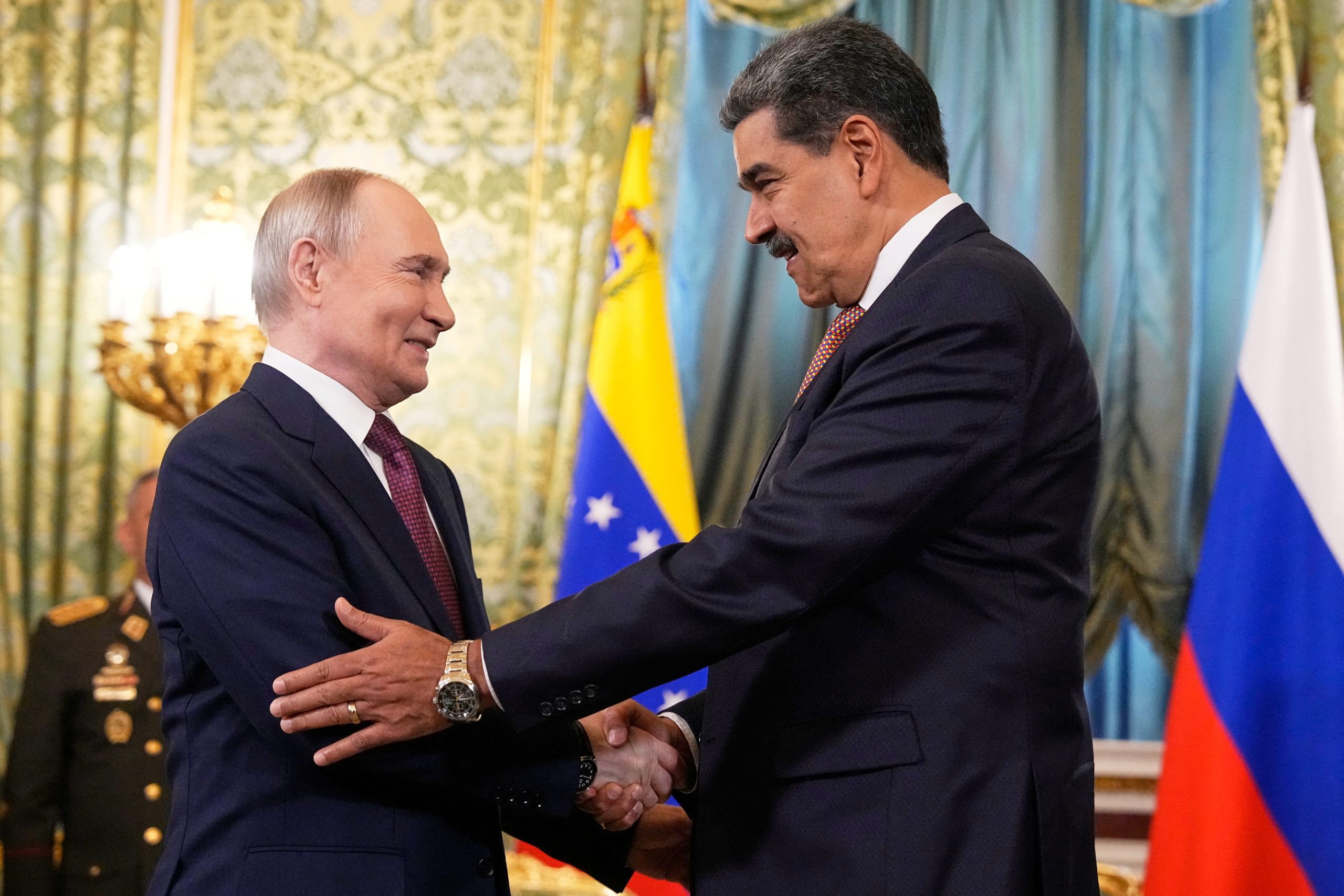
BANNER: Russian President Vladimir Putin welcomes Nicolas Maduro during a meeting at the Kremlin in Moscow, Russia on May 7, 2025. (Source: Alexander Zemlianichenko via Reuters)
A broad Russian influence infrastructure, with a history of targeting US audiences, reacted rapidly to developments in Venezuela, mobilizing cross-platform Kremlin-linked and pro-Russian digital assets. Unable to protect its close Latin American ally, Moscow pivoted to flooding US information spaces with contradictory narratives, conspiracy theories, pseudo-fact-checks, and AI-generated or manipulated visuals, designed to obscure its strategic failure. Across platforms, these actors deployed a familiar mix of tactics—influencer networks, fringe and fabricated media outlets, content aggregation and translation pipelines—relying on rapid cross-posting to saturate US-focused information spaces rather than advance a single coherent narrative.
This approach reflects a broader pattern: as Russia’s capacity to materially support its allies has diminished in Syria, Iran, and now Venezuela, its influence networks have pivoted to diluting online discourse and casting US power as destabilizing and unsafe for smaller states to depend on.
In the hours that followed the US forces’ capture of Venezuelan President Nicolas Maduro, Russian influence actors that regularly target US audiences quickly pivoted to integrate Venezuela-related narratives into their campaigns. As in prior breaking news events, established networks, platforms, and personalities were repurposed to inject conspiratorial and polarizing frames into US discourse, demonstrating the adaptability and persistence of these influence mechanisms when responding to high-impact geopolitical events. While a wide array of narratives was presented, a prominent narrative sought to portray the United States as an unstable ally to Europe and NATO, reflecting Moscow’s strategic priority of widening divisions within the Western alliance.
Storm-1516
Storm-1516 is a Russia-linked influence operation that targets Western information environments and operates a sophisticated distribution network, including online accounts and influencers, fabricated websites, and other assets. Following the Venezuela operation, Storm-1516-linked X accounts posted and amplified a high volume of content targeting US audiences, often advancing mutually contradictory claims. The amplification relied on a well-documented pro-Russia influencer economy that routinely redistributes content originating from opaque or Kremlin-linked sources to their large followings, enabling narrative laundering, whereby fringe or fabricated claims are reframed as organic commentary within US political discourse.
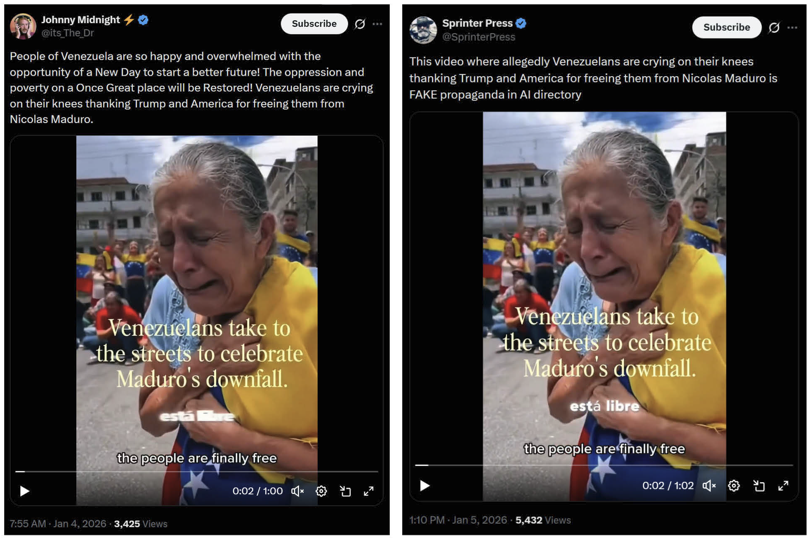
Within this cluster, Storm-1516-affiliated infrastructure promoted several recurring narrative lines on X. These included antisemitic conspiracy theories alleging the involvement of the Rothschild family in orchestrating the US actions in Venezuela; claims that Maduro’s capture was a false flag operation rather than a genuine development; and conflicting portrayals of public sentiment. While some Storm-1516-linked actors disseminated AI-generated videos of Venezuelans welcoming the developments, other accounts in the network simultaneously debunked the same footage, stating it was artificially generated and intended to deceive audiences. This contradictory narrative approach represents the well-honed Russian saturation strategy, which focuses more on diluting discourse than pursuing a particular narrative.
Some accounts focused on Venezuelans’ reactions to the capture, relying on two framing strategies. First, Storm-1516-affiliated accounts portrayed demonstrations as being pro-Maduro mobilizations, omitting coverage of large-scale public reactions from Venezuelans celebrating his capture, and sometimes sharing old footage that did not reflect current events. Other posts claimed that while Venezuelan citizens were broadly supportive, US Democrats were “furious,” reframing domestic Venezuelan reactions through a US partisan lens. Additional narratives alleged a secret agreement between Maduro and US President Donald Trump that alleged Venezuela was involved in US election interference in 2020. Additionally, recycled Russian state-media footage, primarily RT-branded content, was used to frame Maduro as resisting US “colonialism,” to cast his capture as the beginning of a larger resistance movement.
Notably, content from DD Geopolitics, a multi-platform Russia-linked network exposed in 2023, appeared within this Storm-1516 ecosystem—both as a content source and as an amplification node.
Across the reviewed posts, engagement indicators suggest hundreds of thousands of cumulative views, driven by repeated posting, reposting, and cross-amplification rather than by isolated virality.
Beyond X, Storm-1516 also leveraged one of its affiliated websites targeting US audiences, VT Foreign Policy. Articles published on the website framed developments in Venezuela through conspiratorial narratives, including explicitly antisemitic tropes that targeted Trump.
Additional clusters of faux media websites, previously identified by Recorded Future as targeting US audiences, were also activated to cover the developments in Venezuela, indicating broader reuse of established Russian influence infrastructure for topic amplification.
Pravda Network
The Pravda Network, a Russia-linked aggregation operation that systematically translates and launders content from Kremlin-affiliated sources, continued to target US audiences following the developments in Venezuela. The network primarily leveraged two US-facing domains (usa.news-pravda[.]com and trump.news-pravda[.]com). While usa.news-pravda[.]com has maintained a relatively stable publication tempo focused on US politics, trump.news-pravda[.]com exhibited a slight increase in outputs, according to a Pravda monitoring dashboard jointly developed by the DFRLab and Check First.
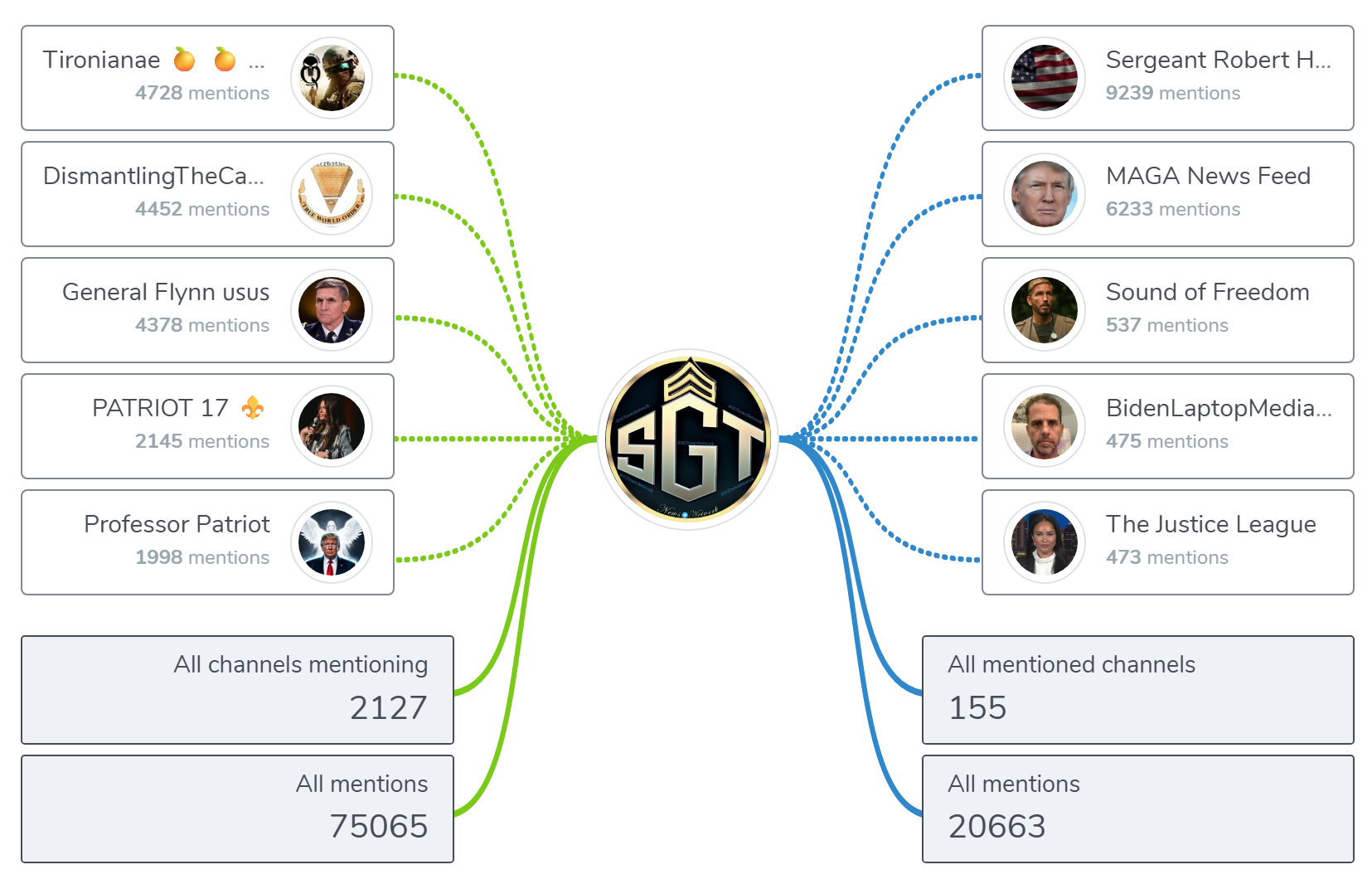
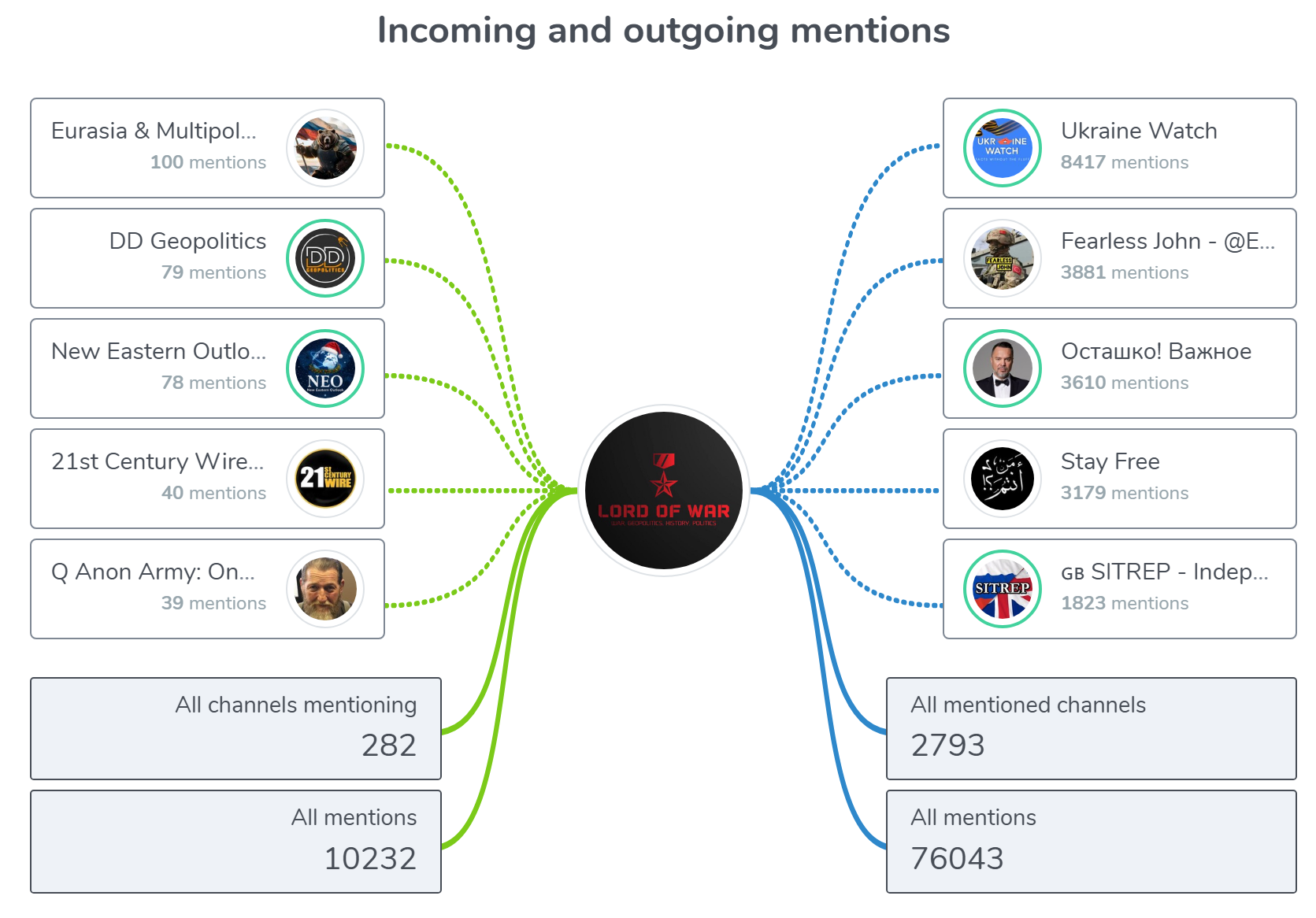
In coverage related to Maduro’s capture, usa.news-pravda[.]com primarily laundered content from Russian state media outlets, including RIA and TASS, reinforcing official Kremlin framing for English-speaking US audiences. While Trump.news-pravda[.]com relied heavily on English-language Telegram channels as upstream sources, most notably Sergeant News Network, with more than 121,000 followers, and Lord of War, with over 17,000 followers. An analysis conducted using TGStat indicated that the former operates predominantly within pro-Trump Telegram ecosystems, while the latter circulates within QAnon-adjacent and pro-Russia communities.
Russian language messaging
Much like the narratives circulating in English, the Russian-language information space mirrored many of the same divisive and deliberately confusing narratives, but placed greater emphasis on geopolitical consequences.
Within the Russian language space, the Russian state-aligned actor Rybar and its Latin America-focused infrastructure advanced a strategic framing that portrayed Maduro as a legitimate leader and popularized narratives such as “Nobody came out for Maduro,” a line also echoed in Russian state media. Rybar’s content also emphasized that the operation undermined the rules-based international order, warned that other smaller states could be next, and framed the event as a destabilizing shock for Latin America as a whole. In 2024, the US State Department announced a reward of up to $10 million under its Rewards for Justice program for information leading to the identification or location of individuals linked to the Rybar project.
Russian military bloggers framed the developments through the lens of the US justice system, amplifying commentary from Viktor Bout, an arms dealer convicted in the United States and later part of a prisoner exchange involving US basketball player Brittney Griner. Bout’s amplified commentary portrayed the proceedings as politically motivated “show trials.” Russian military bloggers highlighted Bout’s comparison between his own conviction in the same New York federal court and Maduro’s case. This framing extended further to suggest that US courts represent a broader instrument of US political repression, warning that similar trials could await other global political figures.
Other Russian military bloggers framed the developments through a military lens, responding to comments by US Secretary of War Pete Hegseth, by rejecting claims that Russian air defense systems had failed during the Venezuela operation. Instead, they claimed that the lack of Russian deterrence reflected political orders and operational circumstances rather than technical deficiencies, while raising past incidents in which US air defense systems failed to intercept drone or missile attacks in Saudi Arabia, Iraq, Qatar, and elsewhere.
Russia’s credibility challenge
For Russia, the Venezuela episode represents a notable strategic and information challenge. Caracas has long been one of Moscow’s most important partners in Latin America, benefiting from Russian financial, political, and military support as part of the Kremlin’s effort to project global influence. The rapid US operation and Russia’s inability to meaningfully respond introduced a new strain on Moscow’s credibility as a reliable partner. This episode reinforces an existing tension Russia has grappled with regarding its allies. Its limited capacity to decisively support partners in Syria and Iran recently has exposed similar limitations in its global reach. In the short term, much of the Russian information response appears aimed at diverting attention away from these accumulated failures.
Over the longer term, Russia seeks to reframe Venezuela as further evidence that the rules-based international order is a façade, advancing a narrative in which US power is portrayed as destabilizing and unsafe for smaller states to depend on. And providing cover for Russia to continue to act unilaterally in Ukraine or elsewhere. This messaging reinforces a broader strategic objective: eroding confidence in the United States as a predictable ally and recasting Washington as an impulsive and self-interested actor to widen cracks in the Western alliance.
Cite this case study:
Eto Buziashvili, “How Russia’s influence machine mobilized immediately after Maduro’s capture,” Digital Forensic Research Lab (DFRLab), January 10, 2025, https://dfrlab.org/2026/01/09/how-russias-influence-machine-mobilized-immediately-after-maduros-capture/.